
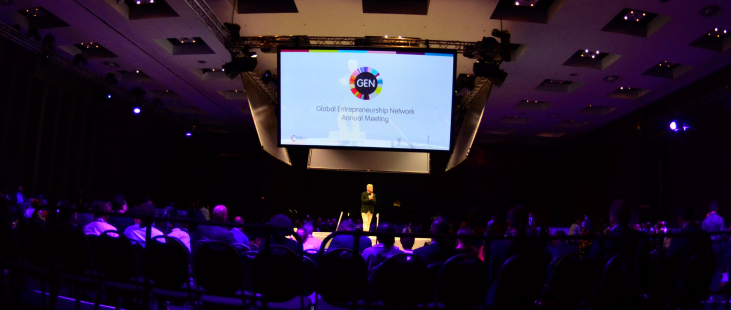


Technology startups and creative industries are becoming more and more important in urban centers around the world. At GEW Global we cannot stop at every GEW hotspot this week, but one we could not miss was Berlin.
Berlin started using the 'creative city' motto in the year 2000 and various policy measures have since been implemented to support this claim. According the Berlin Senate Department of Urban Development and STADTart, this focus had a clear aim: to improve conditions for cultural industries, support new business start-ups, create new urban environments to meet the needs of creative industries and encourage ‘creative clustering’ in ‘under-utilized’ or ‘disadvantaged’ urban areas. Is all the vibrant creativity that is so visible in Berlin translated into viable business opportunities?
Germany is known for its risk-averse culture, which explains why only 11% of the population is self-employed, according the European Commission 2012 Eurobarometer survey. Local entrepreneurs told us that they often think their mindset would fit better in Silicon Valley, and they reference its culture and ecosystem with great respect and admiration. They should rather start thinking of themselves as an internationally recognized entrepreneurial hotspot.
The Federal Ministry of Economics and Technology, supported by the RKW Competence Center, is eager to propagate that culture across the country. The Ministry has funded and hosted Global Entrepreneurship Week since 2010. Locally referred to as “Gründerwoche Deutschland”, the initiative is active in all 16 states in Germany through their Ministries of Economy as well as many business umbrella associations, totaling almost 1,000 partners. As of today, I see there are 1820 events registered so far and activity across the entire nation.
But research and entrepreneurs themselves tell us that location is everything when deciding to launch a business. The city of Berlin has some perks that are especially useful for entrepreneurs. On top of a prime geographical location, the city has plenty of spaces for face-to-face interaction, which facilitates advice sharing, talent pollination, and connecting ideas and trends. This grassroots dynamics is quite unique to Berlin, and it laid the foundation for the success of recent policies to promote startups, such as fostering more informal gatherings and neighborhood activities through theZwischennutzungregulation, which allows for temporary use of abandoned places for little rent for the creative initiatives. One such transformed space is found, for example, inside and around Betahaus, a multi-story co-working space that houses creative startups and programs like the “Berlin Hardware Accelerator” and the Open Design City. Each story of the house offers different services and spaces for entrepreneurs. It has become such a hub for European entrepreneurs, that English is the language most often used in the building.
The city government has also been wise to stay out of the way of entrepreneurs, focusing largely on promotion initiatives instead of managing the pieces of the startup ecosystem. For its part, the federal government’s funding interventions are at the earliest stages as they seek to close a significant financing gap while encouraging more early-stage investment among a traditionally risk-averse financial sector. This is why, for Global Entrepreneurship Week, the Federal Ministry for Education and Research joined the Ministry of Economics and Technology in offering a platform for the startups supported by their publicly funded Exist and Go-Bio programs to present their nascent ventures to German investors. As the representative of the Ministry of Economics and Technology said at the launch of today’s Investment Forum, local investors should be more active in seed capital, highlighting that American investors have taken past successful program participants under their wings.
Despite these obstacles, and the fact that Berlin’s economic strength is small compared to that of other European cities, the city punches well above its weight in fostering an entrepreneurship culture. As the Mayor of Berlin, Klaus Wowereit, has expressed, the city is relatively poor but sexy ('arm, aber sexy'), and it thrives on creative entrepreneurs that hold the potential to create wealth and the much needed jobs as their startups scale (in Berlin more than one in 10 people are without a job, the highest unemployment rate in the country). As of recent years, the Berlin Senate of Cultural Affairs estimates that creative industries account for more than 20 percent of the city's gross domestic product.
It is in scale-up where we find the hardest challenge for entrepreneurship stakeholders in the city. By some estimates, there are some 2,500 start-ups in Berlin, most of them of small size. Consultancy firmMcKinsey estimates that, with a systematic approach to supporting the ecosystem, Berlin’s innovative companies can potentially grow to generate as many as 100,000 jobs by 2020.
“The aim must be to become the number one place in Europe for start-ups," said Berlin's mayor Klaus Wowereit. Judging from what we witnessed at the city’s universities and entrepreneur hotspots this week in Berlin, that is a quite a safe bet.
Tomorrow I will report from Istanbul.