
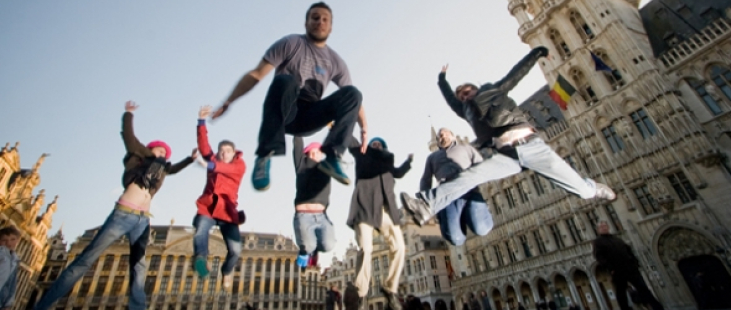


Belgium has a very diverse economy with dozens of influences coming together at its prime location in the heart of the European Union. It is the home to several major European universities, has a diverse market structure that keeps it competitive, and enjoys one of the highest income per capita in the world. This week I visited Brussels and talked with GEW lead Freddie Nurski who is hard at work coordinating what is a vibrant but nascent set of startup networks and programs.
While it appears that there are no fewer than three governments trying to manage this small country (Walloon, Flanders and Brussels), according to Solvay Brussels School of Economics and Management (ULB) Professor and Chair of Entrepreneurship Olivier Witmeur, the country has started to pay attention to entrepreneurs. He highlighted that there are 300 grants available for every type of startup imaginable, along with incubators, subsidized office space and government funding to programs in schools. The government has also sought to bridge the gap between R&D and entrepreneurship according to an analysis citing several government initiatives in this regard. For example, Belgium passed legislation to establish an Industrial Research Fund to provide grants for research ideas that will develop into easily marketable products.
However, we all know that government “programs” only really help if executed in tandem with vibrant bottom up startup communities and a creative culture. The problem lies in that most Belgians are involved in service businesses or public affairs and according to surveys, the majority say that becoming an entrepreneur had not ever crossed their minds as an option. Freddie is taking on this challenge – gathering as many people and organizations as possible to send a clear message to the country this November that Belgium needs more entrepreneurs and bottom up efforts like GEW are their safest way to test their aptitude for this calling.
There are already signs that the startup scene is emerging that includes Startup Weekend Brussels, Betagroup known for its pitch slam, Open Coffee Club Brussels, and the recently launched Startups.be which is trying to map the entrepreneurship ecosystem in the country. It is always a formidable challenge though to create an entrepreneur-friendly environment where enough people are not only ready to see and work on opportunities, but also are willing to take up the challenge. GEW therefore simply looks to have more Belgians pushing for cultural acceptance of entrepreneurship as a career path.
GEW this November promises to achieve this in a variety of ways starting early with a link to Creativity Week with Creative Wallonia and a Startup Weekend Liege. The Week will then include on-line business games with Junior Enterprises at several universities; a TEDx Brussels; an event organized by 3 alumni organizations in Leuven about trade unions perspectives on the profile of an entrepreneur; an event organized by Startups.be, ING Bank and AB Inbev on our digital future and global entrepreneurship; a women’s entrepreneurship event by stund.be; and much more - all supported by commitments from the media to cover GEW in Belgium. And Minister-President Kris Peeters will help at the bully pulpit by providing a video addressing folks in Flanders. Efforts are also under way to convince the Walloon and Brussels government to engage.
Up until recently, EU policymakers in Brussels have been slow to follow the rest of the world in focusing on the importance of new and young firms as opposed to a more politically expedient emphasis on existing Small and Medium Sized Enterprises (SMEs). The fact that the EU’s own taxpayer-funded “SME Week” will now start to appeal to new startups and not just existing SME’s and that the Director General of the EACA in Brussels will launch a new ad campaign targeting young Europeans to help with addressing Europe’s startup deficit are encouraging developments. As European economies adjust to a likely norm of more economic uncertainty in the future, entrepreneurs who thrive on unpredictability and disrupting markets will be a key asset for Brussels. The EU would be wise to join the GEW effort at home in Belgium in November and see what can be learned from reaching out to nascent Belgian entrepreneurs in Brussels… oh and in Flanders and Walloon.
............................................................
[Photo credit: Eole]