

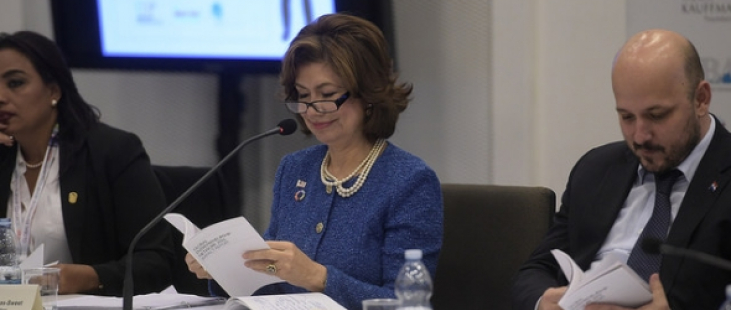


Maria Contreras-Sweet, administrator of the U.S. Small Business Administration, led the SME Ministerial at the Global Entrepreneurship Congress in Milan. The meeting brought together ministers and government officials from 14 countries to discuss global trends and best practices for supporting entrepreneurs.
PREPARED REMARKS
Milan, Italy
March 18, 2015
..............................................................
Thank you, Ambassador Phillips, and good morning, Milan. Grazie to our Italian hosts, Minster Renzi, Minister Guidi, and Mayor Pisapia for making this Congress such an inviting and memorable occasion. And mille grazie – thank you so much – to the Kauffman Foundation, the Global Entrepreneurship Network, and the META Group for bringing us all together.
Since antiquity, visitors have come to Milan for the best in fashion, art, culture and food. And so it will be again this May, when millions will come to Milan for World Expo and discover the innovators who are working to sustainably feed our crowded planet. Once again, Italy is helping us explore new frontiers in agriculture and global commerce – a role this nation has played since the days of the Spice Route.
In America, we teach our children about the famed explorer Marco Polo and his travels throughout Eurasia and North Africa. This spirit of intrepid exploration is alive again, and you, my friends, are the pioneers. We applaud the determination of Prime Minister Renzi to make changes so more young Italians can chart their own course through entrepreneurship.
Yesterday, government leaders from around the world convened here, and we made a bit of history ourselves. We hosted the first convening of small business ministers from around the world. Government leaders from five continents came together to share best practices so we can be as innovative as the SMEs we serve.
Truth be told: The inspiration for this ministerial was you. You’ve come here from all over the world, from 150 countries, with many of you taking long flights to get here. But you made this long journey to be together and learn together. I believe you should expect nothing less from your governments.
You are the world’s startup champions. Your elected officials must be yours.
At our Ministerial yesterday, we talked about what we have in common. We share the responsibility to support the risk-takers who are creating a majority of the world’s new jobs. We must nurture home-grown innovation, because it’s our progress in the STEM professions that will determine each of our nation’s long-term future. Government can play a vital role by creating systems that free up capital, promote business education, and loosen regulations that hinder your growth.
Yesterday may have been the first government meeting of its kind, but it will not be the last. Five hundred seventy kilometers southeast of us sits the ancient city of Rome. We know Rome wasn't built in a day, and thriving entrepreneurial ecosystems aren’t either. But yesterday, we came together to lay a foundation on which to build. Just as it takes government and business leaders working together to preserve planetary ecosystems, thriving ecosystems for our entrepreneurs requires close collaboration as well. You’re here in Milan, and that makes you a leader in this global movement.
Now, as entrepreneurs, we know that your journey will include inevitable setbacks. But never be afraid to fail, because it’s the lessons you learn from failure that stay with you. The inventor Thomas Edison had many stumbles before he had his “eureka” moments and invented the light bulb and the movie camera. He once famously said: “I’ve not failed. I’ve just found 10,000 ways that won’t work.” Spoken like a true entrepreneur.
Failure is part of the journey of every entrepreneur. In some nations, failure in business carries great public shame. In others, bankruptcy is a punishable crime. But in the last five years, we’ve seen attitudes and laws begin to change. Entrepreneurship is no longer considered the job you take because you have to. In 2015, it’s the job you take because it affords incredible opportunities to make a profit and make a difference. More nations are coming to see that entrepreneurship is the path to lasting change and hope for a better future.
The entrepreneur must be given space to take risks without fear of condemnation or consequence. In America, Henry Ford went bankrupt when his first factory didn’t produce as he’d planned. His second factory gave us the assembly line and the invention of the modern automobile. Walt Disney’s first studio went bankrupt when he was cheated by a distributor. But he found another investor, tried again, and created Mickey Mouse and movies that have warmed children’s hearts around the world.
So let’s all go home and work to change attitudes to give our innovators more space to experiment. Because without risk, there can be no reward. No progress. To be constrained by our fears is to fail before we even begin.
In every nation, those with great minds and great dreams often do not have great wealth. So what they need are great government partners. In President Obama’s cabinet room, one of the seats belongs to our nation’s entrepreneur, and it’s my honor to fill it.
My agency, the Small Business Administration, has invested in SMEs that have become some of most successful companies in the history of the human race: Apple, the inventor of the I-Phone; FedEx, the world’s largest shipping company; and Nike, the sports apparel company that made the Air Jordan, a shoe that convinced young athletes that they could fly. The U.S. government nurtured and invested in our SMEs, and the reward was billions in revenue for our economy, jobs for millions of people, and new products that shaped the society in which we live.
At yesterday’s ministerial, Minister Zulu of South Africa said that in her country, if you’re not born rich, you’re born poor. She said entrepreneurship is the way out. It’s the only way to change your circumstances and create a better future.
Every startup is an experiment with the chance to change the world, and governments have a central role to play. Yesterday, we talked about the need for more collaboration to spur innovation. We talked about working together as nations to help you find foreign investors and foreign customers.
The EU is investing billions of dollars in small business innovators through its Horizon 2020 program My country is doing the same through our Small Business Innovation Research Program. We call it SBIR. It’s America’s seed fund.
Through this program, American entrepreneurs have created life-saving drugs and launched rockets into the cosmos. As we sit here today, the Mars rover Curiosity is exploring the planet’s surface with systems designed by five different small businesses funded through this program. The fingerprint scanning technology that unlocks your I-phone was funded through SBIR research. So were 70 percent of the microprocessors in your I-phone. Today, it’s small firms that are the disruptors. They are thinking outside of the box and developing new processes, so we can create prosperity without endangering our environment.
One of our SBIR firms in upstate New York recently invented an all-natural substitute for Styrofoam. The company calls itself Evocative, and their work is so important for the environment, because the active ingredient in Styrofoam takes hundreds of years to break down. And when it does finally degrade, it actually produces a carcinogen.
If you throw away a coffee cup made of Styrofoam, and that cup is taken to a landfill, 500 years later, that’s where it will remain. Styrofoam litters our oceans, our highways, and the digestive systems of animals unfortunate enough to consume it. Evocative is replacing Styrofoam with a durable material made from the tissue of mushrooms. Throw your coffee cup in a landfill, and it could eventually act like compost. From it, new life could grow. The mushroom tissue costs no more than Styrofoam to make. The product is already being used by companies like Dell Computer as a green alternative to ship their products.
This company’s two founders were sophomores in college when they made their discovery in a class project. When they graduated, they got job offers from major corporations. But their college professor – a man named Burt Swersey – persuaded them to follow their own path. These men turned down the safe, easy path – and risked everything on a dream. The SBIR program awarded them $2 million in research grants, and that was the exactly the seed capital they needed to grow. Sadly, Professor Swersey passed away just last week, but he lived long enough to see his students build a company with the potential to change the world. Evocative has opened two manufacturing facilities in New York and Iowa, and they’re building a third.
I share this story because there are other young people like these men in every country around the world. There are visionaries who have great ideas but need great governments to support their work. The Millennial generation is independent and restless. Young people today are less enthusiastic about working for an established company than they are about establishing a company focused on a totally new way of doing business. Evocative is just one example of how a little good government can go a long way.
At last year’s Global Entrepreneurship Summit in Marrakesh, I announced a new global initiative called SPARK. This is President Obama’s ambitious program to attract a billion dollars in investment for the world’s entrepreneurs with at least half of that amount benefitting women and young entrepreneurs.
SPARK is about igniting hope. It’s an antidote to many of our most serious ills. It’s about providing an alternative to violent extremism in the Mideast. It’s about lifting people out of poverty. It’s about recognizing that youth unemployment is too high in the developing and the developed world.
We must empower our next generation to lead. SPARK is assembling a broad coalition of countries, companies, organizations, and individuals to advance this goal. Yesterday’s ministerial was an important first step to bring governments together, but we need leaders like you to join this movement, too. So today, I extend my hand. This movement needs your energy and knowledge.
This year, the Global Entrepreneurship Summit will be held in sub-Saharan Africa. The host country will be announced very soon. There’s an old African proverb: “If you want to go fast, go alone. But if you want to go far, go with a group.” That’s the potential we embrace today.
We’re all fellow travelers on a journey of great promise and great consequence. Let’s continue to learn from another other, support one another, and draw inspiration from each other’s discoveries. Let’s create new paths for entrepreneurs to take their ideas from the lab to a borderless marketplace
The United States is prepared to do our part. Together, we will invest in the innovators who are creating new breakthroughs for the betterment of the human race. That is the promise of Milan.
The work of entrepreneurship is about seeding social mobility and harvesting new opportunities. It’s about providing more choices and more chances. And it’s about creating an expanded middle class and stronger democracies. It allows anybody to start a business, share their talents, and create a better life for themselves and their family.
That has been my story as an immigrant who came to America, became a business owner, and realized my dream. Now I invite you to share your story with the world. Please join the conversation at #StartTheSpark.
Our work transcends provincial or national interests. In our global economy, we have a stake in each other. As Dr. Martin Luther King once said: “We may have come on different ships, but we’re all in the same boat now.” So let’s join together and work together to leave a legacy of hope to our children and our children’s children. Let’s continue our work undaunted and unafraid to fail. I hope to see you again in sub-Saharan Africa in July. Good luck and God bless our entrepreneurs.