

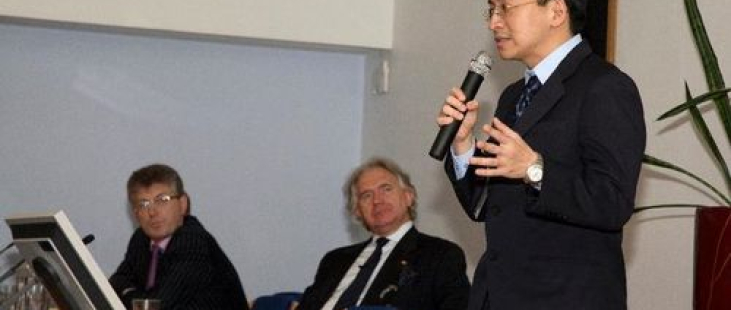


Henry Ong is an entrepreneur and business consultant who writes a 'Money Matters' column for the Philippine Daily Inquirer and is a contributing writer for Entrepreneur magazine. He also serves as the the chairman of Young Entrepreneur Society (YES) International, the host for GEW / Philippines--one of the newest countries to join Global Entrepreneurship Week.
As YES International prepares for its first full GEW campaign this November, we asked Mr. Ong to share their plans and also to help us understand the entrepreneurial climate in the Philippines.
................................................
When and how did you first get involved in Global Entrepreneurship Week?
I happened to know about GEW late last year when I was in London. I attended most of the activities and events during the GEW and I thought that it will be great to also celebrate it in the Philippines. We have many entrepreneurs in the country that need support and encouragement to invest and provide employment in our country.
Why is Global Entrepreneurship Week important to the Philippines?
GEW is important because this is the time when we celebrate the importance of putting up a business of your own. A business that is not only to make profit but to innovate products and services that will make our lives more comfortable. Through GEW, we can encourage more people, especially the youth, to find creative solutions to existing problems by putting up businesses.
How does GEW support the work that you do throughout the year?
We are able to attract partners and sponsors by having GEW to support our advocacy in entrepreneurship through our YES organization. GEW has been great help in promoting our cause and creating nationwide awareness on entrepreneurship.
What are you doing to build momentum for GEW in the Philippines?
This is our first year to host the GEW in November but we have already started promoting it as early as March this year. In fact, last June we just held the Startup Lean Launchap bootcamp for three days which was attended by over 150 people and we made sure that GEW was very visible. We started getting partners too last summer and GEW was already introduced. We will have more events during the next few months until we reach November where we will have the most events. This is how we create momentum towards our main event in November where we wil have Business Startup Expo, Awards and large conference for entrepreneurs, all in celebration of GEW.
Are there challenges or barriers that you would like to overcome to increase participation?
The challenges I can see at the moment will be the funding to sustain this but through support of our partners and sponsors, we are able to implement our plans smoothly. I would wish that we can get more sponsors to ensure sustainability.
What makes your GEW campaign unique?
Our GEW campaign is unique because we do this nationwide. The Philippines is composed of 7,100 islands and through YES, we are able to use our network by reaching our providers and universities to help us celebrate GEW in the whole country. We are looking to create as much as 20,000 participants this year.
ABOUT ENTREREPRENEURSHIP IN THE PHILIPPINES
How would you characterize the entrepreneurial environment in the Philppines? If you could change one thing to make it better, what would it be?
Our entrepreneurial environment is very open to new ideas. Franchising is very big in our country. We have many new business concepts that are turned into franchise, both local and international. If there is one thing I want to change, it will be the sense of entrepreneurial innovation. An entrepreneur must be able to innovate new services or products that will help solve an existing productivity problem in society and turn it into business instead of buying and investing in existing business concept.
What methods and mechanisms are you using to encourage entrepreneurship? What have been most effective and popular? What are your short-term and long-term goals?
We organize events and conferences to encourage people to learn about entrepreneurships. Through seminars and training, we are able to empower entrepreneurs by equipping them with the right skills and attitude. We also invite experts from overseas to share best practices to help our local entrepreneurs and provide possible networking opportunities too. So far these have been effective because it is very convenient for people to join.
Long term goal is to get sponsor who can help build sort of a venture capital fund that will help startups and businesses to expand through equity or low-interest borrowings.
Three-part question. How do we: (1) Create more entrepreneurs? (2) Make those entrepreneurs more successful? (3) Help successful entrepreneurs grow larger and faster?
(1) We encourage people to go into business by showing them role models, local entrepreneurs who have made it, to provide inspiration.
(2) We create more entrepreneurs by empowering them with right education and skills. If they have the knowledge, they will be better guided in putting up their own businesses with high probability of success.
(3) We help successful entrepreneurs to grow larger and faster by introducing the right people to network and possibly partners who can co-invest with them to expand the business.
How are you researching entrepreneurship? What are you most interested in finding out?
We partner with universities in conducting research on entrepreneurship. We are most interested in finding out the behavior of our local entrepreneurs with regards to innovation. How likely are they going to innovate rather than copy existing business? What is their attitude towards validating customer acceptance before investing their resources?
What can other countries learn from the study of entrepreneurship in your country?
Other countries can learn from us in terms of how culture affects entrepreneurship. Culture in a way affects the mind set and attitude of people. A good entrepreneur knows how to use this to his advantage.
What are the key differences in entrepreneurship in a developed nation and entrepreneurship in a developing country?
Entrepreneurship in a developed nation has all the support of their government. Entrepreneurs enjoy free training and low cost funding provided by their government. Governments from developed nations provide a lot of incentives to people to go into business. For developing country like the Philippines, we do not enjoy this kind of support. If there is any, it is very limited that it is not good enough as an incentive at all.
What kind of tools are available in your country for a person with no experience whatsoever in business? Is there a role for government to play in the process?
For someone who has no experience in putting up a business, one can attend training and seminars offered by private providers. YES is one organization that help in encouraging the youth who have recently graduated from university majoring in entrepreneurship degree to practice what they studied in school by going into business. We help by providing training and networks through mentoring. Government has very limited role to play in the process due to budget constraints.
................................................
For more information about GEW/Philippines, visit www.gewphilippines.com