




I report from Istanbul this morning where entrepreneurship is clearly the talk of the town. You could even hear on the radio while riding in a taxi an advertisement saying: “Global Entrepreneurship Week is approaching! Be there to get advice from successful entrepreneurs, discover your entrepreneurial spirit during conferences and workshops, and get one step closer to unleashing your ideas! Details at globalgirisimcilikhaftasi.com.
When the Istanbul Stock Exchange bell rang on Monday, November 18, at 9:15, Stock Exchange Vice-President Mustafa Kemal Yılmaz and others announced the start of the country’s Global Entrepreneurship Week 2013 campaign. Clearly, Turkey is on a journey to transform itself into an entrepreneurial economy. This is the third year GEW Turkey has been honored at the opening of trade activities at the Istanbul Stock Exchange.
The conversation on entrepreneurship here is happening on many fronts. From think tanks focused on economics to large corporations, startups are on the immediate agenda. For example, The Economic Policy Research Foundation of Turkey (TEPAV), a think tank looking at economic issues, has partnered with the United States’ Global Entrepreneurship Program to provide a platform for Turkish entrepreneurs to network with American entrepreneurs and funders. And the Young Entrepreneurs Board of the Union of Chambers and Commodity Exchanges of Turkey (TOBB), led by my friend Ali Sabanci, Founder of Pegasus Airlines of Turkey, always takes an active part in the design of the Turkish government’s new initiatives.
A handful of organizations provide space and services to startups, such as the e-Tohum startup “catalyzer” and The Founders Institute. Then there is of course Endeavor Turkey, one of the earliest to bet on the high-growth startup ecosystem in Turkey, and the main coordinator for the local Global Entrepreneurship Week (GEW) campaign. This local chapter of Endeavor boasts a network of 140 mentors and 36 selected high-impact entrepreneurs. Its GEW campaign this year offers approximately 150 events through 200 partners, such as the International Entrepreneurship Initiative (UGM). UGM was established last year in collaboration with the United Nations Development Program in Turkey along with Vodafone to bring together 25 university entrepreneur clubs from around the country to discuss Turkish case studies. I meet with ten representatives from various regions of Turkey at a dinner organized by UGM’s leader Sezai Hazir to discuss GEW Turkey’s regional expansion strategy for next year.
Mobile giant Turkcell in turn has been helping to fund the “Start-Up Factory” accelerator housed at Ozyegin University on Istanbul’s European side, which I had the chance to visit with Murat Ozyegin, a Board Member at the University and Endeavor Turkey’s Chairman, and Ihsan Elgin, the Factory’s Director. The Start-Up Factory provides space and services to startups and office hours with investors such Galata Business Angels and 3TS Capital. The current round of startups at the factory impressed me. Shopkrowd, for example, provides customized recommendation listings for e-commerce sites by focusing on individual shopping preferences. Picus, another impressive startup, makes real hacking attacks over the internet and checks whether corporate security measures are blocking those attacks. The team of Ebrandvalue, which calculates real time monetary value of brands on internet was also especially strong.
Burak Buyukdemir, a GEW Turkey Advisory Board Member, founder of e-Tohum and the leader of the annual Startup Turkey initiative, told me during my visit to Istanbul this week that Turkey certainly has entrepreneurs and startups, but that innovation is still lacking. Burak sees many ways to enable innovative entrepreneurship in Turkey. For example, he is about to start an “Invest On Board”program in collaboration with Turkish Airlines. The program will allow startups to pitch to business class passengers flying with the airline.
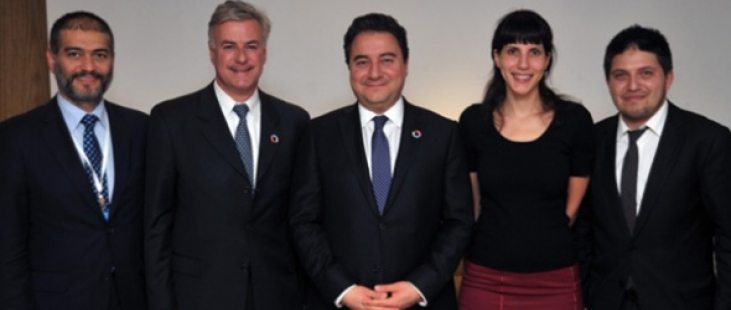
The government is no exception in terms of sectors paying attention to entrepreneurs. During my meeting on Wednesday November 20, 2013 with Ali Babacan, Deputy Prime Minister of Turkey, it was made very clear to me this government understands the importance of specific policy work aimed at new and young firms. He articulated to me the role of young firms in wealth and job creation and walked me through how his administration is ensuring that the economic environment is conducive to entrepreneurial activity. In his view, the government should intervene as little as possible and let the private sector take the lead.
I also spoke alongside Deputy Prime Minister Babacan at the 3rd G3 Entrepreneurship Forum, organized by TOBB (Union of Chambers & Commodity Exchanges), Uluslararası Girişimcilik Merkezi (International Entrepreneurship Initiative) and GATE Turkey. Addressing approximately 1500 young people, Babacan advised potential entrepreneurs to begin their work-life as early as possible even if it is a part-time job after school, highlighting opportunities through a new program for university-industry partnerships. He pointed out that the education system had been sometimes behind the private sector in adjusting to new employments needs and in providing relevant programs. Babacan stated that, as a result of their efforts in utilizing Turkey’s human resources more efficiently, 600,000 additional people joined the workforce in the 5 years, 45 percent of which are women.
While far from a top business environment, the World Bank has reported on regulatory improvementsover recent years that make it easier to start and run a business in Turkey. The government is also acting on Burak Buyukdemir’s concern over the need for more innovation. As the Ernst & Young G20 Entrepreneurship Barometer 2013 report suggests, the aim for a more innovative economy has been institutionalized. For example, in 2011, a new Ministry of Science, Industry and Technology was created to promote innovation through initiatives like the “Techno-Entrepreneurship Capital Support Program”, which provides seed capital to young entrepreneurs with innovative businesses.
To learn more about such government initiatives, I visited Yucel Altunbasak, Chairman of TUBITAK, the National Science and Technology Council of Turkey, which was also formed in 2011. Mr. Altunbasak had the same clarity of mission I saw in Deputy Prime Minister Babacan. TUBITAK is working on vital missing pieces important to its science and engineering based nascent entrepreneurs including incentivizing venture funding; finding hundreds more mentors; and setting up smarter technology transfer offices (TTOs). In collaboration with the Higher Education Council, they are also borrowing a page from the World Bank Doing Business strategy of incentivizing better performance through rankings, by launching an index evaluating universities’ success in fostering entrepreneurship and innovation. I noticed this year the Middle East Technical University rose to the top of the ranking.
Turkey’s universities are key to achieve entrepreneurial innovation success. To bridge the gap between R&D conducted at universities and its commercial applications, the government set up in 2011 the Technology Transfer Support Program, which brings together researchers and entrepreneurial businesses, with grants covering 75% of eligible costs up to a limit of €150,000 and for a maximum of 18 months.
ÜSİMP, the University-Industry Cooperation Centers Platform, has in turn recently sought outside expertise in creating optimal policies to stimulate innovation, entrepreneurship and industrial relationships at Turkish universities. USIMP has also partnered with the Association of University Technology Managers (AUTM) to host several workshops on TTOs, an area that is very under-developed in Turkey. Trainers from AUTM have, for example, expressed their frustration that none of the people trained for new TTOs in Turkey have any direct experience with startups, which could hamper their ability to guide the first-time academic entrepreneur in the commercialization process.
In addition to all this, in 2012 a Council for Entrepreneurship was set up to help entrepreneurs access domestic and foreign financing. More specifically, the Turkish government’s commitment to supporting entrepreneurs is evidenced in a new project to create a fund of funds to provide additionalcapital to early-stage companies. While still in a design stage, this project enables the government to place a substantive amount into one or more fund(s) of funds. According to Babacan, the key issue is not the amount invested by the government but the endorsement by the government to legitimize the fund triggering a multiplier effect for the new rounds.
With organizations like Endeavor and the annual Global Entrepreneurship Week campaign successfully creating cultural capital for entrepreneurs, one of the biggest challenges for the Turkish ecosystem is to continue to create the conditions for this government to cede the driving seat in terms of early-stage startups. According to an assessment by the World Economic Forum (WEF) of venture capital conditions internationally, entrepreneurs in Turkey find it more difficult than their peers in other G20 rapid-growth countries to win support for innovative but risky businesses.
Luckily, there has been some considerable success in this regard. Economic analysts and investors now often refer to "the Turkish opportunity", which is part of the reason why Dell chose to host itsWomen's Entrepreneur Network event in Istanbul this year. According to Mete Cakmakci, a member of the Istanbul Venture Capital Initiative who spoke at the Dell event, there are now at least 50 active funds in Turkey. Moreover, the country is the envy of many other entrepreneurship ecosystems that want to have startup-savvy policymakers, such as the Turkish team at the Undersecretariat of Treasury who created the new laws that embody incentives for angel investors. Since February 2013, licensed angel investors are allowed to deduct up to 100% of their investment amount from their personal income tax bases. Through the program, so far over a 100 investors received licenses, with a handful of investments.
Yesterday in Ankara, Turkey's second largest city and its seat of government, I met with startup-savvy policy influencers, such as Guven Sak and Ussal Sahbaz at a Policy Conference as part of GEW, organized by TEPAV (Economic Policy Research Foundation of Turkey) to discuss best policy practices with key players in Ankara such as TTGV (Technology Development Foundation of Turkey) and the World Bank.
Despite the many challenges ahead, entrepreneurs here have recognized the positive impact of all the government support for new venture creation. In fact, when the young, digitally wired people took the streets here earlier this year, they were not retracting their opinion that the Prime Minister is largely pro-business and that his government helped Turkey emerge from the global economic downturn largely unscathed. They were rather mostly taking issue with the rise in social restrictions that make Turkey, in their view, a less attractive place to live and do business, instead of capitalizing on the country’s geographic proximity to markets in Europe, the Middle East, Russia and Central Asia.
There is long road ahead, but Turkey is clearly making great strides in elevating its global status as a strong entrepreneurship ecosystem with a variety of stakeholders committed to unleashingentrepreneurship beyond the country’s early successes in web startups. Istanbul is on course to become one of Europe’s main startup capitals.
My next report tomorrow will be on GEW in Pakistan. Stay tuned.