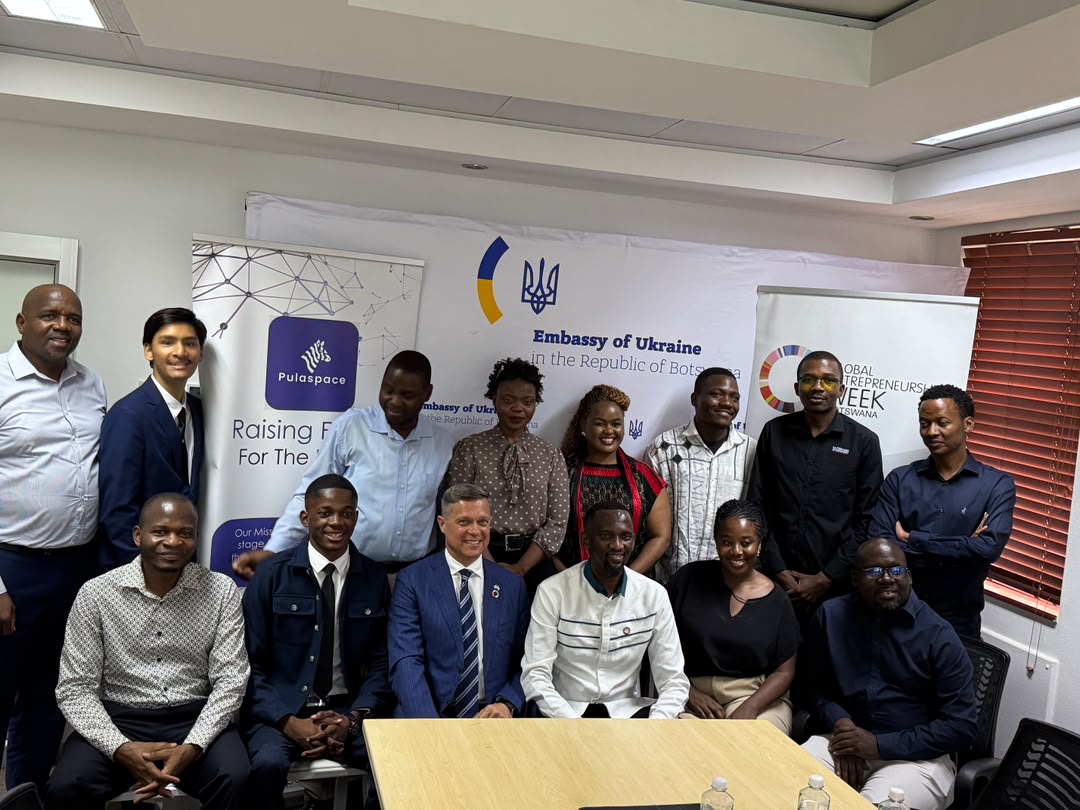
Here's the full speech, ready to copy:
Ukraine's Experience in Applying Digital Tools and Technologies for Development
19 November 2026
Good afternoon, everyone.
I appreciate this opportunity to be with all of you, people interested in technology and digital solutions for the development. I hope we can use this time to discuss not just what Ukraine has done, but what might be useful here in Botswana, what we can do together because the future belongs to those who are ready to change.
My subject is Ukraine's experience with digital tools for development. But I want to keep bringing the conversation back to Botswana: its priorities, its people and the opportunities for practical cooperation.
And I want to begin with a simple question. What is the most valuable resource of a country? Any country.
Natural resources matter, especially in Botswana. But a country's long-term development also depends on the knowledge, skills and initiative of its people.
Let's look at Botswana. On the one hand, Botswana has significant resources and space for development. On the other hand, a relatively small population means a limited domestic market and a limited pool of human resources to develop and manage such a vast country.
That is why I think for a country like Botswana, investing in human capital is not simply one of many development priorities. It is a strategic necessity.
With a relatively small population, it makes sense to create opportunities for as many people as possible to develop their skills and contribute productively.
And this is where digital technologies become especially important.
Digital tools allow a relatively small population to achieve results that previously required much greater human and financial resources.
Artificial intelligence, automation, digital public services, and modern communication technologies can help people work more efficiently, reach wider markets, and manage complex processes across enormous distances.
In other words, for Botswana, digital transformation is not just about modernising the economy. It is about multiplying the potential of its most valuable resource — its people.
That makes education, digital skills and innovation central to Botswana's long-term competitiveness.
The timing matters, too. Technology is changing very quickly.
Let me remind you of this, twenty years ago, smartphones were not part of our everyday lives. Fifteen years ago, many of the digital services we now take for granted were still developing. And just a few years ago, most people had never used generative artificial intelligence.
Today, a young entrepreneur can create a website in a few hours, analyse a market with AI, communicate with customers across continents, receive digital payments, and manage a business from a mobile phone.
There is also a risk: the gap can widen between countries and businesses that adapt quickly and those that do not.
So digital transformation should not be treated as a luxury to consider after other development priorities. It can be one of the ways to address them.
Digital transformation can help improve education, healthcare, public administration, agriculture, tourism, logistics, security, and business development.
But technology alone does not create development.
You can purchase the most expensive computers, install the fastest internet connection, and introduce the most advanced software.
But without people who understand what they want to achieve, these investments may produce very little.
I am not speaking only about formal education, university degrees, or professional certificates.
I am speaking about the ability to understand problems, ask the right questions, evaluate information, work with others, and continuously acquire new skills.
In other words, we need to invest not only in technology, but also in the human capacity to use it intelligently.
The ability to apply available technologies makes the difference and the opportunity I want to focus on today.
There is an expression that I hear quite often that Botswana is not simply a landlocked country. It is a land-linked country.
I like that expression because it presents geography as an opportunity.
Instead of seeing the absence of direct access to the ocean as a disadvantage, Botswana sees its location as an opportunity to connect countries, markets, and people.
I would take the idea one step further.
Why should we think about connectivity only in terms of roads, railways, trucks, and physical goods?
Connectivity can also mean the movement of data, digital services, technical knowledge and successful business models.
Botswana could strengthen its role as a regional hub for digital solutions because a digital product can reach well beyond the domestic market.
This is what I mean by the logistics of digital solutions.
There is another kind of exchange worth encouraging: sharing practical success stories. When one country, one city, or even one small community finds a successful solution to a problem, the others should not start from zero. They should learn from that experience, adapt it, improve it, and develop something even better. This is how innovation spreads.
And this is where international cooperation becomes especially valuable.
Botswana already has its SmartBots digital transformation strategy, a growing innovation ecosystem, and institutions working to build a knowledge-based economy.
The challenge is not to begin from nothing. It is to connect these initiatives, strengthen the skills behind them, and turn digital ambitions into practical results.
A country with a relatively small domestic market may not always benefit from economies of scale. But it can aim for an advantage in the speed of learning, testing and adopting innovations. Digital tools can make that possible. Digital experiences can make Botswana evolve from land-linked to digitally connected.
Human capital, supported by digital technologies, can become a powerful competitive advantage for a country like Botswana.
And Ukraine can contribute to this process.
We do not have solutions to every problem. But over the past decade, Ukraine has accumulated practical experience in building digital public services, supporting technology businesses, developing digital education, and applying innovation at the local level.
And we have continued doing this under circumstances that few countries have ever experienced. Russia's full-scale invasion has created enormous challenges for our country. Millions of Ukrainians have been displaced. Infrastructure has been damaged or destroyed. Under these circumstances, digital technologies have become much more than a matter of convenience. They have become instruments of resilience.
So, when I speak about Ukraine's digital transformation, I am not speaking only about a successful technological reform.
I am speaking about the ability of a nation to adapt, to remain connected, and to continue developing even under extreme pressure.
And now, having discussed why digital transformation matters for Botswana, let us look at what Ukraine can offer — and where our experience may be particularly relevant.
***
I would like to begin with education because every digital transformation begins with people who are prepared to lead it.
Artificial intelligence is a good place to start. AI is already changing the way many of us work. AI can analyze large amounts of information, help write software, translate languages, prepare documents, identify patterns, and support decision-making.
But we still need to understand the problem we are trying to solve and why it matters.
AI can suggest answers, business strategies or policy options, but it cannot take responsibility for our choices. We need to ask good questions, understand the context and check the results.
That is why digital education must go beyond learning how to use particular applications.
We need to develop critical thinking, problem-solving, data literacy, cybersecurity awareness, and the ability to evaluate AI-generated results.
And we need practical experience.
This is one of the reasons why the Embassy of Ukraine has been developing educational cooperation with the University of Botswana.
We have established the Campus of Ukrainian Universities at the Ukrainian Centre at the University of Botswana.
Our intention is to create a practical bridge between Ukrainian educational expertise and the needs of young people in Botswana.
We want students and young professionals to have opportunities to learn directly from Ukrainian specialists.
These include people who have developed platforms, managed technology projects and introduced digital services in public institutions.
But I want to emphasize that our educational ambitions are not limited to university students.
We also want to reach entrepreneurs, small business owners, teachers, community leaders, and people who may never have studied information technology.
Digital skills are not only for IT professionals. They can help so many other professionals improve everyday work and reach more customers.
And this creates opportunities for new types of training.
A practical course might show a business owner how to build an online presence, manage bookings or use AI responsibly for customer communication. Other workshops could focus on creating simple community solutions or using digital classrooms.
We are also engaging with the Botswana Digital & Innovation Hub and other institutions in the country's innovation ecosystem.
On 4 December, we plan to participate in Innovation Day at the Hub.
We see this as an opportunity both to present Ukrainian expertise and to learn what Botswana's innovators are working on, where they face difficulties and where partnerships might be useful.
We are also working towards organizing a Ukrainian–Botswana IT Forum.
I want this forum to be much more than a series of presentations.
I would like Ukrainian and Botswana companies to speak directly about products, investment, technical challenges and commercial opportunities.
Because the real value of international cooperation is not measured by the number of meetings we organize. It is measured by what happens after those meetings.
The results we are looking for are concrete: a new business partner, a joint university program, access to a new market or a useful solution for a community.
And I would like to encourage everyone here to think about their own role in this process.
***
Now let us move to an area where Ukraine has developed particularly valuable experience: digital government.
Why should citizens work for government bureaucracy when digital technology can make government work for citizens? This question became one of the driving forces behind Ukraine's digital transformation.
In 2019, Ukraine established the Ministry of Digital Transformation. But creating a ministry was only one part of the reform.
We understood that digital transformation could not be managed by a single institution working in isolation. Ministries, regions and local communities all have different responsibilities, so each needs people who can lead digital change.
That is why Ukraine introduced the position of Chief Digital Transformation Officer — or CDTO. These officials are responsible for coordinating digital transformation within public institutions. At the national level, they work in ministries as deputy ministers or assistant ministers. The Ministry of Foreign Affairs of Ukraine is also a part of this broader digital transformation process and it has its own CDTO.
At the regional and local levels, digital transformation leaders help communities develop electronic services, improve administration, and introduce new technologies.
The basic idea is simple. Digital transformation must not remain the responsibility of a small group of IT specialists. It must become part of the management culture of the entire public sector.
And the people responsible for it need not only technical knowledge, but also leadership skills, an understanding of legislation, budgeting, public administration, and the needs of citizens.
That is why Ukraine created CDTO Campus, an educational initiative for digital transformation leaders. We are interested in sharing this training experience with partners in Botswana.
The program combines practical knowledge of digital government, artificial intelligence, cybersecurity, public-sector innovation, and project management. It is an important lesson from our experience. Digital transformation requires not only digital infrastructure, but also digital leadership.
For Botswana, this could be a particularly interesting area for cooperation.
Ukrainian experience could contribute to training programs for public officials, sharing practical approaches to service design, and developing digital leadership at the national and local levels.
And here I would like to return to the point I made earlier about Botswana's relatively small population and large territory.
When public services depend heavily on physical offices and face-to-face procedures, delivering them across vast distances requires considerable human and financial resources. Digital services can help a limited number of trained professionals serve a much larger geographical area.
This does not mean replacing public servants with technology. Neither does it mean digitization of their work instead of paper-based documentation. It means giving public servants better tools, so they can spend less time on repetitive administrative tasks. In a country like Botswana, that difference can be particularly significant.
Now let's talk about Ukrainian successful case studies. One of Ukraine's best-known govtech products is Diia. The Ukrainian word Diia means "action". It is also an abbreviation referring to "the state and the individual". The philosophy behind it is that government services should be accessible, simple, transparent, and convenient.
Through the Diia application and online portal, Ukrainians can access digital documents and a wide range of public services.
For example, people can use digital identification documents, access certain certificates, register businesses, pay administrative charges and traffic fines, and complete other procedures without visiting government offices.
It is not about replacing people with machines. It is about removing unnecessary obstacles from people's lives.
These are the kinds of changes that make digital transformation meaningful.
Of course, a digital government system must be built on secure identification, reliable registers, appropriate legislation, data protection, and public trust.
Simply creating an application is not enough.
But when these elements work together, the result can fundamentally change the relationship between citizens and the state.
Another important part of the Ukrainian digital ecosystem is Diia.Education. This platform offers educational materials and training opportunities designed to help people develop digital skills.
It is based on a simple understanding. You cannot build a digital society if only a small part of the population knows how to use digital technologies. Digital education must be accessible to different generations, professions, and communities.
And this is particularly relevant for Botswana. Think about rural communities, small businesses, teachers, older citizens, and people entering the labour market. Digital transformation must include them.
Otherwise, technology may increase inequality instead of reducing it. Some Diia.Education materials are also available in English, which makes them worth exploring here in Botswana.
Let us also briefly consider another dimension - creating conditions for the technology industry. A country needs digital government services. But it also needs a strong private technology sector capable of creating jobs, developing products, attracting investment, and exporting services.
Ukraine introduced Diia.City, a special legal and tax framework specifically designed to support the development of technology companies.
It provides a dedicated regulatory environment for eligible businesses, with provisions concerning taxation, employment arrangements, and intellectual property.
The idea is to make Ukraine an attractive place for technology entrepreneurship and investment.
This is an important lesson for Botswana too. If a country wants to develop its digital economy, it must think not only about training programmers. It must also create conditions in which those programmers can establish companies, attract investors, protect their innovations, and compete internationally.
And maybe one more Ukrainian digital solution this time that I believe deserves your attention. It is called Prozorro. Prozorro is an electronic public procurement system. The word means – transparent.
It allows public institutions to announce tenders and businesses to compete for government contracts through a transparent digital process. The principle behind Prozorro is often expressed in a very simple phrase: "Everyone can see everything." The public can access information about procurement procedures, participants, contracts, and results, subject to applicable rules and restrictions.
Why is this important? Because public procurement involves enormous amounts of money. Governments purchase medicines, school equipment, construction materials, vehicles, and many other goods and services. When procurement is transparent and competitive, businesses have more opportunities to participate, while citizens and oversight institutions can better monitor how public resources are used. For a small company, access to information about government tenders can open a new market. For the government, greater competition can improve the use of public funds. And for society, transparency can strengthen accountability and trust.
Prozorro also offers an important lesson about innovation itself. It emerged through cooperation involving civil society, technology companies, and public institutions. This reminds us that digital transformation does not always begin with a government directive. Sometimes it begins with people who see a problem and decide to create a better solution.
***
What could this mean for Botswana? I am not suggesting that Botswana should simply copy Ukraine's digital systems.
Every country has its own legal framework, administrative traditions, technological infrastructure, and social needs. But the underlying principles are widely applicable.
Public services should be designed around people, unnecessary procedures should be removed, and information should be accessible where appropriate. At the same time, governments need skilled digital leaders and systems that can exchange data securely.
There is another important point. We should not digitize bureaucracy simply to preserve it in electronic form. If a procedure requires ten unnecessary steps on paper, turning those ten steps into an online form does not necessarily make it a good service. Sometimes the first task is to redesign the procedure itself. And only then to digitise it.
That is the difference between digitization and genuine digital transformation.
Now let me turn to tourism, an area where I have had some personal experience in Botswana.
Botswana has remarkable wildlife and landscapes, as well as historical and cultural sites that deserve wider attention. People around the world know about the Okavango Delta and Chobe National Park.
But during my travels across Botswana, I have discovered something else. There are many interesting places that international visitors know very little about. Historical sites, villages, traditional communities, old buildings, local crafts, and natural attractions. And very often, these places are not easily visible in the digital world.
Let me explain why this matters. Consider someone planning a trip to Botswana. What does that person do first? Most likely, they open Google Maps, search online, read reviews, look at photographs, and compare possible destinations.
If a place does not appear on the map, has no reliable information, no photographs, no contact details, and no clear directions, there is a good chance that the tourist will never discover it.
That leads to a practical point.
In the modern tourism economy, digital visibility creates economic opportunity.
A beautiful place that nobody can find online may remain outside the tourism market. Or a small business that cannot be discovered through digital platforms may lose customers before they even arrive in Botswana.
And that is why digital mapping and digital marketing are so important.
Let me share a personal story. In September, I participated in the MapCamp Botswana initiative together with Ukrainian colleagues and local partners. We travelled through several places in Botswana, exploring historical and natural sites and working to improve their digital visibility. One of our stops was near Mahalapye, where we visited an extraordinary old baobab tree.
We also travelled to Serowe, a place of enormous historical importance for Botswana. And to Old Palapye, the former capital of the Bangwato, where the remains of an old church and other historical sites remind us of the country's rich past.
During these visits, we worked with digital mapping tools to document locations and make information about them more accessible. But the most important part of this experience was not the technology itself. It was the opportunity to connect digital skills with local history, cultural heritage, and economic development.
A place that is accurately mapped and properly presented online becomes easier to discover. A tourist can find it, plan a visit, and perhaps spend money in the surrounding community. That visitor may need accommodation, food, transport, a local guide, or souvenirs.
So improving the digital information about one place can support economic activity in the surrounding community.
Of course, placing a location on a map does not automatically create a successful tourism business. The place must be accessible, properly managed, safe, and ready to welcome visitors. But digital visibility is an important first step. And this is something that young people, representatives of local communities can help provide.
A person with a smartphone, internet access, and some digital skills could offer services to local businesses.
For example, helping guesthouses, restaurants, shops, tour guides, and cultural attractions establish or improve their presence on Google Maps and Google Business Profile.
They could take professional photographs, prepare accurate descriptions, update opening hours, verify contact information, and help businesses respond to customer reviews.
They could also assist with simple websites, online booking systems, social media marketing, and digital payment options.
This is a service that local businesses may be willing to pay for.
And it does not necessarily require a large initial investment. A young entrepreneur might start with five or ten local businesses, then expand the service to neighboring regions as demand grows.
That is why I see digital tourism not only as an opportunity for the tourism industry. I see it as an opportunity for youth entrepreneurship.
Such materials can support education, tourism, research, and heritage preservation. And they can help local communities tell their own stories.
Ukraine has developed experience in digital heritage documentation, and our work with Botswana's local partners can build on that experience.
I would like to see young people involved in this work, learning digital skills while helping communities document and present their heritage.
***
When we speak about digital transformation, we often think about national governments and major cities. But I believe that some of the most meaningful changes can begin at the community level.
Because that is where people experience the everyday challenges of development. A farmer may need a document, a business may need a license. These are everyday problems, and some can be made easier through better digital services.
This is why I am particularly interested in our planned initiative, Digitizing Kanye, scheduled for December.
Our intention is to bring Ukrainian experience closer to local communities.
We want to demonstrate how digital technologies can be applied in different areas of everyday life.
Not only in large institutions, but also in local government, education, tourism, agriculture, and small businesses.
I would like this initiative to become a practical conversation.
We want to ask what problems people in Kanye face, which ones could benefit from digital tools, what skills are already available locally and where Ukrainian experience might help.
The answers should come not only from government officials and invited experts. They should also come from local entrepreneurs, teachers, students, farmers, and community leaders.
And there is a broader lesson here.
Data becomes valuable when it is accurate, secure, accessible to authorised users, and connected to real decisions. A database that nobody uses is simply a collection of information.
A well-designed digital service can turn that information into economic value.
And once again, this is particularly relevant to Botswana as a country with a large territory and a relatively small population.
When digital services are properly designed, a limited number of skilled professionals can deliver better services across a much larger territory.
That is another way of multiplying the value of human capital.
***
Now I would like to speak about several areas where we see particularly promising opportunities for future Ukrainian–Botswana cooperation.
I want to distinguish between what Ukraine has already achieved and what we would like to develop together with Botswana.
Because international cooperation should be based not only on ambitious ideas, but also on realistic expectations.
Let us begin with schools.
I strongly believe that digital transformation must start long before a young person enters university.
A child who learns to use technology creatively and responsibly will be much better prepared for the future. But digital education is not simply about putting computers in classrooms. It is about changing how teachers teach and how students learn.
For example, platforms such as Google Workspace for Education and Google Classroom allow teachers to organize learning materials, distribute assignments, provide feedback, and communicate with students.
So the success of these solutions depends on teachers. A teacher who receives a laptop but no training may not be able to use its full potential. That is why professional development is essential.
We are interested in sharing the experience of Ukrainian educators who have been working with digital learning tools for many years. In particular, we are exploring educational activities involving one of the best Ukrainian transformational educators Antonina Bukach and her colleagues from Academy of Digital Development.
Our idea is to organise lectures and practical workshops for teachers and educational professionals in Botswana. These activities could demonstrate how to organize digital classrooms, manage assignments, encourage collaboration, and use AI tools responsibly in education.
And digital transformation should create opportunities for every child, not only for those who already have access to the best technology.
I would like to add something from Ukraine's recent experience.
During Russia's full-scale invasion, digital education has helped many Ukrainian children continue learning despite displacement, disrupted school operations, and attacks on educational infrastructure.
Technology cannot replace the safety of a classroom or the personal relationship between a teacher and a student. But it can help maintain access to education when normal conditions are disrupted. This is one of the lessons Ukraine can share.
***
Now let us consider another technological field where Ukraine has gained considerable practical experience.
Unmanned aerial systems — commonly known as drones.
Because of Russia's war against Ukraine, our country has had to develop and adapt drone technologies at extraordinary speed.
This experience includes different types of unmanned systems, data processing, mapping, communications, and coordination between technological platforms.
Of course, the circumstances in which much of this experience was developed are tragic. But some of the underlying technologies also have important civilian applications. And I believe that these applications deserve attention in Botswana.
Think about the country's geography. Botswana has vast territories, remote areas, wildlife reserves, and long borders. Monitoring these areas can be difficult, expensive, and time-consuming.
Drones equipped with suitable cameras and sensors can support mapping, environmental monitoring, infrastructure inspection, and search-and-rescue operations.
Drones could also assist authorised conservation teams in monitoring selected areas, identifying environmental changes, or detecting possible threats to wildlife.
They may also help with certain anti-poaching activities, subject to appropriate laws, safety procedures, and environmental safeguards.
In border management, aerial monitoring technologies may support situational awareness in areas that are difficult to reach by road.
In the fight against human trafficking and illegal drug trafficking, digital technologies can support legitimate law-enforcement investigations and coordination, provided that their use respects privacy, due process, and human rights.
And in emergency situations, drones may help locate people, assess damage, or deliver information to rescue teams.
But I want to emphasize that technology is only one element. Effective systems require trained personnel, clear operating procedures, appropriate regulation, reliable communications, data protection, and institutional accountability.
A drone is not a solution by itself. The solution is a well-organized service that knows how to use the drone responsibly. And this is where Ukraine's experience in integrating different technological systems may provide useful lessons.
***
Another area that I consider particularly important is healthcare.
The goal is to give authorized healthcare professionals secure access to relevant patient information through an electronic health system.
The patient's history, previous consultations, prescribed medicines, and test results can be available when needed, subject to the appropriate access controls.
This can support continuity of care.
Ukraine has developed a national electronic healthcare system, commonly referred to as eHealth. It connects authorized healthcare providers through digital infrastructure and supports electronic medical records, prescriptions, referrals, and other healthcare processes.
Electronic health information could support referrals between clinics and hospitals. Digital systems could also help healthcare administrators understand service demand, plan resources, and identify gaps in access.
But healthcare information is extremely sensitive. So any digital health system must have strong privacy protections, cybersecurity measures, clear rules for access, and appropriate clinical safeguards.
Again, the general principle is simple. Technology should make it easier for people to receive care and for medical professionals to provide it.
***
We have covered quite different areas today — from education and public services to tourism, healthcare, security and digital logistics. What connects them is the practical use of knowledge and technology to solve problems.
Digital transformation is not a separate sector of the economy. It can strengthen almost every sector, provided there is a clear purpose and people who can lead the work.
From the perspective of the Embassy of Ukraine in Botswana, I see several practical priorities for our cooperation.
First, we want to invest in knowledge and skills.
Through the Campus of Ukrainian Universities, educational workshops, and cooperation with academic and technology institutions, we want to help create more opportunities for young people and professionals in Botswana to access Ukrainian expertise.
I would particularly like to see practical training programs that lead to real projects.
The aim should be practical results — products, services and new business opportunities — not only lectures and certificates.
Second, we want to connect innovators and businesses.
Our cooperation with the Botswana Digital & Innovation Hub, our planned participation in Innovation Day, and our intention to organize an IT Forum are all part of this approach.
We want Ukrainian and Botswana technology companies to exchange ideas, explore partnerships and, where it makes sense, develop solutions together.
Third, we want to bring digital transformation closer to local communities.
Our MapCamp Botswana initiative has shown how digital skills can support tourism, cultural heritage, and small businesses.
Our planned Digitizing Kanye initiative is another opportunity to demonstrate practical solutions at the community level.
I would like to see such cooperation gradually expand to other communities across Botswana.
Fourth, we want to share practical experience in digital public services.
Ukraine has learned important lessons about building digital platforms, organizing digital leadership, improving transparency, and connecting public institutions.
We are ready to share this experience with interested partners in Botswana. But we also want to learn from Botswana's own achievements and priorities. The most successful cooperation will be based on mutual interest, practical needs, and joint ownership of the results.
And we want to support a new generation of digital entrepreneurs.
I would like to see more young people in Botswana thinking not only about how to find a job, but also about how to create a business. How to identify a problem that needs solving. How to develop a digital service for that.
Because the digital economy gives small countries and small companies opportunities that were much more difficult to access in the past.
Our Embassy can help connect entrepreneurs, universities and public institutions, share knowledge and support initiatives with practical results. The actual work, of course, must be done by the partners themselves.
And I want to emphasize one final point about our priorities.
We understand that investing in human capital and investing in digital transformation should not be seen as two separate tasks. They are two parts of the same development strategy.
We want to help build the skills, partnerships, and institutional capacity that will allow Botswana to develop and apply technologies independently.
Because the most valuable result of international cooperation is not simply a product delivered or a project completed. It is the knowledge and capacity that remain in the country and continue producing results long after the project has ended.
Ukraine is ready to share what has worked for us, discuss what has not and build practical partnerships with Botswana. I hope some of those partnerships will begin with people in this room.
Thank you very much.