


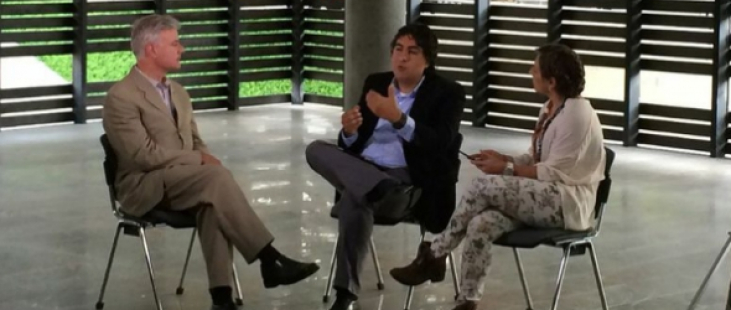


Jonathan Ortmans founded his first company at the age of 19. He left his native United Kingdom for the United States, creating more enterprises before deciding to make spreading the spirit of entrepreneurship around the world his biggest business yet.
Over the past seven years, he has founded and presided over the Global Entrepreneurship Congress (GEC) and Global Entrepreneurship Week (GEW).
This global network comes together under the leadership of Ortmans and his team, with thousands of highly innovative businesses, investors, experts, opinion leaders and representatives of 8,000 public and private institutions across 153 countries, in which “entrepreneurship ecosystems” are born and grow stronger.
One such ecosystem has emerged in Medellín, which just won the host seat of the 2016 GEC that will take place during the third week of March 2016, as Ortmans confirmed last Friday. The GEC is one of the most important gatherings of its kind, in which more than 3,000 participants from abroad are expected and which promises to reach the record participation of 10,000 people taking part in the events at Plaza Major.
Over the course of four days, the city will become the world capital of entrepreneurship, welcoming delegations from 155 countries to discuss new business creation, share best practices, and hear success stories, among other topics on an agenda that will be designed jointly by the GEC planning team and the city of Medellín government.
During his first visit to Colombia, Ortmans visited the hillsides of Medellín along which social innovations had climbed. He also walked the two floors of the Ruta N building that has seen the rise of more than 30 local and foreign business with revolutionary or “disruptive” ideas, as the experts call them.
It was there that Ortmans spoke with El Colombiano, one of the largest and most influential newspapers in Colombia, about the election of Medellín as the host for the 2016 GEC.
Why did you choose Medellín to host the 2016 GEC?
We were especially struck by the rapid progress of social innovation in Medellín. While the majority of people think that entrepreneurship is a topic related to commercial or financial issues, we see here how development is at the heart of it, starting with simple ideas. We see an entrepreneurship culture developing, and a creative community with tools and ideas.
With bids from other cities on the table, what helped make the decision?
The size of the city of Medellín is interesting, since it is in fact not a very large city. Its size works to its advantage, just like in Silicon Valley it allows innovation and entrepreneurship to interact in a good way. Here, the GEC can have a greater impact than in London, for example. We also noticed that there is continuity in government policies; there are very clear goals that are not an occurrence of the current administration to effectively build an ecosystem for entrepreneurship, as well as strong public-private alliance to catalyze it.
What examples should Medellín look to for best practices in entrepreneurship?
I think of great cities like Berlin, Tel Aviv, London, New York, and Austin, which are examples of cities with mature entrepreneurial ecosystems. There are also small cities like Wellington in which development flows between institutions and entrepreneurs, with a clear agreement and cohesion between entrepreneurship policies and the final beneficiaries. We also have to look at the success in Boulder, Colorado, in the U.S. where government and academia followed the entrepreneurs. In Medellín, I already see commitment and a defined structure.
What role do entrepreneurs play in the ecosystem?
There should be an active participation in how entrepreneurs self-regulate and self-manage within the entrepreneurial community. Problems arise when there is not sufficient leadership.
How can new local entrepreneurs insert themselves into global markets?
One option is to begin working within a network and join global entrepreneurship communities, which can be accessed online. This collaborative work offers the opportunity to find solutions.
What advice do you have for entrepreneurs interested in the base of the pyramid?
Innovation does not have to be high-tech. With the reduced cost of technology, there are more possibilities to create massive solutions for marginalized populations. It doesn’t matter how poor or how uneducated a person is, anyone can be an entrepreneur.
How do we bring this idea to life in Medellín?
People that live at the base of the pyramid know their needs better than anyone else and they are the entrepreneurs that can provide the best solutions in the most effective way. It doesn’t matter how poor or uneducated someone is.
What do you say to those that believe everything has been invented already?
In 2008, we launched GEW with Gordon Brown, the British Prime Minister, and I remember in the auditorium someone said something to the effect of “everything has already been invented” and he responded: “If you have not found something that you can fix in this world in health, education, security, environment, or poverty, then you are not very observant.”
What are three suggestions for entrepreneurs to become successful?
The first is to focus on thinking whether you are solving a problem or a meeting a need. Secondly, work in a team to look for this solution. One team member should be the creative one with a disruptive idea; the other should have the expertise to convert the idea into an innovation. Lastly, before launching your business, you have to test your business idea many, many times.
What should entrepreneurs not do in order to be successful?
Do not ask for a loan or go into debt when you are starting your business, unless you are absolutely sure of the success of your venture. Secondly, don’t pay for things that you can find for free, such as a free space to get started, online courses, managing social networking, etc. Don’t forget, the biggest challenge for entrepreneurs is time, not money.
Global Entrepreneurship Congress to Bring Investment
Upon signing the memorandum of understanding between the GEC and the Medellín Municipality, the countdown to preparing for the Congress began. The GEC demands an investment of close to a million dollars, raised with the support of local co-financing institutions, as explained by Deputy Mayor for Economic Development and Innovation, Felipe Hoyos Vieira. One of the reasons to have the GEC take place in Medellín was to recognize the active participation of Medellín during GEW last November, with 59 activities across 13 areas of the city and more than 7,000 participants. “The Congress will provide the opportunity for best practices from around the world to take hold in the city, for many people to get know our entrepreneurial ecosystem, and see this city as a destination for investment,” commented Tomas Cipriano Mejia, Secretary of Economic Development, who added that the 2016 GEC will be promoted next year during the 2015 GEC in Milan, Italy.
---------------------------
Story originally published on El Colombiano