


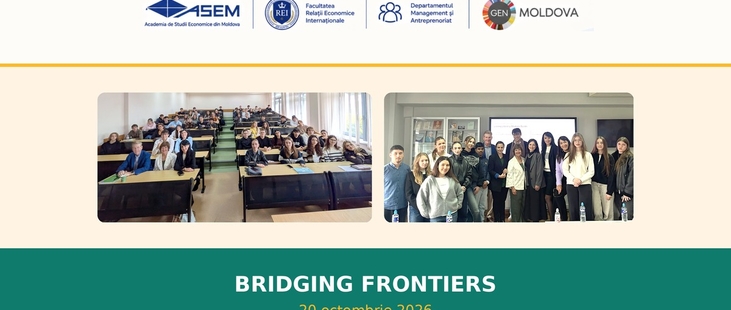


The events and the speakers
The events were organized by GEN Moldova with the Academy of Economic Studies of Moldova (ASEM), its Faculty of International Economic Relations and its Department of Management and Entrepreneurship. They began with an opening conversation on international careers, pitching and the impact of AI on work, followed by an interactive session for management students that combined four short "masterclass seeds," live polls on real management choices, open questions and a Living Library, in which speakers became "Living Books" for one-on-one advice.
The speakers were Leslie Heavey, a global HR executive who helped scale a company from about 7,000 to more than 77,000 employees; Mike Heavey, a business-to-business sales, marketing and development executive; Cristian Fortuna, a robotics and machine-learning engineer trained at EPFL and ETH Zurich, whose startup Carenux has raised more than $200,000 and is piloting AI scheduling and documentation tools with care homes in Switzerland; Liliana Buzilă, President of the National Inbound and Domestic Tourism Association of Moldova (ANTRIM), which brings together more than 100 member organizations, and founder of the Casa Rândunicii guesthouse; Marina Lița, General Manager of GEN Moldova; and Olesea Fortuna, Board President of GEN Moldova and ASEM lecturer, who moderated.
Students voted on realistic management choices, including how to retain young talent in Moldova and whether to leave university for a $50,000 startup offer. They also asked how to stand out in a crowded market, how managers guide employees through mergers and acquisitions, and whether a college degree is still needed in 2026.
The ideas gathered at the events
The discussion started from people. Leslie Heavey, who helped scale a company from about 7,000 to more than 77,000 employees through mergers and acquisitions, told students that flexibility and critical thinking matter as much as technical knowledge, and that a career rests on reputation: "The only person who has control of your professional reputation is you." She applied the same logic to her HR teams across four continents, asking them to "keep the human in human resources." That human element, the speakers argued, is exactly what students need to protect in an age of automation.
This is why AI should remain an assistant. Cristian Fortuna, co-founder and CEO of Carenux, explained that models now deliver most of a result, but companies pay people for judgment and taste: "You're not paid to just prompt the model. You're paid to look at what it tells you and extract the useful information." Olesea Fortuna made the same point for the classroom: "Use AI as a new assistant. Do not make it think for you." For the same reason, speakers agreed that a degree still matters, because strong fundamentals are what let you tell whether an AI result is any good.
Skills built this way travel well, and the speakers encouraged students to take them abroad, with a purpose and a plan to return. "We should not be afraid of brain drain; we should be afraid of brain not circulating," said Olesea Fortuna, adding: "Travel the world, be happy, come back, build more, invest." Mike Heavey urged students to "step out of your comfort zone" and get to know other cultures. In the live vote on how an employer can keep young talent at home, the student who explained their choice favored international exchange and mentorship over cash bonuses or fully remote work.
Talent that returns, however, needs an ecosystem ready to receive it. Marina Lița, General Manager of GEN Moldova, named three gaps that hold regions back: fragmentation, invisibility and mistrust. Her answer was not another project but better alignment: "Communication is not a declaration; it is an infrastructure." She asked students to map their stakeholders, build one shared narrative, communicate results and not only activities, and, above all, to "invest in the relationship, not just in AI or in technology."
Aligned regions can also build on what makes them distinct. Authenticity and rural traditions remain the main assets of Moldovan tourism, alongside the wine sector. At the event, Liliana Buzilă, President of the National Inbound and Domestic Tourism Association of Moldova (ANTRIM), highlighted the growing economic potential of the field: "Preserving authenticity is the key factor in tourism in the Republic of Moldova. Tourists come for our villages and for the wine industry, and the recognition of tourism at ministerial level confirms that it is a sector that brings real revenue to the country. Our goal is to protect the national heritage and to develop new tourist destinations," said Liliana Buzilă, President of ANTRIM.
The same attention to real needs applies to entrepreneurs, who can start from them instead of from assumptions. Cristian Fortuna spoke with more than 100 care homes before discovering that their real problem was paperwork and not the lack of robots, and he advised: "Focus on the problem, not on the solution." Mike Heavey added that failure is part of the path: "It's okay to take chances and even fail at those chances, because that's where you learn." Olesea Fortuna reminded students that fundraising is not the finish line, because "changing lives is a better metric" than the money raised, which brings the conversation back to people, where it began.
Background: the North Carolina–Moldova partnership
The visit is part of the North Carolina–Moldova partnership, a sister-state relationship that connects the two regions through economic development, education and civic exchange. Olesea Fortuna serves on its advisory board for Sustainable Entrepreneurship and Economic Development, which works with the Rotary Club of Wake Forest. Leslie and Mike Heavey are members of that club and host delegates of the Open World Program, which brings Moldovan leaders to the United States. During the week, discussions with Chișinău Rotary members explored a twin-club relationship with Rotary Wake Forest and the co-funding of future Rotary Global Grant projects in education and community development.
Building on an earlier dialogue
The events continue a conversation GEN Moldova began earlier this month with ASEM's Faculty of International Economic Relations and Department of Management and Entrepreneurship. That seminar, "Your Skills. Your Attitudes. Your World.", brought together international HR expert Michele Mary, Member of Parliament Stela Macari, Dean Larisa Dodu-Gugea and the GEN Moldova team to discuss the skills, attitudes and connections students need in a changing job market.
"Technical skills matter, but attitude and the ability to adapt often make the difference," said Michele Mary at that seminar. Larisa Dodu-Gugea, Dean of the Faculty of International Economic Relations, added that "dialogue with professionals from various fields complements academic education and helps students better understand the realities of the labor market." (Quotes translated from Romanian.)
The week in brief
Beyond the events, the program included a welcome dinner and an informal meeting with Chișinău Rotary members on Monday, a visit to the social enterprise EduJoc on the day of the events, meetings with American Councils and a visit to the Parliament of the Republic of Moldova on Wednesday, regional excursions to Călărași and Ungheni County, and a closing trip on Friday to the Cricova winery and to Orhei, including Liliana Buzilă's rural guesthouse and the Orheiul Vechi heritage site.
About the organizers
GEN Moldova is the national partner of the Global Entrepreneurship Network, building the country's entrepreneurship ecosystem through Global Entrepreneurship Week, Creative Business Cup and regional programs. ASEM is Moldova's leading economics university. Rotary Club of Wake Forest (North Carolina) is a service organization pursuing a twin-club initiative with Chișinău.