





The Global Entrepreneurship Network (GEN) is proud to be on the International Advisory Board of the Latin American Group of Intelligent Ecosystems (GEIAL, Grupo de Ecosistemas Inteligentes de América Latina), reflecting its commitment to connecting global peers with regional expertise. That is why GEN introduces the winners and finalists of the IDB–GEIAL Awards to our global community each year in the context of Global Entrepreneurship Week (GEW).
Together, this year's winners and finalists demonstrate that building stronger entrepreneurial ecosystems requires action at multiple levels—from helping individual ventures scale to strengthening the institutions and relationships that made entrepreneurship possible
In 2026, the IDB–GEIAL Awards introduced a new category: Exemplary Practices. Presented by the Inter-American Development Bank (IDB) and GEIAL, this Award's winners were selected by a jury comprising Lorenzo Tosini (Division on Investment and Enterprise, UNCTAD), Pablo Angelelli (Head of Operations in Colombia, IDB), and Esteban Campero (Director, Subregional Office, SEGIB).
Each Awardee in this category tackles a problem many ecosystems share: one closes the financing and network gaps that hold women entrepreneurs back, and the other shows how universities, businesses, and government can coordinate for the long term.
Inclusive and/or Sustainable Entrepreneurship Subcategory:
Quito Mujer (Quito, Ecuador)
Quito Mujer was created to close the financial gaps and relational barriers faced by women entrepreneurs. Part of the FonQuito Entrepreneurship Fund and operated by ConQuito, it selects women-led ventures with dynamic potential at the start-up or consolidation stage and funds them with seed capital, fostering their scalability and socio-economic sustainability.
The program combines money with support. Its key instruments include compulsory technical assistance and mentoring on business models and finance, and access to seed capital together with six months of incubation and twelve months of follow-up.
Selection is rigorous. In the 2024 call, applicants went through a technical assessment of desirability, feasibility, and viability, followed by a final pitch before a committee drawn from the public sector, the private sector, and academia. Of 987 applications, 14 ventures were selected, accredited, and funded, strengthening their commercial capabilities and networks.
“When GEIAL's data revealed the barriers women faced in accessing opportunities to develop dynamic ventures in Quito, we knew we had to act. That evidence led us to create FonQuito Mujer, the first seed capital fund specifically designed for women-led ventures. Today, we are seeing encouraging results in job creation, business growth, and access to additional sources of financing. This recognition reinforces our commitment to ensuring that women entrepreneurs are not left to navigate their journeys alone, but have the opportunities and support to turn their dreams into reality and generate impact in their communities.”
— Gonzalo Criollo Galván, Executive Director, ConQuito, Ecuador
Articulation and Governance Subcategory:
CUEE Triple Helix platform in Medellín, Colombia
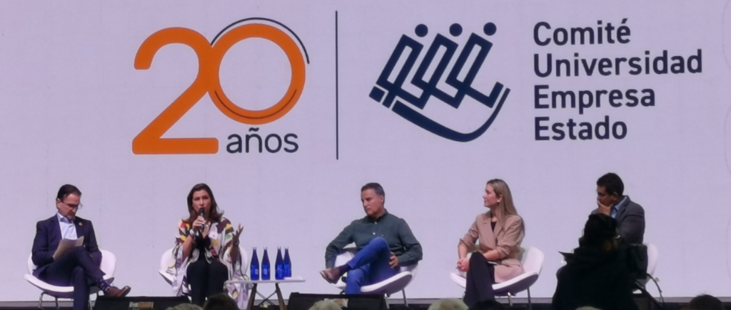
The Antioquia University–Business–State Committee (CUEE) was established in 2003 at the initiative of the Higher Council of Universidad de Antioquia, together with business and government leaders. It is a voluntary and neutral Triple Helix governance platform that fosters science, technology, innovation, and entrepreneurship (STI+E).
The committee works through shared leadership, coordinated by an Advisory Board, and through monthly plenary sessions and four thematic working groups: Human Talent, Financing, Platforms, and Innovative Entrepreneurship. It acts as a strategic coordination mechanism rather than an implementing agency. It does not manage funds directly or depend on government decrees, and focuses instead on building trust and regional consensus.
In more than two decades, the CUEE has held 557 monthly plenary sessions with over 27,000 participants. Its model has been replicated in eight subregions of Antioquia and 17 Colombian departments, and it helped create anchor entities such as Ruta N, Parque E, and Tecnnova.
“Building a strong entrepreneurial ecosystem starts with building trust among those who are part of it. For more than two decades, CUEE has worked to bring universities, businesses, and government together around shared challenges and common goals, turning dialogue into collaboration and collaboration into concrete action. This recognition celebrates not just a particular initiative, but a sustained way of working together to strengthen our region and create opportunities for its people. Above all, it belongs to the entire community that has made this collective effort possible.”
— Julián Sierra, Head of the Innovation Division, Universidad de Antioquia, and Technical Secretary of CUEE Valle de Aburrá, Colombia
Lessons for other ecosystems
The two practices work at different scales, but both show that ecosystems grow stronger when support is structured and sustained. Quito Mujer pairs seed capital with mandatory mentoring and long follow-up. The CUEE has kept universities, businesses, and government at the same table for more than twenty years.
GEN invites you to get to know the people and institutions behind these practices at the Global Entrepreneurship Congress (GEC) in Doha, Qatar, and to connect with them through GEN Connect or by contacting info@geial.com.
This article is the first of GEN's four-part Global Entrepreneurship Week (GEW) series celebrating the winners and finalists of the 2026 IDB-GEIAL Ecosystem Development Awards.
Previous articles in the series: