




Freetown, Sierra Leone | 19 November 2026
Innovation SL has successfully concluded the four-day celebration of Global Entrepreneurship Week (GEW) Sierra Leone 2026 with an inspiring final-day programme focused on Green Economy and Sustainable Fashion, held at the Limkokwing Gallery Hall in Freetown on 19 November 2026.
Held under the global theme “The World Needs What You Build,” Day 4 brought together entrepreneurs, innovators, business leaders, environmental advocates, fashion designers, young people and development partners to explore how entrepreneurship and innovation can contribute to environmental sustainability, economic empowerment and inclusive development.
The final day highlighted the importance of transforming environmental challenges into viable business opportunities through resource recovery, sustainable production, appropriate technology and creative enterprise. From green business storytelling and practical innovation challenges to the introduction of a place-based innovation project and a sustainable fashion showcase, the programme demonstrated how locally developed solutions can contribute to a greener and more resilient economy.
Promoting Green Entrepreneurship and Sustainable Business
The day's programme was hosted by Ms. Binta Buhari, Business Development and Advisory Officer at Innovation SL, alongside Mrs. Isatu Kassimatu Brima, Incubation and Acceleration Lead and Cassava Value Chain Expert at Innovation SL.
The keynote address was delivered by Mr Ibrahim Marrah, Country Director of DelAgua, who contributed to discussions on green entrepreneurship and sustainable business opportunities. His contribution highlighted the importance of developing enterprises that address environmental challenges while delivering practical economic and social benefits. DelAgua's distribution of 320 clean cooking stoves also provided a practical example of interventions supporting cleaner household energy solutions.
From Agricultural Challenges to Innovation: The Ento-Tech Innovations Story
One of the day's engaging sessions featured Mohamed Samu, CEO of Ento-Tech Innovations, who shared his entrepreneurial journey and the development of his work in insect-based technology.
Drawing from his upbringing in an agricultural household, Samu explained how his early exposure to local food production influenced his interest in agriculture and entrepreneurship. In 2019, he and a friend began exploring business opportunities, including fertiliser production and cassava flour processing. These early experiences exposed them to the practical realities of building and sustaining an enterprise.
His subsequent academic journey to Europe through an Erasmus Mundus scholarship, where he studied insect technology, opened new opportunities to explore how insects could be used to convert organic waste into valuable products, including organic fertiliser and animal feed.
Upon returning to Sierra Leone, he continued developing and piloting the solution, gaining recognition through innovation and impact awards.
A particularly important lesson from his presentation was that innovation alone does not guarantee business success. Entrepreneurs must understand their customers, test their products, gather feedback and establish whether there is a genuine willingness to pay for what they offer.
As he emphasised: “Innovation is one thing. Business is something different.”
His story reinforced the importance of mentorship, market validation, collaboration and starting small before attempting to scale an innovative business.
Green Business Challenge: Turning Environmental Problems into Business Opportunities
Participants also engaged in an interactive Green Business Challenge titled “What Can You Create?” The activity encouraged teams to develop practical green business ideas within a limited timeframe, with each group given five minutes to present its concept.
Participants were guided by three central questions: What problem are you addressing? Who is your intended customer? What green solution are you proposing?
Two concepts stood out during the exercise.
The first group proposed an organic waste collection and waste-to-energy business model. The idea focused on collecting organic waste from communities and businesses to reduce indiscriminate dumping, blocked drainage and environmental pollution. The collected waste could subsequently be processed to produce biogas for household cooking and other uses, while creating paid waste collection opportunities for young people.
The second group explored the use of cassava waste and natural, plant-based dyes as materials for clothing and fashion accessories. The concept sought to encourage local fashion production, promote alternative materials and reduce dependence on imported clothing. The group also highlighted the need for collaboration among designers, tailors and students, alongside access to training, funding and equipment.
The challenge demonstrated how environmental problems and underutilised local resources can become starting points for innovative products, services and employment opportunities.
Beyond Waste: Turning Organic Waste into Energy, Jobs and Opportunity
Further exploring the economic potential of environmental sustainability, Mr. Lyndon B. Johnson delivered a TED-style presentation titled “Beyond Waste: Turning Organic Waste into Energy, Jobs and Opportunity.”
His presentation challenged participants to reconsider the way waste is viewed, encouraging a shift from seeing waste as something to discard to recognising it as a resource with significant economic value.
He explained how organic waste from markets, farms and households can be converted into biogas through anaerobic digestion. This process involves placing biodegradable materials in an airtight system, allowing them to break down and produce gas that can be captured and used as an alternative energy source.
The presentation highlighted several opportunities associated with organic waste recovery, including:
- Renewable energy: Producing biogas for household cooking and other energy applications.
- Organic fertiliser: Processing digestate and slurry into useful agricultural soil inputs.
- Employment creation: Developing waste collection, sorting and processing services that create opportunities, particularly for young people.
- Green enterprise development: Establishing businesses that provide practical waste-management and resource-recovery solutions.
He also discussed the potential use of Sargassum seaweed in fertiliser production, noting that further testing and standardisation would be necessary to establish its suitability for reliable commercial use.
The session reinforced the importance of combining environmental responsibility with technical testing, product quality and viable business models.
Innovation in Action: Judith Neilson Foundation Place-Based Innovation Project Introduced
A major highlight of Day 4 was the introduction of the Judith Neilson Foundation (JNF) Place-Based Innovation Project by Mr. Francis Stevens George, CEO and Managing Director of Innovation SL.
The initiative reflects a place-based approach to innovation, focusing on understanding the challenges and opportunities within a particular community and developing practical solutions using locally available resources, appropriate technologies and enterprise development.
Mr. George explained that Innovation SL had been working with 11 cassava processors since 2024 to support the development of cassava flour production. Through engagements and field visits, several challenges affecting the processors' productivity and business growth were identified.
These included high energy costs and limited access to reliable electricity connections for processing machinery, difficulties accessing affordable fertiliser and plant nutrients, and the high cost of transporting finished cassava flour to markets, particularly along the Makeni–Freetown corridor.
These challenges informed the development of an integrated innovation concept designed to connect different parts of the cassava value chain.
Introducing the Cassava Food Corridor Concept
The Cassava Food Corridor concept explores how cassava peels and other locally available resources can be converted into useful inputs that support agricultural production, processing and distribution.
The proposed approach includes converting cassava peels into energy to support processing activities, producing organic plant nutrients to improve agricultural productivity and exploring locally manufactured electric tricycles, commonly known as e-kekes, for the transportation of cassava flour from Makeni to Freetown.
Supported by the Judith Neilson Foundation, the initiative is being piloted in Makeni and demonstrates how agricultural waste recovery, renewable energy, local manufacturing and sustainable transportation can be connected to address challenges across an entire value chain.
Mr. George also recognised innovators contributing to different aspects of the initiative and the wider innovation ecosystem, including black soldier fly technology, enterprise development and the local manufacture of electric tricycles.
He highlighted the work of James Saba, who manufactures electric tricycles locally using scrap and recycled materials, while acknowledging that certain components, including batteries, still require external sourcing.
The introduction also recognised Mr. Lyndon B. Johnson's role in supporting environmental and social safeguards for the project.
The discussion highlighted the importance of strengthening organisational capacity, people management and operational systems as innovative enterprises develop and prepare to scale.
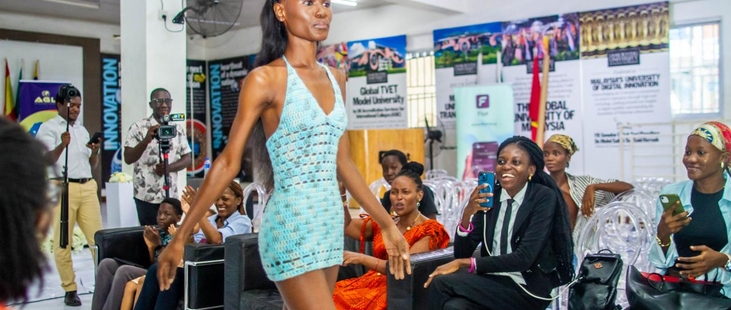
Sustainable Fashion Show: Celebrating Creativity, Reuse and Responsible Production
The final major feature of GEW Sierra Leone 2026 was the Sustainable Fashion Show, facilitated by Ms. Khadieja Deen Sesay.
The showcase celebrated local designers and creative entrepreneurs who are exploring more responsible approaches to fashion through recycling, upcycling, reuse and redesign. It demonstrated how discarded materials and existing fabrics can be transformed into valuable fashion products while supporting local creativity and enterprise development.
Before the runway presentations, the founder of Ada's Adorables Touch delivered a presentation highlighting the environmental impact of textile and plastic waste and the importance of responsible production.
She explained how her brand collects discarded materials, particularly plastics, and transforms them into clothing, accessories and lifestyle products. Examples included flower vases made from rubber, earrings and other creative accessories.
Her presentation encouraged participants to recognise that materials often considered waste can become valuable resources when combined with creativity, innovation and practical design skills.
Showcasing Sierra Leonean Fashion and Creative Enterprise
The fashion showcase featured four designers and creative brands, each presenting a distinctive approach to craftsmanship, sustainability and creative expression.
Salma's Crochets – Salamatu Bah
Founded by Salamatu Bah, Salma's Crochets presented handmade crochet fashion and accessories. She shared how her interest in crocheting began during her primary school years and gradually developed into a business over the past five years. Her participation highlighted the value of nurturing creative interests and transforming personal skills into entrepreneurial opportunities.
Ada's Adorables Touch
The brand showcased creative products developed through the repurposing of discarded materials. Its presentation included flower vases made from rubber, earrings and other accessories, demonstrating the potential of waste materials to become attractive and functional products.
Stunner Wears – Mohammed Dumbuya
Led by founder and creative director Mohammed Dumbuya, Stunner Wears presented designs inspired by creativity, cultural connection and sustainability. The brand contributed to the celebration of local fashion talent and the role of design in promoting environmental awareness and creative enterprise.
Been Frank – Designer Frankly
Representing Been Frank, designer Frankly presented a collection inspired by his grandmother and his reflections on climate change and youth unemployment.
He shared how his fashion journey began during his first year in college, initially creating clothes for himself. His collection incorporated discarded jeans and fabrics, demonstrating how existing materials can be redesigned into new fashion pieces.
Beyond the runway, he spoke about his ambition to create employment opportunities for young people, promote affordable sustainable fashion and organise practical workshops that teach people how to transform old clothing and plastics into bags and accessories.
He also encouraged consumers to repair, patch and redesign their clothing rather than frequently replacing garments.
Together, the designers demonstrated that sustainable fashion is not only about environmental responsibility but also about building creative businesses, preserving local skills, supporting artisans and creating employment opportunities.
Celebrating Collaboration and the Power of Collective Action
In his closing remarks, Mr. Francis Stevens George, CEO and Managing Director of Innovation SL, expressed appreciation to the speakers, facilitators, partners, entrepreneurs, innovators, exhibitors, designers, participants, volunteers and the organising team for their contributions to the successful delivery of Global Entrepreneurship Week Sierra Leone 2026.
He acknowledged the importance of collaboration in building an entrepreneurial ecosystem and encouraged stakeholders to maintain the relationships established during the week, continue sharing ideas and translate the opportunities identified into practical action.
The closing message reinforced the importance of collective effort in advancing entrepreneurship, innovation and sustainable enterprise development across Sierra Leone.
Key Takeaways from Day 4
The final day of GEW Sierra Leone 2026 reinforced several important messages:
- Green entrepreneurship can create economic opportunities while addressing environmental challenges.
- Innovative products and services must be supported by market research, customer feedback and viable business models.
- Organic waste can become a valuable resource for renewable energy, fertiliser, new products and employment.
- Place-based innovation can connect local challenges, available resources and appropriate technologies to develop practical solutions.
- The cassava value chain presents opportunities to integrate agriculture, waste recovery, energy and sustainable transportation.
- Recycling, upcycling and responsible production can strengthen creative businesses and support sustainable livelihoods.
- Collaboration among entrepreneurs, innovators, institutions, development partners and communities is essential to developing and scaling sustainable solutions.
Looking Ahead: Building a More Sustainable Entrepreneurial Ecosystem
Day 4 brought the four-day celebration of Global Entrepreneurship Week Sierra Leone 2026 to a close, leaving participants with a renewed appreciation of the role entrepreneurship can play in addressing environmental and economic challenges.
From the development of insect-based agricultural solutions and organic waste-to-energy concepts to the Judith Neilson Foundation Place-Based Innovation Project and the Sustainable Fashion Show, the programme demonstrated the importance of developing solutions that respond to local realities and make effective use of available resources.
The final day also reinforced a central message: sustainability and entrepreneurship can work together to create new markets, support local industries, generate employment and strengthen communities.
As the GEW 2026 celebrations conclude, Innovation SL extends its appreciation to all partners, speakers, entrepreneurs, innovators, designers, participants and supporters who contributed to making the four-day event possible.
Through continued collaboration, innovation and enterprise development, Innovation SL remains committed to supporting an entrepreneurial ecosystem where locally developed ideas can grow into impactful and sustainable solutions.
THE WORLD NEEDS WHAT YOU BUILD.
Global Entrepreneurship Week Sierra Leone 2026 was organised by Innovation SL.
Innovation SL – Creating The Future Today.