





Entrepreneurship ecosystems do not grow in isolation. They thrive when the organizations supporting entrepreneurs connect, exchange knowledge, and learn from one another, and strengthen their ability to pass those insights, relationships, and opportunities on to the founders they serve. Yet across Latin America and the Caribbean, fragmentation between ecosystems continues to limit the flow of ideas, resources, and opportunities.
Marcos Vega, Executive Director of the Prendho incubator at UTPL and a GET Fellow from Loja, Ecuador, who leads is helping change that.
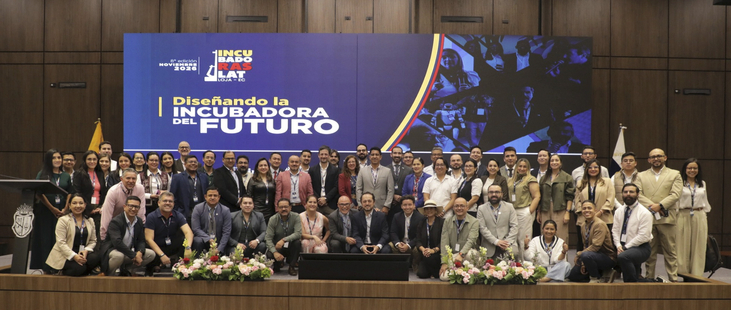
As a leader in the regional incubation community, Marcos brought the 8th IncubadorasLAT Annual Meeting to Loja, Ecuador, from November 17–19, 2026. Under the theme "Designing the Incubator of the Future," the gathering brought together incubation professionals, entrepreneurship support organizations, universities, public institutions, and ecosystem leaders to explore how incubation models must evolve to respond to entrepreneurs' changing needs.
IncubadorasLAT is a platform connecting over 200 centers across Latin America and the Caribbean. Its year-round community, led by Pablo Peralta of Agile Policy and Sergio of Fundación Da Vinci, works to strengthen the institutions that help entrepreneurs turn ideas into viable businesses and generate impact.
Turning connections into collective capacity
The three-day gathering at the Universidad Técnica Particular de Loja (UTPL) featured international panels, expert presentations, collaborative workshops, and networking opportunities. Its agenda tackled some of the most pressing questions facing entrepreneurship support organizations today: how to finance the incubator of the future, how to improve support and incubation processes, and how emerging technologies—including artificial intelligence—are transforming the way organizations accompany entrepreneurs.
“There’s often a lot of goodwill, but no clarity about how to do these things,” said Marcos Vega, a GET Fellow and coordinator of Prendho.
Bringing the IncubadorasLAT Annual Meeting to Loja also put a secondary-city ecosystem at the center of a regional conversation—demonstrating that innovation and ecosystem leadership are not confined to the region's largest entrepreneurial hubs. In fact, Prendho, the incubator and accelerator for high-growth ventures at Universidad Técnica Particular de Loja (UTPL), has already been regionally and globally recognized for its impact on new venture creation. Its methodology has already been transferred to four Ecuadorian universities, and UBI Global ranked it among the five best university incubators. In 2026, it received the IDB–GEIAL Award for "Support for entrepreneurs" in recognition of its eight-month INCUBITI programme and prototyping with university laboratories, which has incubated more than 600 projects.
A GET Fellow advancing a shared regional mission
Marcos's initiative to mobilize his local ecosystem to bring a regional gathering to the UTPL campus reflects a central ambition of the GET project, led by the Global Entrepreneurship Network (GEN) and IDB Lab: bridging the gaps between entrepreneurial ecosystems across Latin America and the Caribbean.
The project recognizes that incubators, accelerators, and other Ecosystem Support Organizations (ESOs) produce essential public-good effects, yet often operate with limited resources and insufficient connections to peers and potential partners. Strengthening these organizations—and the relationships between them—is fundamental to creating more cohesive, inclusive, and resilient entrepreneurial ecosystems.
By mobilizing a regional network of more than 200 incubation centers around a shared learning agenda, Marcos is putting this mission into practice. Attendees traveled from Peru, Colombia, Argentina, Uruguay, Paraguay, Chile and Mexico, and about over 20 Ecuadorian universities took part alongside local governments, banks and investors. His work illustrates how GET Fellows can serve as connectors and catalysts, translating regional collaboration into concrete opportunities for their organizations and the entrepreneurs they support.
Because bridging the gaps between ecosystems starts with the people willing to bring them together.
During Global Entrepreneurship Week (GEW), GEN is highlighting the efforts of members working to connect a historically fragmented Latin American and Caribbean (LAC) entrepreneurship ecosystem—breaking down knowledge silos, making resources more accessible, and creating opportunities for collaboration across borders.