
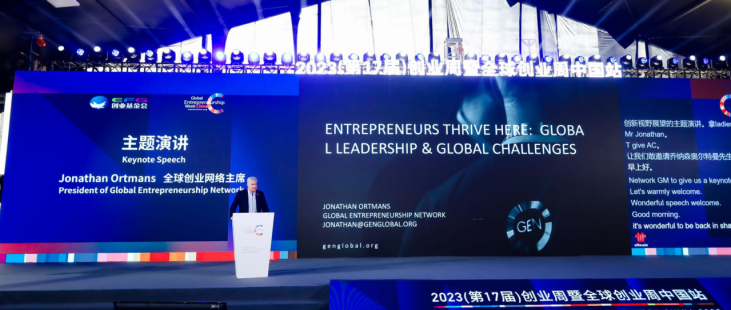


GEN President and GEW co-founder Jonathan Ortmans opened Global Entrepreneurship Week in China with a keynote speech at the Yangtze River Delta Innovation and Entrepreneurship Summit in Shanghai.
The campaign in China is led by the Entrepreneurship Foundation for Graduates (EFG), based in Shanghai.
You can watch the recording of his speech or read his prepared remarks below.
PREPARED REMARKS
I can think of no place better to celebrate GEW than Shanghai. The pandemic did not let us visit each other and so I am so very excited to be back here in Shanghai - especially to open Global Entrepreneurship Week 2023 under our theme, Entrepreneurs Thrive Here.
Entrepreneurs do indeed thrive here. The world now looks to China to understand deep tech innovation, scale and grit.
It thrives here because entrepreneurial activity has deep roots in China and has surged over the past twenty years. Beginning with the hundreds of millions of getihu owners who sought to scratch out their own living, through the “sea turtles” acquiring skills and education abroad and planting successful new businesses back at home, and now with business-savvy homegrown entrepreneurs, cities across China have rapidly become an entrepreneurial hotbed.
This phenomenal rise did not happen by chance. Governments set the rules and incentives in all nations and it is the result of your government's unwavering commitment to technological development and innovation, coupled with a surge in venture capital investment. This potent combination has fostered a nurturing environment for startups, transforming cities like Beijing, Shanghai, and Shenzhen into bustling hubs of entrepreneurial activity.
Proof that entrepreneurship thrives in China is also borne out in the data. Patent applications for Chinese inventions soared to 1.58 million in 2022 – more than the US, Japan, Republic of Korea and Germany combined. Chinese researchers are the 2nd most cited in international scientific journals with annual growth outpacing that of the USA.
And China also has a stunning lead in 37 of 44 critical and emerging technologies including synthetic biology, electric batteries, 5G and nano manufacturing, AI, machine learning, advanced robotics, and quantum communications.
It is often said that “Technological revolutions are invariably overestimated in the short term and underestimated in the long term”. Many are predicting this to be the case with AI where the long-term work being conducted in China could far outweigh the initial bang created by Chat-GPT in the USA. From ByteDance to Pony.ai, significant competitors for the future of AI are emerging. I am watching Qi Fancahao who founded DeepLangAI, Shang Yanvi and Wu Zhengyang who launched StellaRover to transform how users interact with software platforms that use AI.
There are thousands more success stories you know better than me in Chinese ecosystems. Shenzhen defied global trends by being one of just a handful of ecosystems to increase the number of unicorns it produced last year, more than doubling its total number from 2021. Likewise, Beijing and Shanghai remain the top two leaders in Asia by Ecosystem Value, Exit Value and Early-Stage funding.
When I first visited here over 20 years ago, I stayed at the People’s Hotel and looked out over the river which had not a single building on it. We launched the Global Entrepreneurship Week campaign here and around the world to instill confidence in economically challenged communities and show that Silicon Valley had no monopoly on entrepreneurship.
The theme “Entrepreneurs Thrive Here” tells it all in showing how far not just China but the whole world has come in just a decade a half. Communities, cities and nations have embraced entrepreneurship as a force for improving lives and an engine of economic growth so much so that they seek to promote their “soft landing packages” and immigration policies and other incentives to attract people to their cities. Entrepreneurs certainly thrive here.
This week we celebrate this achievement alongside the emergance of a global entrepreneurial ecosystem where different cultures and communities find more in common with each other than divides them. It is for that reason GEW has never been more important.
We meet at a moment of transition. A time, it seems, defined by its contradictions.
Tremendous relief – on the one hand – after the lifting of pandemic restrictions and the return to the simple joys of normal life and daily freedom. Tempered – on the other – by global economic headwinds that sow the seeds of doubt in the minds of investors, consumers and policymakers alike.
Huge optimism, powered by technological breakthroughs in fields such as AI and quantum computing that point to a truly bright future for humanity. Tempered, by outbreaks of global violence that hark to the darkest moments of human history.
Profound transition breeds these challenges as a byproduct and reaction against progress.
It is our job to stay laser focused on the mission at hand and empower entrepreneurs all around the world to deliver that progress by transforming their ideas into viable commercial enterprises that deliver prosperity, tackle global crises, and revolutionize the way we live and work.
Clean energy, artificial intelligence, global food supplies, vaccines and the irradiation of deadly diseases. The progress we make on these issues in the next decade will determine the success of the next 100 years and beyond. That is the prize and its why we must stay the course and continue our work together to build an environment where ordinary citizens are empowered to become entrepreneurs and flourish in advanced ecosystems.
It was the former Chinese Premier Wen Jiabao who said that “In times of economic turmoil, confidence is more precious than gold or currency.” Our latest data on the performance of the global ecosystem shows venture capital dropping by 35 percent, a 40 percent global decline in the number of new unicorns, a drop in the number of startups receiving funding and a significant drop in the number of exits worth over $1 billion.
But the Chinese word for crisis 'Weiji,' also means opportunity. This is especially true for entrepreneurs who thrive in times of austerity and innovate to overcome barriers that seem insurmountable to others.
Indeed, the financial crash of 2008 was the backdrop to which tech giants like Uber, WhatsApp, and Airbnb emerged. By 2009, over half the companies on the Fortune 500 list had been launched during a recession or bear market. Time and time again, recessions produce more lean, mean and investable cohorts when bullish capital returns.
Investors and entrepreneurs alike should take strength from this fact. There is a huge amount we as ecosystem actors and policymakers can learn from these lean economic times as we watch as the strongest innovators emerge by eliminating redundancies and identifying efficiencies.
Our world also faces burgeoning geopolitical distrust. The rise of nationalism in many parts of the world and growing skepticism towards globalization makes those of us who have been working collaboratively over the years, banking trust with colleagues from societies with different views and values more important than ever.
You know, some suggested to me I should not open GEW here in China – suggesting China is not interested in a global and transparent ecosystem but rather its own rise and competition against the United States. Of course, none of them have ever been here. Anyone who has visited or bothers to read history does not subscribe to this view.
I have a son who started college last month at Harvard. His passion is physics and math and track and field, but when I went to drop him off, I took the opportunity to visit some of Harvards’s many history museums and institutes and spent some time refreshing some of my knowledge of the history of your great nation. History is one of the great forgotten subjects of our time.
Yours is still a nation built on knowledge, wisdom, customs, discipline, loyalty, respect, hard work and resilience. Yes, you are fierce competitors not afraid of defend your perspective of the state of the world but the world respects this.
However, with such power and authority comes responsibility. I am honored to be your guest this week and invite you to actively engage with other investors, startups, educators and accelerators around the world. Our world of dreamers, doers, and risk-takers creating new value needs China to work together alongside other economies. The mature tech ecosystems of the world have more in common than divides them. Entrepreneurship and Innovation offer a powerful common ground for big competing economies where their achievements in innovation can be bigger than the sum of their parts. The global entrepreneurial ecosystem must set an example to the world in together solving even bigger challenges faster.
I see a global ecosystem united widely across the planet by the sheer force of our collective determination to fix the world we live in. We are united by the uniquely human capacity to transform our curiosity into technologies that spread around the world and revolutionize the daily lives of all who occupy it. We must not let distrust by some slow human progress. Human endeavor transcends borders and can be transformational.
So 16 years later, GEW’s challenge if is no longer an empowerment mission to those who were in intimidated by Silicon Valley, but one of convincing the major economies where entrepreneurs thrive to unite to meet common global challenges - from climate and energy, to space and smart and safe uses of deep technologies like AI.
Of course, entrepreneurship is business and there will be winners and losers in the marketplace. But competition does not mean we cannot collaborate. The pandemic should have taught all of us that.
These are times of incredible opportunity for us as leaders with the strength and ambition to grasp it. The biggest economies set an example for the rest. Global Entrepreneurship Week seeks to spread entrepreneurial culture to all communities across the globe. It’s our mission to ensure that every citizen with a good idea feels empowered to become an entrepreneur, and to ensure they have the opportunity to transform that idea into a product or service that impacts the lives of people across the world.
Our belief now – as it was then – is that no single culture or ecosystem has a monopoly on good ideas and more importantly that every person excluded from entrepreneurship is a loss to the entire global community. All boats rise on an incoming tide.
This week we expect over 40,000 events happening in 200 countries with over 10 million participants showing that entrepreneurs can start, scale and thrive anywhere. We are deeply indebted to foundations like the Ewing Marion Kauffman Foundation in the United States, corporations like FedEx and our national organizers like EFG in China.
Throughout the week, I encourage you to think about how entrepreneurs are thriving in your community. And tell us what you learned. Join the global dialogue on your favorite social media channel with the official hashtag – #GEW2023 and #EntrepreneursThriveHere.
Please also visit GEW.CO to add your events, find events near you, and complete our GEW participant survey.
I hope you are as excited about the rest of today’s program as I am. I am looking forward to joining you again in a few hours where I’m going to discuss the international headwinds that are influencing the global ecosystem and share with you GEN’s vision and practical tips for policymakers and ecosystem actors who want to raise the level of entrepreneurial activity and success rates in their communities.
If you want to learn more about GEN visit genglobal.org.
Thank you.