





Contribution by GERN Research Member Serban Mogos, PhD Candidate in Technological Change and Entrepreneurship in a dual degree program at Carnegie Mellon University (USA) and Instituto Superior Técnico (Portugal).
The long tradition of research into firm growth has generated a comprehensive list of factors that influence the growth performance. However, high growth firms (HGFs), firms that experience high rates of growth in multiple consecutive years, are a fairly recent subject of conversation. The implication of growth persistence and rapid expansion imposes additional constraints, that have not yet been fully incorporated in the discussion of growth determinants.
Looking at the most common factors, we note how they apply in the context of high growth firms, and discuss a pattern of interaction on multiple levels.
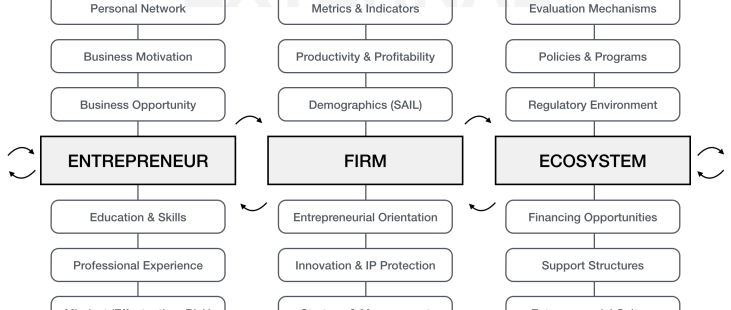
The Firm
* Demographics - The firm is ‘endowed’ with some fixed characteristics: size, age, industry, location. Whether these attributes influence the probability of a firm to be high growth is still largely inconclusive - studies have found evidence both in favor of small and large, of young and old, of high-tech and services. However, the latest research from Kauffman Foundation and OECD suggests that age is more important than size, with young high growth firms being the largest contributors to job creation.
* Innovation - Research has found that HGFs are associated with high levels of innovation, however, the bulk of evidence on HGF and innovation comes from developed countries, with advanced levels of industrialization and technological development. At the technological frontier, strategies are more inclined to focus on innovation investment; the farther a country is from the frontier (developing economies), the more opportunities to find alternative sources of competitive advantage.
* Management - Management decisions determine how effective innovation and resources are converted into competitive advantage. The capacity (1) of an organization to “acquire, assimilate, transform and exploit knowledge” determines its capability to “ integrate, build, and reconfigure internal and external competences to address rapidly changing environments”. Higher levels of absorptive capacity (1) and dynamic capability (2) are linked to higher performance.
* Performance - The metrics and indicators for firm success vary, depending on the focus of the firm: profitability, productivity, number of employees, financial efficiency, customer retention and satisfaction, etc. High growth firms are by definition selected to be the best performing, however, performance in one indicator does not immediately translate to a similar level of performance in others.
The Entrepreneur
* Human capital - Higher levels of education, industry experience, management experience, and entrepreneurial experience show positive effects on survival, innovation, profitability, and growth. Additionally, the sex of the entrepreneur can play a role, as startups founded by women have been found to experience slower growth. This is consistent with observations from practice, where we see women entrepreneurship being underrepresented and facing additional barriers to entry (Kauffman, 2015).
* Motivation - Entrepreneurs start businesses with a wide range of motivations. Entry from unemployment (“necessity entrepreneurship”), has lower probability of survival and even less of high growth. Similarly, family firms have a different risk and growth profile, being more conservative. “Lifestyle business” is another option, depicting individuals looking to maintain a level of income similar to employment, but with greater flexibility. Growth aspiration is not a sufficient requirement for achieving high growth, but it is a required piece of the puzzle.
* Opportunity and network - The “knowledge corridor” developed by education and experience, combined with a natural “entrepreneurial alertness” will define one’s ability to identify opportunities. Entrepreneurs will usually start businesses in industries where they already have prior experience, and if they have high alertness to capture the opportunity in time. Without proven track record, early stage entrepreneurs will have to leverage their social networks, which are also often created through workplace interactions.
The Ecosystem
* Development level - Country-level resources - skilled labor, suppliers, financing, infrastructure, customers - are more difficult to be improved in short-term and can be considered a fixed input. On the other hand, the entrepreneurial ecosystem is open for improvement. Entrepreneurial potential is the result of the interaction of the actors in the ecosystem - entrepreneurs, startups, investors, universities. Support structures (incubators, accelerators, conferences, networking events) and financing opportunities (loans, grants, angels, venture capital) improve than chances of aspiring entrepreneurs to firstly, take the plunge and secondly, have greater chances of success.
* Regulatory environment - When the cost of doing business is high, potential entrepreneurs remain stuck in other alternatives for earning income. Governments have the option to simplify regulation for private enterprises, allowing more (and better!) entrepreneurial entry. Nevertheless, political realities often obstruct the implementation of beneficial regulatory changes.
* Policies and programs - Startups are susceptible to failure due to their limited resources and lack of market history (“liability of newness”). Public sponsorship programs are designed to ‘buffer’ (providing resources) or ‘bridge’ (networking with opportunities) in order to correct market failures. National programs are increasingly targeting the creation of high growth firms, preponderantly in developed countries (Finland, Sweden, Netherlands, UK).
The growth determinants discussed above can be illustrated in a simple model. While not comprehensive or perfect, it does provide a framework for discussing key dynamics. We separate internal and external factors on a timeline that advances from readiness for growth to growth potential or actual growth. Elements from the Firm, the Entrepreneur and the Ecosystem are in constant interaction with each other, in a continuous flow of information transfer.
While research often imposes limitations on what can be taken into consideration, it is important to not lose sight of the complexity of the growth process, and its span on multiple levels. Even more so in policy design, where growth influencers on lower levels are often the target of the policy intervention.
The article makes reference to unpublished research by Serban Mogos at Carnegie Mellon University (US), part of his PhD dissertation. For comments or additional information, the author can be contacted at mogos@cmu.edu .