




The Kingdom of Saudi Arabia has recently demonstrated its commitment to building a strong and prosperous entrepreneurial ecosystem within its borders.
Led by Qotuf, Global Entrepreneurship Week in Saudi Arabia has reached thousands of budding entrepreneurs over the past several years. However, the focus on entrepreneurship lasts more than one week in November.
The World Bank’s annual “Doing Business” report issues last year rated Saudi Arabia as the 22nd most economically competitive country in the world, up from 67th in 2004. With low rates and a light administrative burden, Saudi Arabia’s tax regulations make the country appealing for startups and overall fairly entrepreneurship-friendly.
A strong emphasis on developing an entrepreneurial mindset at all levels of education has lead to the creation of programs that seek to empower and educate entrepreneurs. Perhaps surprising to some may be that female entrepreneurs exist and thrive in Saudi Arabia. As the political and economic landscape has shifted, women have taken advantage of the move away from social constraints on their gender to follow their dreams and build their businesses.
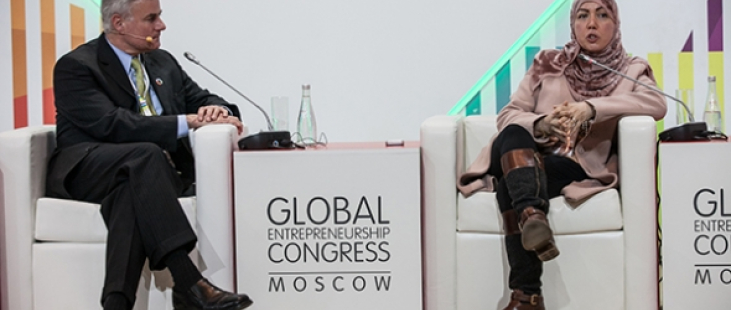
At the recent Global Entrepreneurship Congress in Moscow, Princess Loulwa al-Faisal, Vice Chair of the Board of Trustees & General Supervisor of Effat University in Saudi Arabia provided the following written statement on the progress that her country has made towards becoming a stable entrepreneurship ecosystem.
Ladies and gentlemen, I appreciate very much having the opportunity to speak to you briefly about a subject that is of so much interest to each of us. We are all here today because of our shared view that entrepreneurship, and the required vision, initiative and drive which achieve entrepreneurial success, are now more than ever before key factors in lifting economies world-wide, and, above all, key factors in enhancing conditions for employment, progress and stability, especially in the developing world.
Successful entrepreneurs are not merely quick to respond to change. They lead change to a very significant degree. This is evident in the tremendous technological advances we have today. Of even greater significance is the importance of the social role of entrepreneurship which cannot, and must not, be underestimated.
In any discussion on the fundamentally important issue of entrepreneurial activity, few would associate the Kingdom of Saudi Arabia as a key player and role model. I am here to convince you otherwise - not least in the case of women entrepreneurs, of whom we have many in our country.
Inspiration, tenacity and determination may be the key attributes of entrepreneurs but their prime motivation is the aspiration that their ideas will reach a successful, and rewarding conclusion. Then comes the tenacity and determination, needed to regard difficulties and setbacks merely as obstacles to be overcome, not as deterrents. But something more is needed. A corresponding prime factor for the success of entrepreneurs is the availability of advice, critical analysis and practical support. Those seeking to find profitable long-term investments in new ideas must have the clearly focused willingness, and ability to provide encouragement and practical support in defining the feasibility and market potential of a unique new enterprise. They also need to have the vision and imagination to assist in refining the ‘product’ to surpass perceived needs, and move on to new horizons.
These fundamental principles are very well understood in the Kingdom of Saudi Arabia. As the poorly developed nation we once were – just a lifetime ago - we did not easily find ourselves, as we are now, with a world-class educational system. This was entirely due to pioneer thinkers in the early days who combined vision and determination to succeed, and who fought many hard arguments to win the support of those who doubted –or even of those who were once opposed. Their example has given us a heritage of which we are justifiably proud. Our progress was built on the principles of entrepreneurship at their best. It set an example, which we now follow throughout our educational system, in encouraging original thinking, and supporting the development and fulfillment of new ideas in the most practical manner. How? You will naturally be curious to know.
I offer you one example, which gives a lead for all other institutions to follow. The King Abdullah University of Science and Technology – a co-educational institution - demands the highest academic standards, not merely to promote academic excellence, but to define actions where such excellence can be developed into practical uses in a potentially profitable new business enterprise. This means not only full support in turning good ideas into practical and achievable business plans with the strong support of business expertise, but also of ensuring that the financial resources of a seed-fund is available as venture capital. This is the ethos of an excellent university, which encourages and supports talented students to produce their best efforts, for the ultimate benefit of all.
Good ideas, no matter how worthy, are just that – simply good ideas. Without the qualities and attributes of all those involved – and above all the support, which I have outlined to you - nothing of lasting value can be achieved. Not every business will succeed, or turn into a huge multi-national corporation overnight but lessons can be learned, not least from failure. Change can be threatening but it can also lead to opportunity. Failure can be valuable experience and spur a willingness and determination to try again.
It is a too frequently accepted misconception that women in Muslim societies are disadvantaged, being confined to a role of domesticity. We are not at all disadvantaged. We have many successful women entrepreneurs in the Kingdom of Saud Arabia, and they find ample resources within government organizations and private institutions to support them in turnings dreams into practical achievement.
Their motivation, as with any entrepreneur anywhere in the world can be the familiar ‘push’ to progress for personal benefit, or the ‘pull’ of seeing clearly an opportunity which must be seized. One recognizes that disadvantages exist in some communities, but these are invariably a consequence of social custom, not of religious faith, and are frequently overcome. All Muslims are well aware that the wife of the Prophet Mohammad (PBUH) was a prominent merchant in her own right, and was supported and encouraged by her husband. Then, from a religious point of view, we know that the first word of the Holy Quran is the imperative ‘Read!’; and consequently to learn, and to use the benefit of learning wisely. It is a command to all Muslims, regardless of gender. This, I would argue, is entirely compatible with the ethos of successful entrepreneurship.
We are in a world where populations are growing rapidly and change is an increasingly common feature of society, as are obstacles and opportunities for young people to find and build careers. Opportunities will always be there, as will talented and determined people to develop and benefit from them. The human race is abundantly resourceful. It must also be borne in mind that the majority of employers worldwide, with the greatest total work-force, are SMEs’, not large multi-national companies
The major challenge to meet the needs of a complex contemporary world is that those of us who are involved in the educational sector must appreciate the great responsibilities we now have in preparing young people for the inherent uncertainties which will face them as they reach adulthood and go forward to build a worthy life, for themselves, for those who depend on them, and for society as a whole.
It is often very difficult for educational policies and strategies to change with the rapidity demanded by progress. This means that throughout the whole span of a young person’s education, it is now an imperative responsibility to encourage an entrepreneurial mindset as an essential attribute to develop in young minds. Educational progress and understanding must relate to changes in the real world around us. We must encourage the attitude of looking always for positive opportunities presented by change. ‘What if?’ and ‘What could be?’ must be a constant approach in any situation. Adaptability, communication, cooperation, critical thinking, a readiness to lead, not just to follow, and an acceptance of risk, are fundamental attributes to an entrepreneurial mind-set. They must, however, be accompanied by the humility and good sense to learn throughout life.
Nor must we forget that the adoption of such principles applies not only to the young but to all of us. We, in the Kingdom of Saudi Arabia are ever aware of these attributes. As I have told you, they were possessed in abundance by those who set us on the sound path we follow today.
I invite you to join us.