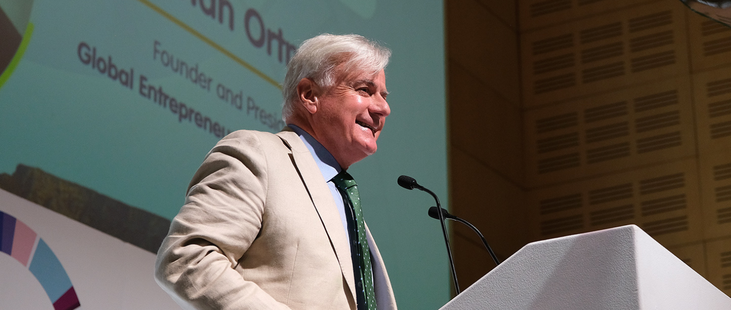


The following speech was delivered by GEN President Jonathan Ortmans at the opening of GEC+Africa in Cape Town on September 16, 2026.
Two years ago, this hall held the first GEC+Africa. Two thousand delegates. Seventy countries — thirty-eight of them African.
And then something happened that does not usually follow a conference — except when Kizito’s team is involved.
Impact.
That November, as you know 22 on Sloane opened a hub in Green Point. A second home on this continent for the campus model it has run in Johannesburg since 2017.
GEN and Sloane did not visit Cape Town. We moved in.
And the two years since have not been quiet ones.
On StartupBlink's index this year, Cape Town grew thirty-nine percent and climbed twenty-four places — the fastest rise of any city in Africa's top ten.
And last November, when OpenAI came to this continent for its AI Innovation Forum, it held it at 22 on Sloane. Here. In this city.
Notice the sequence.
A hub opened. Within a year, the frontier came to it.
That is progress. But I want to begin this morning with a map.
Not a map of the world as it is. A map of the world as capital currently imagines it — showing according to data where the future is being built, and who is building it.
In June, at VivaTech in Paris, GEN and Startup Genome published this year's Global Startup Ecosystem Report. Five and a half million companies across three hundred and fifty ecosystems.
Everything I am about to describe is measured against where those same ecosystems stood twelve months ago.
Over the past twelve months, on that map, there are three very bright cities.
By comparison, most other places are dim. Cape Town is, relatively speaking, dim. So is Lagos. So is Nairobi. So, for that matter, are Paris and Seoul and São Paulo.
I have spent twenty years studying the bright places and trying to brighten up the dim ones. And I can tell you that map is worrisome.
That map is not drawn by geography. Not by talent. Not by some law of markets that none of us can argue with.
It is drawn by choices. And very recent ones.
So let me tell you how it got drawn.
Last year was a good year for the entrepreneurial economy. After a brutal contraction following the post-COVID boom, global startup ecosystem value rebounded by close to forty percent.
However, to my amazement, roughly two-thirds of that landed in just three American cities.
The same report tracks where the money behind the defining companies of this era is going. Close to nine in every ten late-stage dollars flowing into AI are being deployed in a single region.
So here is the contradiction we are living inside.
Never has the entrepreneurial economy created more value. However, never has it created it in so few places.
Four developments have created this concentration.
First, global development assistance contracted — by the largest margin ever recorded in a single year.
Second, wealthier economies have frankly become more self-serving, redirecting spending inward, toward defense and domestic priorities.
Third, national conflict and fragmentation pushed trade, capital and talent to move along political lines rather than commercial ones.
And finally, of course, AI arrived, and pulled massive amounts of capital hard toward just a few places.
Four separate decisions, taken in different rooms, for different reasons.
Nobody sat down to redraw the map. But between them, they redrew it.
Now — you could look at all that and call it physics.
You could say that frontier technologies always begin concentrated, that the powerful get more powerful, and that the rest of the world waits its turn.
But the data does not support that.
Look at China. Almost every Chinese ecosystem in this year's top forty lost ground. Beijing. Shanghai. Shenzhen. Hangzhou. Guangzhou.
These are not weak ecosystems. They are among the most formidable on the planet.
Then look at Sri Lanka, which jumped more than sixty-five places in a single year. The largest move in the entire ranking.
Incumbency guarantees nothing. Distance guarantees nothing either.
Which means the narrowing is not a law. It is a result.
And results can be changed.
So that is the question I put to us in Africa in this room this morning.
Is what has happened to the map a trend?
Or is it a blip?
Four answers.
I have spent more than two decades helping build connected communities of trust — what we now call ecosystems. And I have been struggling to defend the performance of many of the support organizations inside them.
Too many of our programs report the things that are easy to count. People enrolled. Events held. Founders engaged. And then go quiet on the questions that actually matter. How many businesses created are still trading three years later? Has their model created growth, or should its founders have recycled it and moved on to another? How many jobs did they create? Whose life was changed?
Now connect that back to the map.
When money tightens — and it has tightened — it retreats to where results are already visible. To the places that can prove what they produce.
So if our industry cannot show what a dollar buys in Accra, or Kigali, or right here, that dollar is increasingly repurposed to a city that can.
We have had an excuse for our failure to measure ourselves. Serious evaluation used to cost more than most programs could afford.
That excuse expires this year.
AI has collapsed the cost of running a program — and of tracking what happens to founders long after they leave us.
We can finally hold ourselves to the standard we hold our founders to. At a fraction of what it used to cost.
So to everyone in this room who supports founders for a living: measure what you produce. Publish it. Let the results decide who gets funded next.
Second. If capital has pooled in three cities, then the money that reaches everywhere else has to work differently.
Start with the number I did not give you earlier.
Development assistance fell to one hundred and seventy-four billion dollars last year. A drop of twenty-three percent in just twelve months, on the OECD's own preliminary figures. On this continent, the fall was steeper still.
But let us be honest about what it means.
Grief is a fair response to loss, but it is not a strategy. The question is what replaces it.
We already know one answer, because it has been run before.
When the Berlin Wall came down, the United States capitalized ten enterprise funds across nineteen countries with one point two billion dollars. Handed not to a government agency, but to private boards, investing like any fund manager answering to a return.
Those funds returned one point seven billion in net proceeds, and pulled in six point nine billion more in private capital.
I was personally involved in one of those funds. I still remember the day we handed the United States government back its hundred-million-dollar initial investment.
Nearly ten billion in total. As many as three hundred thousand jobs. That is USAID's own evaluation.
Money that came back — and left institutions standing. That is a model.
So, to our development partners: what is ending is a funding model, not your work or your mandate.
The best of you always knew the job was to become unnecessary. Fund the conditions. Capitalize the thing that outlives the grant cycle.
But catalytic capital only lands where it can thrive. And that part is up to us.
Because investors do not read speeches. They read our data.
Tunisia understood this. Its Startup Act gave labeled firms faster customs, lighter paperwork, the right to hold foreign currency.
World Bank economists evaluated it last year. Those firms were eighteen percentage points more likely to survive, and roughly doubled their headcount.
Not the tax breaks. The rules.
We are documenting many of these ideas in GEN Atlas, where we have more than five hundred policy case studies ideas of what works, and what does not, in making capital invested in an ecosystem thrive, not dive.
Third. Better money and better programs still only serve the people who show up.
Everything so far assumes a queue of founders waiting for support. In most communities on earth, that queue is a fraction of what it should be.
Not because the talent is missing. Because most people have never seen entrepreneurship as something available to them.
Concentration is not only geographic. It is demographic.
Across Africa's startup ecosystems, the share of female founders is higher than Europe's. But it still sits at fourteen percent.
Enormous potential is left unrealized. Economies suffer when people are left out of opportunity.
Every person with a good idea who never gets to test it is economic activity we never see, and a solution the world does not get.
So the most dangerous shortage on earth is not capital. It is not compute. It is not rare earths.
It is having enough people who believe they can build something. And that is where you come in.
That belief is the thing our industry can actually manufacture. Not with a grant. With exposure. A story, a role model.
That is what our competitions do at scale. Since 2019, GEN Competitions like the Entrepreneurship World Cup have connected founders to more than two hundred and sixty-six million dollars in support and services.
And it is what Global Entrepreneurship Week has done every November since 2008. Since then we have dangled opportunity in front of over a 100M people.
Last November, the largest campaign on earth was Algeria's. More than thirty thousand events registered in a single week.
That is a campaign built patiently, over many years, and it now leads the world.
Second on earth was Ethiopia, with more than twenty thousand.
Now hold that number against this one. Three years ago, Ethiopia registered twenty-eight events.
Twenty-eight. Then twenty thousand.
That is not growth. That is a country deciding, all at once, to open its doors.
And Nigeria, Uganda, Tunisia, Senegal, Botswana, Niger and Côte d'Ivoire all joined them in the global top forty nations for engagement.
Later today, we launch the 2026 global campaign on the Pitch Stage in the Exhibit Hall at 12:45PM
So talk to your neighbors. Tell them what entrepreneurship can do for their lives, and for the lives of the people around them.
Because every one of those events is a door, held open, in a place the map says nothing is happening.
Fourth. And this is the one I most want you to leave with.
Every instinct in the world right now says the opposite of what I am about to say.
Countries are turning inward. Supply chains are being redrawn along political lines. The assumption now is that it is no longer safe, or even viable, for a founder in one country to reach markets and capital in another.
The honest response to that is not to build higher walls around our own ecosystems. It is to build faster across them.
Because ecosystems that connect outperform ecosystems that isolate. That is not an assumption. It is the arithmetic of how firms scale.
Look at what isolation is already costing this continent. Roughly eighteen percent of the world's people. Less than one percent of its data-center capacity.
Africa's five largest markets together run under five hundred megawatts. France alone runs around eight hundred, on McKinsey's figures.
No founder builds at the frontier on that.
Now look at what pooling buys. More than fifty African governments have signed up to a proposed sixty-billion-dollar continental AI fund.
It is not capitalized yet. The governance is unresolved.
But look at what the proposal already concedes. That no country here can finance this alone, but that together they might.
Call it borrowed scale. You do not have to own the capacity. You have to be connected to it.
And we know connection compounds, because it already has.
Since 2017, on 22 on Sloane's own numbers, the Johannesburg campus has supported more than eleven hundred entrepreneurs, who created over two thousand two hundred jobs and generated more than five hundred million rand.
That is African-built connective infrastructure. And it did not wait for permission.
So my ask is not that you think globally eventually. It is that you think globally first.
Before you design the program. Before you write the rule. Before you pick the market.
Because the map does not widen on its own. It widens every time one of us chooses a partner on the other side of it.
We are not describing a wider map. We are drawing it.
So I have given you 4 things to do. And none of them require anyone's permission.
Measure what you produce, and publish it.
Write the rules that lets capital thrive.
Open a door — or, as I like to think of it, light the candle in the heart and mind of someone who never thought this was for them. Someone new to the notion of identifying a problem, testing a solution, forming a team and dreaming big.
And finally, think globally first.
That is the whole list. And the beauty of it is that not one item on it is waiting on a donor, a summit, or a change of heart in a capital city on another continent.
Let me end where I started.
That map. Those bright cities, and the rest of the world in shadow.
I said it was worrisome. It is worse than that.
Because a map like that is not a record of where talent lives. Talent is already everywhere. It always has been.
It is a record of where we have been looking.
And the thing about where people look is that it changes. It changed for Shenzhen, which nobody was watching in 1990. It changed for Tel Aviv.
It is changing right now for Colombo. Sixty-five places in a single year, because a small country decided it was tired of being in the shadow.
So the question is not whether the map is fair. It is not, and it never was.
The question is whether you are part of redrawing it. And whether entrepreneurs will thrive where you live.
Fifty-four countries. A billion and a half people. The youngest population on earth. Sitting on the largest unlit stretch of that map.
I do not think this narrowing is a trend. I think it is a blip.
But blips do not end on their own. Somebody ends them.
So let us go and be the reason the next map looks different.
Let's get to work.