



On 20 November, a group of students leaves Hannover for Hamburg. The train ride is short, but the trip has a clear purpose. It is an innovation trip: the students come to see how a startup ecosystem works from the inside and to meet the people who keep it moving.
For many young founders, one ecosystem is all they have ever known. They learn whom to ask for an introduction, which events are worth the evening, how a first customer gets found, and how big an ambition is allowed to sound. Because nobody around them does it differently, these habits start to feel like rules. A student deciding where to build a first company, or whether to build one at all, rarely has more than one city's evidence to go on.
Hamburg and Hannover sit in different federal states, a short train ride apart. Both have startups and universities, so it is easy to assume they work alike. Side by side, the assumption falls apart.
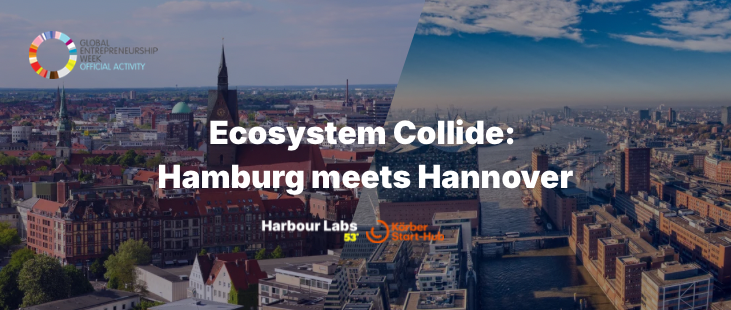
That is the moment Ecosystem Collide is built for. The event, a cooperation of Harbour Labs 53° and Körber Start-Hub, puts Hamburg and Hannover into one room and lets them look at each other. The question on the table is what the other side does that nobody here has seen.
The day gives that question room. Keynotes introduce both ecosystems, so the students hear Hamburg described from Hamburg and Hannover described from Hannover. A panel talk, Hamburg x Hannover, then puts both cities on one stage, where differences stop being abstract and start carrying names. Networking follows, and an exhibition of local initiatives gives the conversations something concrete to point at.
The stakes are modest and real. A founder who has seen one ecosystem builds inside its limits without knowing they are limits. A founder who has seen two can tell which of them are choices. A student who has spoken to a founder and a peer from the other city no longer starts from a list of names.
Ecosystems tend to look inward, and the people inside rarely need to explain their shorthand. For one day the guests travel, the hosts open the doors, and both sides say out loud how they work. That is where most of the learning happens.
By the evening the students will have seen a second ecosystem up close. The train back to Hannover carries the same students, and a second ecosystem they now know by name.