




Freetown, Sierra Leone | 16 November 2026
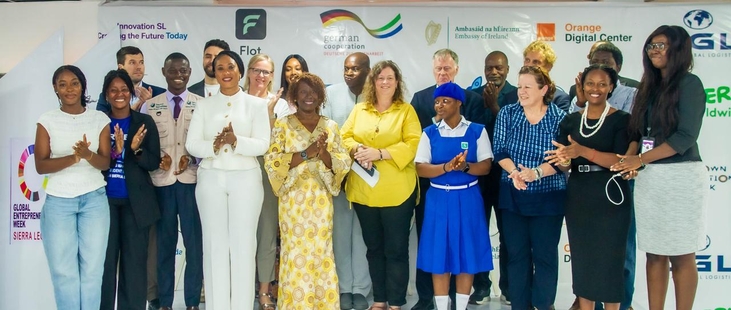
Global Entrepreneurship Week (GEW) 2026 officially opened in Sierra Leone on Monday, 16 November, bringing together entrepreneurs, investors, development partners, business support organisations, students and other key stakeholders at the Orange Digital Centre, Hill Station, Freetown.
Organised by Innovation SL, the opening ceremony was held under the global theme “The World Needs What You Build”, with a special focus on ESO Collaboration and the Entrepreneurship Ecosystem.
The opening brought together key actors within Sierra Leone's entrepreneurial landscape to explore how stronger partnerships, coordinated support systems, innovation, investment and practical business development services can contribute to a more inclusive and sustainable entrepreneurship ecosystem.
The programme featured welcome remarks, partner statements, a keynote address, an entrepreneurial spotlight and a high-level panel discussion examining the role of Entrepreneurship Support Organisations (ESOs) in strengthening the business environment.
Celebrating Entrepreneurship and the Power of Collaboration
The event commenced with registration and networking, providing participants with an opportunity to connect, exchange ideas and engage with other stakeholders across the entrepreneurship ecosystem.
The official programme was hosted by Tairatu Bah, who welcomed delegates and introduced the purpose and significance of GEW 2026.
Innovation SL subsequently unveiled the global theme, “The World Needs What You Build,” encouraging entrepreneurs and innovators to recognise their responsibility in identifying real-world challenges and developing solutions that create economic and social value.
In his welcome remarks, Mr. Francis Stevens George, CEO of Innovation SL, emphasised that entrepreneurship is essential to economic development and that building a thriving ecosystem requires collective responsibility.
He encouraged young people to move beyond waiting for employment opportunities and instead identify challenges within their communities, develop innovative solutions and create opportunities through entrepreneurship.
Drawing lessons from successful business examples across Africa and beyond, he highlighted the importance of understanding local problems, identifying customers and developing sustainable business models.
He also emphasised that entrepreneurs must be able to clearly communicate the problems they are solving, their target markets, business models and the value they create, particularly when seeking investment and business partnerships.
Recognising the changing nature of work and the growing influence of artificial intelligence, he encouraged young people to develop creativity, critical thinking, problem-solving and entrepreneurial skills to remain relevant in the evolving economy.
He further acknowledged the contributions of Innovation SL's partners and supporters, including GIZ, Africa Global Logistics (AGL), FLOT, the Embassy of Ireland and Orange Digital Centre.
Ireland's Experience: Building an Innovation and Entrepreneurship Ecosystem
A significant highlight of the opening ceremony was the address delivered by His Excellency Patrick McManus, Ambassador of Ireland, who shared insights into Ireland's experience in developing a competitive technology and entrepreneurship ecosystem.
His remarks explored the importance of strategic investment in education, research and development, infrastructure, skills development and partnerships between universities, research institutions and the private sector.
He explained how Ireland's approach to innovation has helped connect academic research with commercial opportunities, prepare graduates for industry and attract investment into emerging business sectors.
The Ambassador also highlighted the importance of STEM education in developing a skilled and innovative workforce, emphasising the need to introduce young people to science, technology, engineering and mathematics from an early age.
A particularly important part of the address focused on women's entrepreneurship. He highlighted barriers affecting women's participation in business, including limited access to finance, insufficient networking opportunities, limited technical expertise and the need for stronger female representation and mentorship.
Drawing attention to Ireland's initiatives supporting women in business, including the ACORNS Programme, Women in Business Networks and the Competitive Start-Up Fund, he demonstrated the importance of deliberate policies and support mechanisms in expanding women's economic participation.
The address offered valuable lessons for Sierra Leone, particularly around education, research, government policy, investment, institutional partnerships and inclusive entrepreneurship.
Strengthening Partnerships and Support for Entrepreneurs
Representing Orange Digital Centre, Madam Annie Wonnie-Katta delivered partner remarks highlighting the importance of collaboration and support systems in developing entrepreneurship.
Her contribution reinforced the role of partnerships in improving access to skills development, financial inclusion, markets and opportunities for young people and emerging businesses.
She also emphasised the importance of connecting entrepreneurs with the resources, networks and support structures required to transform ideas into viable businesses.
The partner contributions reinforced a central message of the opening ceremony: building a successful entrepreneurship ecosystem requires institutions and organisations to work together towards shared development objectives.
Official Opening of GEW 2026
The keynote address and official opening of Global Entrepreneurship Week 2026 were delivered by Prof. Mariam Conteh Morgan, Vice Chancellor of Limkokwing University.
Centred on the global theme, “The World Needs What You Build,” the keynote highlighted the importance of entrepreneurship, education and innovation in responding to societal and economic needs.
Her address formed a key part of the opening ceremony, marking the official commencement of GEW 2026 activities in Sierra Leone.
Entrepreneurship Spotlight: The Easy Solar Journey – From Idea to Scalability
One of the most engaging sessions of the day featured Alexander Tourre, Co-Founder of Easy Solar, who shared the company's entrepreneurial journey, from its early beginnings to its growth and expansion in Sierra Leone.
His presentation offered practical lessons on identifying market opportunities, understanding customer needs, developing sustainable business models, attracting investment and building resilient enterprises.
Alexander explained that Easy Solar's journey began in 2016 after the founding team won a pitch competition in Kigali, securing approximately US$5,000–US$10,000 to fund their initial trip to Sierra Leone.
The team's first objective was to understand the country's energy market and investigate the challenges faced by households without reliable electricity.
Through extensive research and household surveys, they identified a significant market opportunity in providing affordable access to solar energy.
Easy Solar subsequently developed a payment model that enabled customers to acquire solar systems through affordable instalments, including those without access to traditional banking services.
Key lessons from the Easy Solar journey
Alexander shared four important lessons for entrepreneurs:
- Fall in love with the problem you want to solve: Entrepreneurs must understand the challenges they are addressing and remain committed to developing meaningful solutions.
- Be clear about the role you want to play: Businesses should identify their strengths and concentrate on the areas where they can create the greatest value rather than attempting to do everything themselves.
- Ask for help: Mentorship, partnerships and professional relationships are important resources for navigating entrepreneurial challenges.
- Be mindful of your information diet: Entrepreneurs should continuously read, research and explore different perspectives to develop creativity and original ideas.
He also discussed challenges Easy Solar encountered, including access to funding, economic instability and balancing social impact with business sustainability.
The presentation demonstrated that successful entrepreneurship requires more than a promising idea. It requires market research, customer understanding, strategic partnerships, financial discipline, resilience and continuous learning.
ESO Panel Discussion: Rethinking Collaboration Within Sierra Leone's Entrepreneurship Ecosystem
The central discussion of Day 1 focused on the role of Entrepreneurship Support Organisations (ESOs) in strengthening the entrepreneurial ecosystem.
The panel brought together representatives from different organisations supporting entrepreneurs to examine existing gaps, institutional challenges and practical opportunities for improving collaboration.
Moderated by Mr. Chuks, the discussion explored the need for stronger coordination, evidence-based interventions, specialised business support services and sustainable models for entrepreneurship development.
Several important issues emerged during the conversation.
1. The need for evidence-based entrepreneurship support
Panellists highlighted the importance of strengthening local research institutions and ensuring that entrepreneurship programmes and policies are informed by reliable evidence.
Universities and research institutions were encouraged to work more closely with ESOs, government and private-sector organisations to support product development, testing and commercialisation.
2. Harmonising tools and improving ESO coordination
The discussion identified the lack of standardised business development tools as a challenge for entrepreneurs working with multiple support organisations.
Different pitch deck formats, assessment methods and business development approaches can create confusion, particularly for early-stage entrepreneurs.
Panellists recommended harmonising tools and strengthening coordination to ensure that entrepreneurs receive consistent and relevant support.
3. Supporting businesses at different stages of development
Another important issue was the tendency for ESOs to provide similar services to businesses regardless of their stage of development.
The discussion emphasised that early-stage startups, growing enterprises and established businesses have different needs and therefore require tailored support programmes.
4. Building an association for Entrepreneurship Support Organisations
The importance of establishing a stronger ESO association emerged as a key recommendation.
Such a platform could enable organisations to share resources, coordinate activities, develop common standards, engage development partners and collectively address challenges affecting the ecosystem.
Panellists stressed that collaboration should replace unnecessary competition for limited resources and opportunities.
5. Financial sustainability and accountability
The discussion also examined the financial sustainability of ESOs and their dependence on donor funding.
Participants highlighted the need for organisations to develop sustainable operating models, provide valuable services and remain focused on the actual needs of entrepreneurs rather than becoming overly driven by donor priorities.
The importance of improving financial management and business development skills among entrepreneurs was also emphasised to ensure that businesses can manage investment and funding responsibly.
6. Addressing barriers facing women entrepreneurs
Gender inclusion featured prominently in the conversation.
Panellists raised concerns about barriers affecting women's access to finance, including loan requirements and institutional practices that can disadvantage women entrepreneurs.
The discussion called for stronger advocacy, more inclusive financing mechanisms and deliberate interventions to ensure women have equal opportunities to establish and grow businesses.
7. Strengthening ecosystem data and government collaboration
The panel highlighted the shortage of reliable entrepreneurship ecosystem data and the challenges this creates for programme planning, policy development and measuring impact.
The need for clearer responsibilities between government institutions and ESOs was also discussed.
Panellists emphasised that government should focus on creating an enabling business environment while working collaboratively with existing ecosystem organisations rather than duplicating their functions.
8. Encouraging sector specialisation among ESOs
The final discussions highlighted the importance of developing specialised support services.
ESOs were encouraged to identify their areas of expertise and build stronger capabilities in particular sectors rather than attempting to provide every form of business support.
Sector specialisation was identified as an important step towards improving the quality, relevance and effectiveness of entrepreneurship support.
Key Outcomes and Recommendations from Day 1
The discussions throughout the opening day identified several priorities for strengthening Sierra Leone's entrepreneurship ecosystem:
- Establish and strengthen an association of Entrepreneurship Support Organisations.
- Develop harmonised tools and standards for business development support.
- Encourage sector specialisation among ESOs.
- Provide tailored support for businesses at different stages of development.
- Strengthen collaboration between universities, research institutions, government and the private sector.
- Improve financial management and investment-readiness skills among entrepreneurs.
- Strengthen data collection and evidence-based decision-making.
- Develop sustainable funding and operational models for ESOs.
- Clarify institutional responsibilities between government and entrepreneurship support organisations.
- Address systemic barriers affecting women entrepreneurs.
- Improve the wider business environment and infrastructure supporting enterprise development.
Moving Forward: Building an Ecosystem Through Collective Action
The official opening of Global Entrepreneurship Week 2026 provided an important platform for examining the opportunities and challenges within Sierra Leone's entrepreneurship ecosystem.
From the CEO's call for entrepreneurs to become problem-solvers, to Ireland's lessons on strategic investment and innovation, Alexander Tourre's practical insights from Easy Solar, and the ESO panel's recommendations on institutional collaboration, the day's discussions reinforced the importance of building a coordinated and supportive entrepreneurial environment.
A central message emerged: no single organisation can independently build a thriving entrepreneurship ecosystem.
Entrepreneurs, business support organisations, government institutions, universities, investors and development partners must work together to create opportunities, strengthen businesses and develop solutions that respond to the country's needs.
As GEW 2026 continues across Sierra Leone, the global theme “The World Needs What You Build” serves as a reminder that meaningful economic transformation begins with ideas, but requires collaboration, commitment and action to turn those ideas into lasting impact.
Global Entrepreneurship Week 2026 – Sierra Leone
16–19 November 2026
Organised by Innovation SL
Innovate. Collaborate. Thrive.