





From Skills to Enterprise: GEW 2026 Day 2 Challenges Sierra Leone's TVET Ecosystem to Turn Skills into Businesses
Freetown, Sierra Leone | 17 November 2026
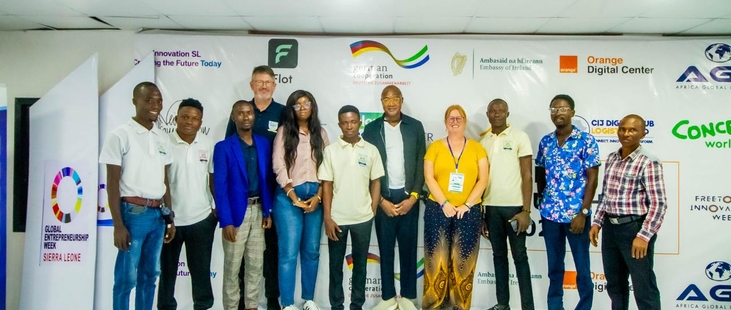
As Global Entrepreneurship Week (GEW) 2026 continued in Sierra Leone, Innovation SL brought together technical and vocational education institutions, development partners, entrepreneurs, educators and young people for a day of discussions and practical learning on transforming vocational skills into sustainable business opportunities.
Held at the Orange Digital Centre in Freetown on Tuesday, 17 November, Day 2 of GEW 2026 focused on “Building Entrepreneurs – From Skills to Enterprise: Vocational Skills & Entrepreneurship,” under the global theme, “The World Needs What You Build.”
The programme explored an important question facing Sierra Leone's workforce and entrepreneurial ecosystem: how can young people move beyond acquiring technical skills and turn their knowledge and abilities into viable businesses, sustainable livelihoods and employment opportunities?
The discussions highlighted the need to bridge the gap between vocational training, industry requirements and entrepreneurship, while strengthening collaboration among training institutions, employers, government and business support organisations.
Connecting Vocational Education with Economic Opportunities
Delivering the keynote address, Madam Edleen Elba, Chairperson of the National Council for Technical and Vocational Education (NCTVE), emphasised the importance of aligning technical and vocational education and training (TVET) with labour market demands and emerging economic opportunities.
She identified agriculture, mining, construction, manufacturing, fisheries, hospitality and tourism, and the automotive industry as sectors offering significant opportunities for employment and enterprise development.
She challenged vocational institutions to move beyond traditional approaches to training by integrating entrepreneurship, financial literacy, customer service, pricing and business management into their programmes.
According to her, technical competence alone is not sufficient to guarantee economic success. Graduates must also understand how to identify market opportunities, attract customers, manage finances and establish sustainable businesses.
She further called for stronger collaboration between training institutions and industry, encouraging employers to provide apprenticeship opportunities, entrepreneurs to mentor young people, and financial institutions and business support organisations to create clearer pathways for vocational graduates to establish formal businesses.
Her message was clear: vocational skills should be viewed as economic assets capable of creating employment, supporting financial independence and contributing to national development.
Stakeholders Call for Stronger Collaboration in the TVET Ecosystem
The keynote address was followed by a stakeholder panel discussion on “Addressing Skills Mismatch and Strengthening Industry Engagement,” moderated by Mr. Bashir Muhammad Idris of Limkokwing University.
The discussion brought together representatives from GIZ, YWCA, REAPS, Eastern Polytechnic, the College of Business and Maritime Studies, and the Chamber of Commerce.
Panelists examined the challenges affecting the TVET ecosystem, particularly the disconnect between what students learn in training institutions and the competencies employers require in the workplace.
Mr. René Pape of GIZ shared insights from Germany's dual vocational training model, where students combine classroom instruction with substantial practical experience within companies. He highlighted the value of exposing trainees to real working environments, where they develop not only technical competencies but also an understanding of customer expectations, business operations and workplace standards.
Other contributors highlighted challenges including limited practical training facilities, weak institutional coordination, insufficient industry placements and the need for improved career guidance.
The discussion also explored entrepreneurship as an important pathway for vocational graduates. Panelists stressed that skilled individuals must be equipped with business management, financial literacy, marketing and customer relations skills to operate independently and build sustainable enterprises.
Importantly, representatives of participating institutions outlined commitments to strengthen practical training, expand employer engagement, improve career orientation, support entrepreneurship education and advocate for policies that create a more enabling environment for vocational graduates.
The session reinforced the importance of treating TVET as more than a pathway to employment. It must also serve as a foundation for self-employment, innovation and enterprise creation.
Innovation SL Introduces Practical Approaches to Building Sustainable Enterprises
Moving from policy discussions to practical entrepreneurship development, Innovation SL's CEO and Founder, Mr. Francis Stevens-George, facilitated an interactive YAGBA Masterclass designed to help vocational students and graduates identify business opportunities within their existing skills.
The session challenged participants to rethink how they approach entrepreneurship, emphasising that successful businesses should begin with a clear understanding of the problems experienced by potential customers rather than simply developing products or services based on personal interests.
Through the YAGBA framework, participants explored how to identify customer challenges, understand the significance of those challenges, assess market opportunities and determine whether a proposed solution has the potential to become a sustainable business.
Using practical examples from tailoring, electrical installation, agriculture, fish farming, cake baking, coding and other vocational areas, Mr. Stevens-George encouraged participants to look beyond the obvious applications of their skills and identify opportunities in different sectors.
He also highlighted the importance of understanding customer needs, validating market demand, determining appropriate pricing and identifying the resources and partnerships required to establish a business.
A key part of the masterclass involved group exercises in which participants transformed their skills and observations into potential business concepts. They subsequently developed and presented short business pitches, applying the principles discussed during the session.
The presentations covered a wide range of ideas, including FemNet, a proposed digital professional network for women; Tasky, a platform connecting skilled service providers with customers; agricultural data solutions; CCTV installation services; community health screening; waste recycling; digital patient records; maritime safety training; and inclusive STEAM education.
The diversity of ideas demonstrated how existing vocational and professional competencies can be applied to address practical challenges within communities.
Following the presentations, the facilitator provided feedback on problem identification, customer segmentation, market validation and business sustainability. The Data Analysis team emerged as the first-place winner, while For We All and Inventors jointly secured second place. The College of Business and Maritime Studies (CBMS) placed third.
The exercise reinforced Innovation SL's approach to entrepreneurship development: helping individuals move from identifying a skill to understanding a problem, validating an opportunity and developing a viable business solution.
Entrepreneurship Education Takes Centre Stage
The day's programme also featured a TED-style presentation by Madam Blossom Onike Decker, Coordinator of the SLEEK Entrepreneurship Academy, Acting Head of the Department of Entrepreneurship and Marketing, and Programme Manager at IPAM.
Her presentation examined the role of entrepreneurship education in strengthening innovation, economic growth and Sierra Leone's entrepreneurial ecosystem.
She challenged the perception that entrepreneurship is exclusively an innate ability, emphasising that entrepreneurial thinking and competencies can be developed through structured education, practical learning and effective teaching methods.
Introducing the SLEEK Project – Sierra Leone Education in Entrepreneurial Pedagogy and Skills – she highlighted its work in strengthening entrepreneurship education through collaboration between four Sierra Leonean universities and two European partner universities.
The initiative is supporting the development of Entrepreneurship Academies, entrepreneurship teaching resources and training-of-trainers programmes to equip educators with practical approaches to teaching entrepreneurship.
Madam Decker emphasised that universities must prepare graduates not only to seek employment but also to identify opportunities, solve problems, establish businesses and create jobs.
The presentation was complemented by remarks from Madam Christina Vince of the SLEEK Consortium, who highlighted the importance of strengthening educators' capacity and extending entrepreneurship training beyond universities to TVET institutions, business incubators and non-governmental organisations.
Celebrating Institutions Driving Skills Development
Another important component of Day 2 was the TVET Institutions Showcase, which provided participating institutions with an opportunity to demonstrate their contributions to vocational training, professional development and enterprise creation.
Representatives from REAPS Vocational Institute, YWCA Vocational Institute, Freetown Polytechnic and the College of Business and Maritime Studies highlighted their respective training programmes, achievements and experiences in preparing young people for the world of work.
The presentations demonstrated the diversity of vocational opportunities available in Sierra Leone, spanning engineering, renewable energy, information technology, construction, agriculture, catering, fashion and creative arts, maritime studies and other professional fields.
REAPS Vocational Institute highlighted its longstanding contribution to skills development and shared examples of former trainees who have established businesses and created employment opportunities.
YWCA showcased its broad range of vocational programmes and its Student Entrepreneurship Scheme, which supports students facing financial challenges in undertaking practical training activities.
The participating institutions collectively highlighted the importance of strengthening practical learning, improving access to training resources and creating pathways through which graduates can apply their competencies in the marketplace.
The programme also featured a presentation by Mr. Barnabas Fornah, Founder of Elevate, who advocated for inclusive Science, Technology, Engineering, Arts and Mathematics (STEAM) education.
He emphasised the importance of equipping young people with creativity, critical thinking and practical problem-solving skills while ensuring that children and young people with disabilities are not excluded from educational and entrepreneurial opportunities.
Turning Skills into Opportunities for National Development
As Day 2 drew to a close, the central message remained consistent: acquiring a vocational skill is only the beginning. Its real value is realised when it is applied to solve problems, generate income, create employment and contribute to economic development.
The discussions highlighted the importance of stronger partnerships between vocational institutions, employers, development partners, government and the private sector in creating an ecosystem where young people can transition from training into meaningful economic opportunities.
For Innovation SL, the programme reflected the importance of practical entrepreneurship education, enterprise development and ecosystem collaboration in supporting individuals to transform their ideas and capabilities into sustainable ventures.
Through the YAGBA Masterclass, participants were encouraged to take a more deliberate approach to identifying problems and validating business opportunities, while the institutional showcases and stakeholder discussions reinforced the need for continued investment in skills development and industry engagement.
Day 2 of GEW 2026 concluded with renewed emphasis on building an entrepreneurial culture in which vocational skills are not simply certificates of achievement but foundations for innovation, enterprise creation and economic transformation.
As Global Entrepreneurship Week continued, attention turned to Day 3, “Dare 2 Aspire – Women in Entrepreneurship,” celebrating women's leadership, mentorship and contributions to Sierra Leone's entrepreneurial ecosystem.
Global Entrepreneurship Week 2026 – The World Needs What You Build.
Organised in Sierra Leone by Innovation SL, with the support of its partners and stakeholders.