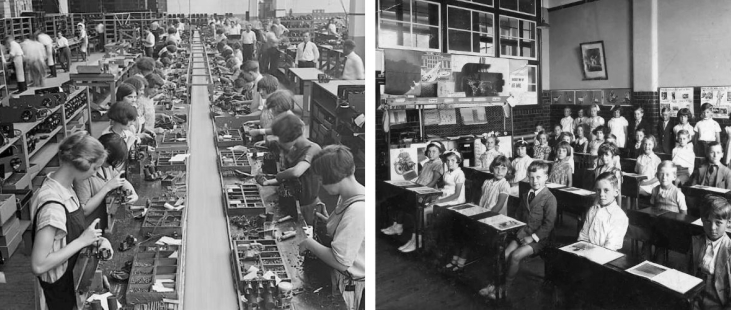



What do the two images above have in common?
Both are from the 1950s.
Each of them shows an industrial-era process of manufacturing. The one on the left is about building widgets. The one on the right is about building knowledge.
Fast forward to today, and the modern factory is highly automated, dominated by robots that allow humans to perform previously-unimagined tasks like writing software and sourcing materials from around the world. No modern manufacturer would ever consider building products using 1950’s-era technology and practices.
Yet the industrial-era model of young adult learning — one teacher, many students, rote instruction, repetitive processes — still looks the same as it did in the middle of the 1900’s. Despite huge leaps forward in learning science, neuroscience, technology-enabled learning, and human skills development, the traditional college experience is mired in a traditional learning process and a similarly-dated business model.
The impact on the student and society is profound. In the U.S. alone, student debt totals $1.7 trillion — about the size of the entire economy of Canada. In developing economies, parents often bear the entire weight of the cost of schooling, with few guarantees of their child’s future career success. Over 40% of U.S. students don’t finish college (yet the school invariably retains the money the student spent). Well over half of graduates don’t end up working in their field of study, and 40% of all graduates end up in jobs that don’t require a degree. Demographics are the enemy of traditional higher ed, with declining birth rates around the world and an aging workforce. And public confidence in American higher ed has dropped rapidly, to the point where a little more than half believe colleges have a positive effect on the country.
That comes at a challenging time for existing colleges. Already burdened by costly physical campuses, tenured faculty, and alumni-dependent fundraising strategies, many traditional higher education institutions forced to support remote learning during the pandemic found themselves having to justify charging high tuition for cookie-cutter learning experiences. Outdated curricula and degree-centric learning no longer function well either as a learning experience or as an arbiter of future success.
At the same time, the pace and spread of change are accelerating. The average “shelf life” of knowledge-based skills is five years, and significantly less in technical fields like programming. Automation is transforming jobs, with 1.7 million manufacturing jobs alone lost worldwide to robots since 2000. And the “skills mismatch” between worker abilities and job demands continues to grow, with over 10 million unfilled job listings in the U.S. in summer 2022.
A time traveler from the 1950’s would find modern life almost incomprehensible, transformed by automation and globalization. But if they walked into a college classroom, they would suddenly feel at home, because they would see practices that have changed little in seven decades.
Now, just as entrepreneurs played a foundational role in the industrial revolution, founders are paving the way for the future of education.
What if we designed higher education from scratch?
Entrepreneurs are asking this question, and are answering it with startup neouniversities.
Enter the “neouniversity”, also known as “NeoU.” NeoU’s start from a simple question: What would a young-adult learning launchpad look like if it was designed from scratch?
NeoU’s have five core characteristics that deeply differentiate them from traditional higher ed.
- Creation-based, not consumption-based
- Global and digital, not local and analog
- Portfolio-focused, not degree-focused
- Community-based learning, not individual learning
- Business model innovation, not pay-by-degree
Creation-based learning means that learners use project-based learning to solve problems and develop skills. Rather than organizing coursework around disciplines, learning is problem-centric — encouraging learners to solve real-world challenges — and intersectional, involving multiple disciplines at the same time. Learners never sit in a huge lecture hall or a mass Zoom call, but engage in small groups facilitated by learning guides and mentors. For example, rather than three separate coding courses like Statistics, Python Programming, and Data Visualization, a group of learners works together to deliver projects like “Designing a Sales Forecasting Dashboard.”
Global and digital means that technology tools are continually leveraged to allow learning from anywhere on the planet. This means that learners, experts, learning guides, and mentors can each be located in different geographies. And targeted in-person interaction occurs specifically to help build relationships and social cohesion.
Portfolio-focused learning provides the context and resources for learners to develop project portfolios that illustrate their ability to solve problems, both individually and collaboratively. The portfolio approach rapidly builds the confidence of young learners, and creates a body of work that serves as a showcase for future employers. And portfolio components can each support verification mechanisms like badges and stackable micro-credentials designed to add up to certifications for specific work opportunities.
Community-based learning ensures that learners develop “flex” skills like collaborating, communicating, leading, and empathy. Community learning models dramatically reduce learner isolation, increase engagement in the learning process, and prepare learners for future team-based work.
Business model innovation incentivizes the NeoU to develop creative revenue-generation approaches that distribute risk between learners and the institution. Instead of guaranteeing a college income through inflexible tuition models, NeoU’s continually innovate with a range of strategies, such as supporting a diverse learner’s ability to pay based on future employment outcomes, involving employers in funding learning opportunities, and using public-private partnerships to blend government, community, and business resources.
Disrupting a new generation of learners
The era of the neouniversity is just beginning. As it is often the case with major industry shifts, new institutions, run by entrepreneurs, are a major part of the shift.
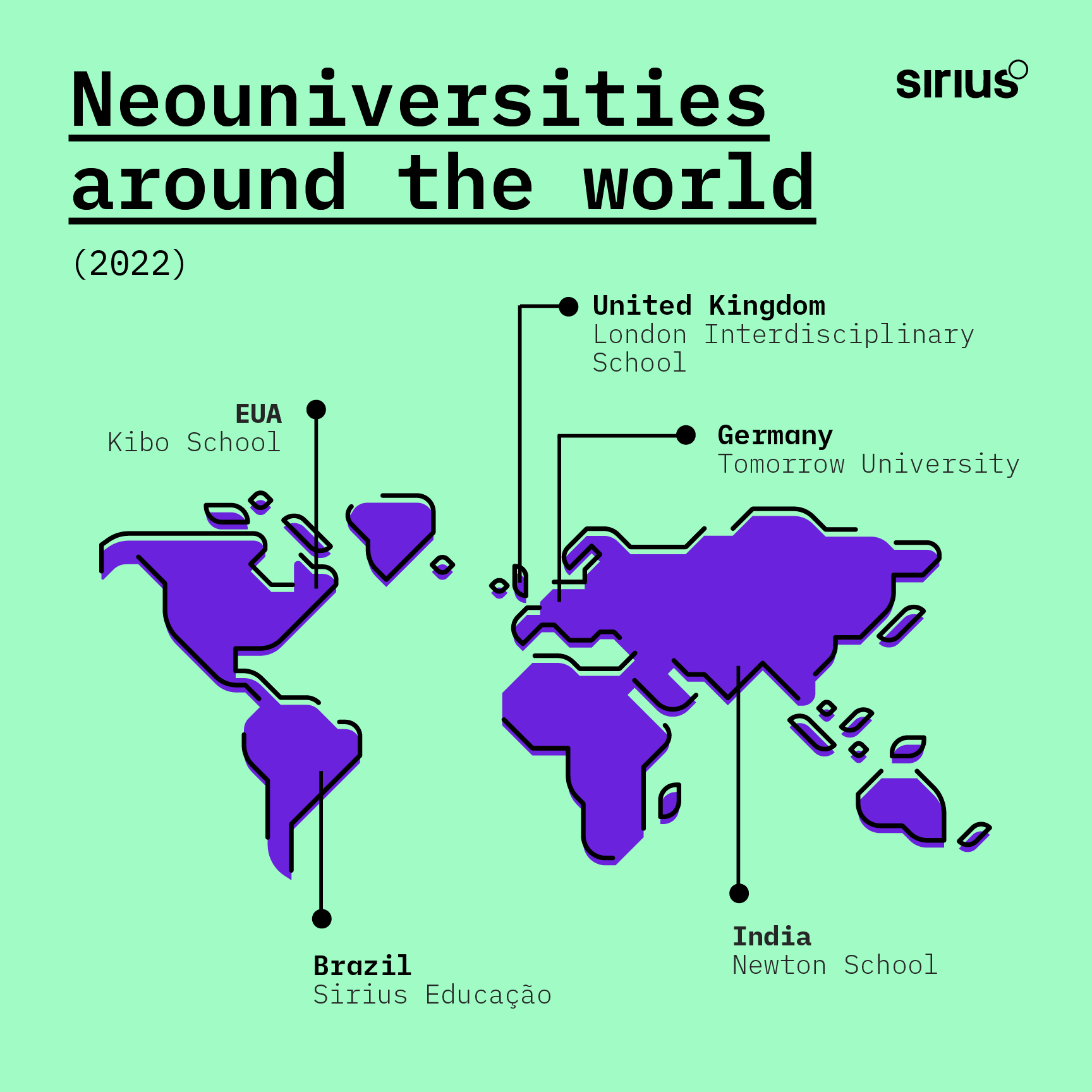
Source: Sirius Lab (2022)
In the case of our own Sirius Education, even though the first graduates completed training just this year, alumni have a 97% employment rate, working for employers such as Google, ABInbev, Danone, Heineken, Sebrae, and Payface. Sirius is the first neouniversity in Brazil, and the only one in the world focused on data science.
At the same time, incumbents increasingly implement characteristics associated with NeoU’s.
- While still a traditional tuition-charging and degree-granting institution, Western Governors University (WGU) in Colorado in the U.S. is a completely virtual provider with an impressive track record providing flexible learning paths for learners in all 50 states.
- Also degree-granting, but rapidly offering a broad range of flexible learning opportunities, is Southern New Hampshire University (SNHU). From a solely campus-based university to an increasingly virtual provider, SNHU already had a distributed faculty and student body before the pandemic.
Think of these innovative learning providers across landscape offerings that catalyze learner agency — helping learners to drive their own learning and work — and increase institutional flexibility, encouraging the nimbleness and agility of the provider to continually provide new approaches to spark a new generation of learners.
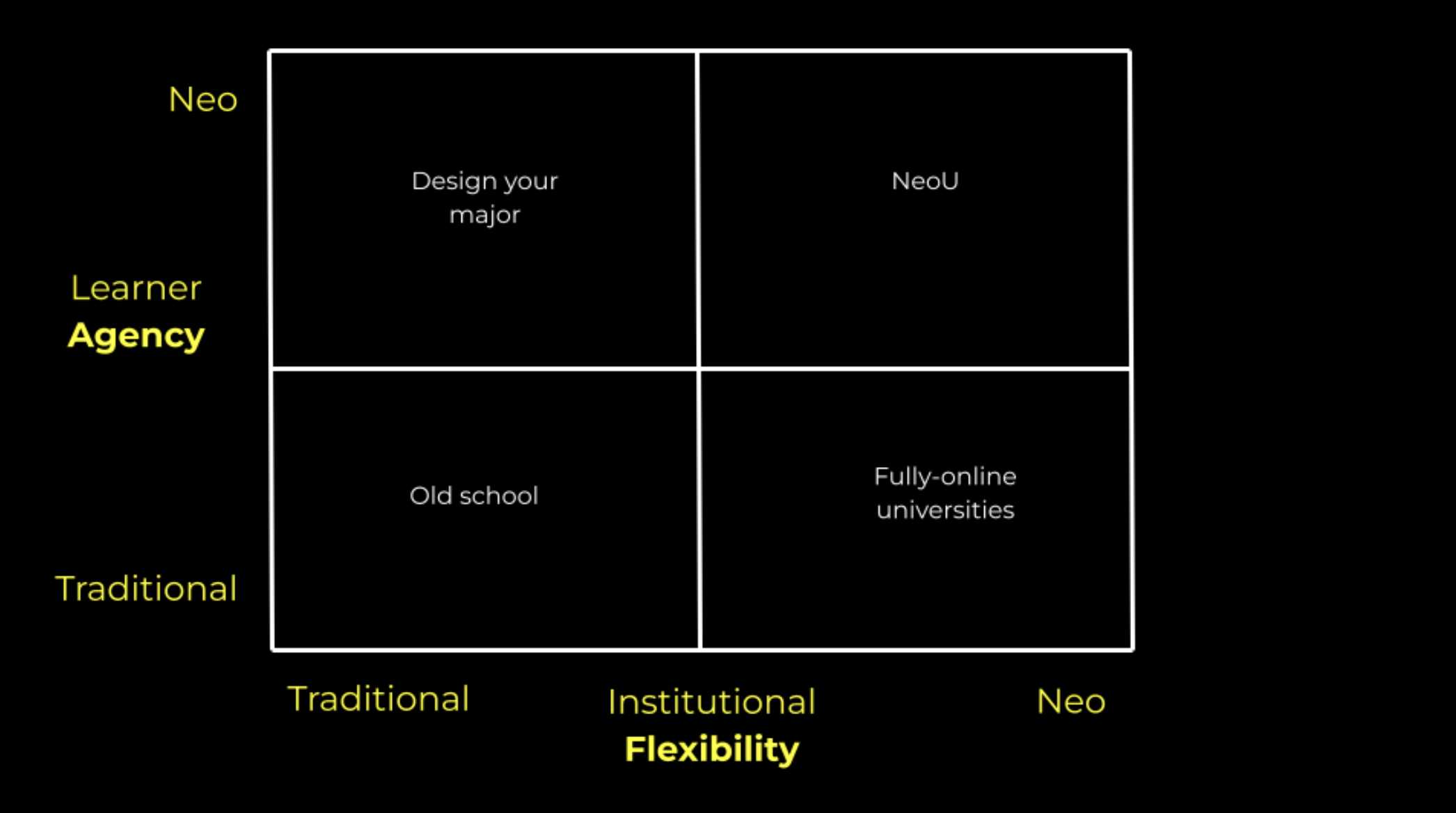
Will neouniversity startups disrupt higher education?
Despite some concerns that countries like the U.S. have reached “peak college” — enrollment will only to continue to erode — the Royal Melbourne Institute of Technology projects that about 250 million net new people will seek higher ed learning opportunities by 2035 — requiring the equivalent of a new UC Berkeley-sized university every day for the next 15 years. The only answer to this kind of demand will be the rapid launch and growth of NeoU’s around the globe. In other words, it will take entrepreneurs creating new institutions to meet the demand.
Of course, critical to the growth of the NeoU will be mechanisms that ensure quality and protect the interests of the learner. The traditional approach in many countries is the use of accrediting agencies, which often require colleges to freeze a curriculum to allow the accreditor time to assess their offerings. While this potentially protects the learner by attempting to ensure that a curriculum will actually deliver value, it also adds tremendous friction to the process of innovation in learning. In a world of exponential change, completely new models for quality control will be needed to encourage NeoU’s while ensuring consumer protections.
This shift toward the NeoU is inevitable. Just as the old models of hi-tech innovation — when large companies like AT&T and Xerox funded monolithic labs — were supplanted by an innovation ecosystem of nimble startups, the higher education landscape will inevitably be disrupted by smaller, nimbler innovators that can help learners to gain the skills the world will need to solve the problems of today and tomorrow.
--
Gary A. Bolles writes and lectures around the world on the future of work, learning, and the organization. He is the author of The Next Rules of Work, Chair for the Future of Work at Singularity University, and Partner at Charrette LLC. He has nine courses on LinkedIn with over 1.2 million learners.
Arnobio Morelix is the co-founder and CEO of Sirius Education, the first neouniversity in the world focused on data and decision science. He is the author of Rebooted, and serves as Senior Advisor for the Global Entrepreneurship Network.
