


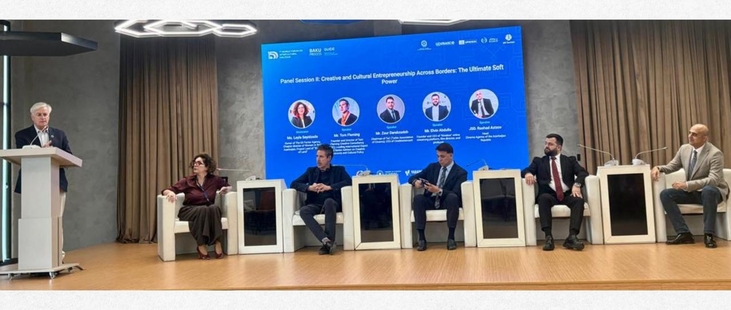


BAKU, Azerbaijan — As global diplomatic strategies evolve, creative and cultural entrepreneurship is rapidly stepping into the spotlight as a primary mechanism for international soft power. Speaking at GEC+Baku 2026, an official side event of the 7th World Forum on Intercultural Dialogue, policy leaders, cinema executives and streaming innovators outlined how cross-border business models are reshaping global influence.
The panel discussion, titled "Creative & Cultural Entrepreneurship Across Borders: The Ultimate Soft Power," examined the intersection of policy, regional cinema alliances and digital infrastructure.
Leyla Seyidzade, owner of The XX Factor Agency and moderator of the session, noted that soft power has transitioned from a theoretical diplomatic term into an active economic force driven by independent creators and business leaders.
"Culture is no longer just heritage to be preserved; it is a dynamic currency of global influence," Seyidzade said. "When creative entrepreneurs build scalable businesses across borders, soft power transitions from diplomatic theory into real economic and social impact."
Setting the international policy baseline, Tom Fleming, founder and director of U.K.-based Tom Fleming Creative Consultancy, emphasized that governments must adapt their creative economy frameworks to support agile micro-entrepreneurs.
"Soft power cannot be top-down or strictly government-mandated," Fleming said. "It requires nurturing micro-entrepreneurs, creative hubs, and digital innovators who can take local narratives and translate them into globally viable creative assets."
Addressing regional infrastructure, Zaur Darabzadeh, chairman of the Turkic Association of Cinema, highlighted how co-production agreements and shared distribution networks enable regional markets to compete on a global scale.
"No single national market in our region can compete globally in isolation," Darabzadeh said. "By aligning production standards, shared distribution channels, and co-funding mechanisms across the Turkic world and beyond, we transform regional stories into globally recognized soft power assets."
The digital media landscape was addressed by Elvin Abdulla, film director, producer and founder of streaming platform KINOBX. Abdulla emphasized that independent distribution channels are critical for local creators seeking direct access to international audiences.
"Distribution is where soft power meets scale," Abdulla said. "A great story stays dormant without modern tech infrastructure. Platforms like KINOBX ensure that local talent retains creative ownership while reaching global audiences directly without relying on traditional legacy systems."
Representing the public sector, Rashad Azizov, head of the Cinema Agency of the Republic of Azerbaijan, outlined how government bodies are shifting from passive regulatory institutions to proactive ecosystem facilitators.
"State support must act as a catalyst, not a constraint," Azizov said. "Our mission at the Cinema Agency is to create a frictionless environment through clear regulatory frameworks, tax incentives, and strategic funding so our creative entrepreneurs can project national identity onto the global stage."
The panelists agreed that expanding public-private partnerships, streamlining co-production regulations and investing in digital distribution infrastructure remain essential steps for emerging markets seeking to project cultural influence abroad.
Key Policy and Industry Focus Areas
- Policy and Infrastructure: Transition from traditional top-down cultural subsidies toward funding agile, entrepreneur-led creative hubs and micro-enterprises.
- Regional Alliances: Leverage cross-border co-production agreements to pool capital, upgrade production values and expand international market access.
- Digital Distribution: Utilize independent streaming infrastructure to democratize international content reach while preserving creator equity.
- State Governance: Modernize state cinema and cultural agencies to operate as regulatory enablers, tax incentive administrators and venture catalysts.