


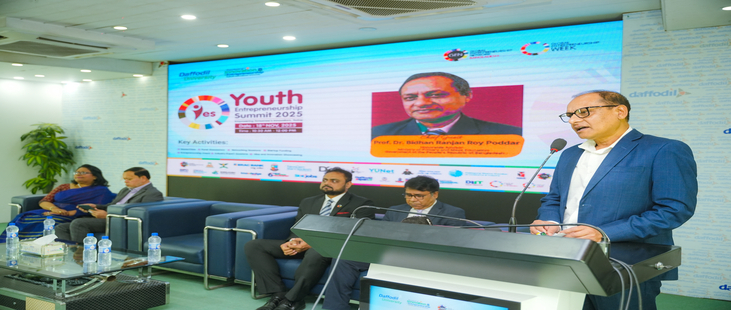



Dhaka, Bangladesh, November 18, 2025 – This week, as nations across the globe unite to celebrate Global Entrepreneurship Week (GEW), we at GEN Bangladesh were proud to inaugurate the national segment with the Youth Entrepreneurship Summit 2025. Held at the 71 Auditorium, Daffodil Plaza, and organized in partnership with Daffodil International University, the event was a vibrant testament to this year’s global theme, "Together We Build." Under the powerful local theme, "Empowering Tomorrow's Innovators, Today" we brought together young entrepreneurs, educators, and ecosystem leaders to chart a new course for innovation in Bangladesh. The summit was more than just an event; it was a cornerstone of a week-long celebration and a powerful statement of our national commitment to shifting from a job-seeking to a job-creating culture. We were honored to have a distinguished lineup of speakers, but the address from our Chief Guest, Professor Dr. Bidhan Ranjan Roy Podder, Honourable Adviser, Ministry of Primary and Mass Education, Government of the People's Republic of Bangladesh, offered a profound and foundational perspective that resonated deeply with our mission.
𝐀𝐧 𝐄𝐧𝐭𝐫𝐞𝐩𝐫𝐞𝐧𝐞𝐮𝐫𝐢𝐚𝐥 𝐌𝐢𝐧𝐝𝐬𝐞𝐭 𝐁𝐞𝐠𝐢𝐧𝐬 𝐚𝐭 𝐭𝐡𝐞 𝐑𝐨𝐨𝐭𝐬: Professor Dr. Poddar began by framing his perspective from his crucial role in shaping the nation’s primary education. "It has been said here, how can we nurture this mindset—the mindset of entrepreneurship—from the primary school level?" he asked, immediately grounding the conversation in the most fundamental stage of a child’s development. He pointed out that before we can dream of building high-flying entrepreneurs, we must first address the core challenge of primary education: literacy. "Literacy means that when a primary school student passes...they will be able to read fluently in their mother tongue, understand what they read, and express their thoughts in writing," he explained. He stressed that without mastering these fundamentals—along with basic numeracy—our children enter higher education unprepared, leading to high dropout rates and a qualitative gap in their skills. This is not a problem confined to urban centers. "When I speak," Dr. Poddar shared, "I don't just see a few good schools in the city... I see the schools in the remote areas of our hills, our haors, our char areas, and rural areas. I feel the responsibility to think about everyone." 𝐁𝐚𝐥𝐚𝐧𝐜𝐢𝐧𝐠 𝐈𝐧𝐝𝐢𝐯𝐢𝐝𝐮𝐚𝐥 𝐓𝐚𝐥𝐞𝐧𝐭 𝐰𝐢𝐭𝐡 𝐒𝐨𝐜𝐢𝐚𝐥 𝐆𝐨𝐨𝐝: Professor Dr. Poddar articulated that education has two interconnected objectives: to help a child’s latent potential flourish and to develop them into productive citizens. He warned against an education system that fosters an individual-centric mindset at the expense of societal well-being. "If we cannot fulfill these two things together," he cautioned, "we might get some very talented individuals, but we will not get a good society. Because there, their talent will be used for their personal gain—towards harming society, harming the state." This is where the true spirit of entrepreneurship comes in. It is not just about personal success but about creating value for society. 𝐂𝐫𝐞𝐚𝐭𝐢𝐯𝐢𝐭𝐲: 𝐓𝐡𝐞 𝐇𝐮𝐦𝐚𝐧 𝐄𝐥𝐞𝐦𝐞𝐧𝐭 𝐢𝐧 𝐚 𝐓𝐞𝐜𝐡𝐧𝐨𝐥𝐨𝐠𝐢𝐜𝐚𝐥 𝐖𝐨𝐫𝐥𝐝: While technology is rapidly augmenting our mental capacities, Professor Dr. Poddar reminded us of the one thing that remains uniquely human: creativity. "But within that whole context, one thing has remained unique, for which man is man—that is his creativity." He explained that primary education already incorporates co-curricular activities like sports, arts, and debates to nurture this creativity. When a child draws, sings, or dances, they are exercising the very skills that lead to innovation. The challenge, he argued, is to connect this creativity to practical, socially beneficial outcomes. "In the field of innovation," he stated, "there is always a mental dimension, which is its social utility. Whatever I am doing, whatever I am innovating, what is its social utility? Because without social utility, it cannot become a matter of successful entrepreneurship." This is the bridge between a classroom art project and a world-changing startup. It’s about teaching children to ask not just "What can I create?" but "What social need can my innovation serve?" 𝐀 𝐂𝐚𝐥𝐥 𝐟𝐨𝐫 𝐚 𝐒𝐮𝐩𝐩𝐨𝐫𝐭𝐢𝐯𝐞 𝐄𝐜𝐨𝐬𝐲𝐬𝐭𝐞𝐦 Finally, Professor Dr. Poddar acknowledged the systemic challenges that often stifle great ideas, echoing sentiments shared by our Chairman, Dr. Md. Sabur Khan. He candidly referred to the bureaucratic hurdles as "unpleasant truths" and a "failure of our state" that prevents our nation from reaching its full potential. But his message was ultimately one of hope. Looking out at the young faces in the audience, he concluded, "We hope that those of you who are sitting in front of me, the young people, you will overcome these issues. You will come into the future leadership of the state—not just as entrepreneurs. And you will build our state in such a way that we can become a friendly state for these entrepreneurs, and we can stand tall in the world." At GEN Bangladesh, we couldn't agree more. The journey of building an entrepreneurial nation begins with a single, powerful idea nurtured from childhood. Professor Dr. Poddar’s address was a crucial reminder that to empower tomorrow's innovators, we must start by strengthening their foundation today. Together, we can and we will build a brighter, more innovative future for Bangladesh.