






In today’s fast-paced world, the choice is clear: Evolve or be extinct. No company—regardless of size, industry, or geography—is immune to disruption. Internal R&D and traditional partnerships may have sufficed in the past, but they are no longer enough. Technologies now evolve at unprecedented speed and require in-depth expertise across a wide range of domains.
Innovation today comes from startups—fast, agile, focused, well-funded, and globally dispersed vessels of innovation.
This is why corporates must open themselves to collaboration with startups. This approach—known as Open Innovation—will be the focus of our upcoming Masterclass at the Global Entrepreneurship Congress (June 2–5, 2025), with a particular emphasis on mid-sized companies.
The Open Innovation Imperative: Do or do not. There is no try.
Open Innovation is now a cornerstone of corporate strategy. According to recent research [Economist Impact, 2022], 95% of corporations are adopting Open Innovation practices. This shift reflects the urgent need to remain agile and competitive in the face of rapid market changes.
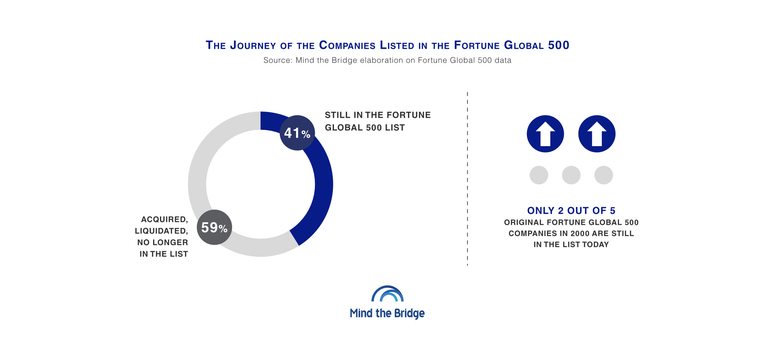
Large, established incumbents are particularly at risk. According to the latest analysis [Mind the Bridge, 2024], only 41% of the companies currently on the Fortune Global 500 were also there in 2000—a stark reminder of the consequences of failing to innovate.
But the real question is: how proficient are companies at Open Innovation?
Our research shows that only 42% of Fortune Global 500 companies take a holistic, multi-tool approach to Open Innovation. Interestingly, this percentage mirrors the proportion of companies that have remained on the index since 2000. While this correlation is not causation, it may be worth exploring further.
A Shifting Landscape: New tools, more complexity
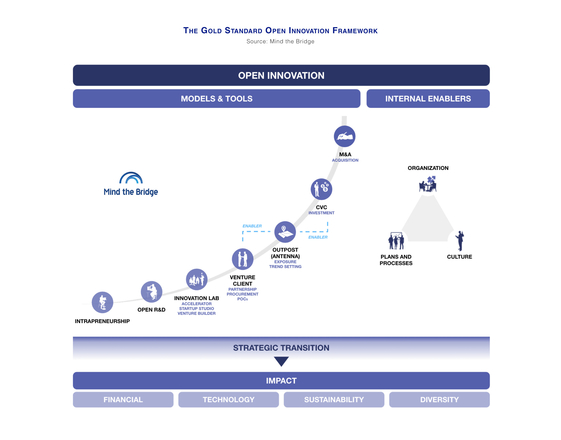
As Open Innovation evolves, so too do the tools. Venture Client models, Intrapreneurship, Corporate Venture Capital (CVC), and Innovation Antennas in global tech hubs are now standard. Meanwhile, Corporate Accelerators are declining, and Venture Builders are gaining traction—despite some early-stage setbacks.
Innovation models are becoming more hybrid and sophisticated. Mastering a multidimensional approach is critical to long-term success.
Source: Mind the Bridge, 2024
Mid-Sized Companies: No longer an excuse not to innovate
For mid-sized companies, limited resources are often cited as a barrier to startup engagement. But that’s no longer a valid excuse.
Open Innovation is the great equalizer. Even large corporations can no longer dominate innovation alone. Mid-sized firms can leverage their focus, agility, and ability to form strategic partnerships as competitive advantages.
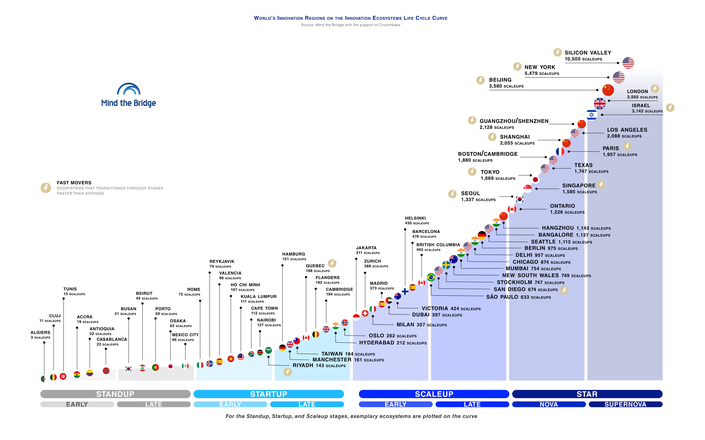
Startups can be the R&D department you don’t have to build. And new AI tools are making it easier and cheaper to identify relevant startups that unfortunately are not unlikely to be found nearby —being hugely concentrated in a few main hotspots (Silicon Valley and dozen other ecosystems in the globe [see data below from Mind the Bridge 2024]).
Open Innovation doesn’t have to be expensive, but it does need to be intentional, well-scoped, and supported by the right mindset and tools.
From Ideas to Execution: Make it real
At the Global Entrepreneurship Congress, companies will come together to explore practical strategies and real-world use cases. In a dedicated masterclass, we’ll take a hands-on approach to designing startup collaboration models that work at mid-size scale—identifying common pitfalls and how to avoid them, and learning from companies that have used Open Innovation to:
- Launch new products
- Enter new markets
- Transform Business Models
- Reduce Operating Costs and Time to Market
Final Thought: The question is no longer “if” but “how fast”
In today’s world, time is the only luxury we don’t have. The companies that win are those that act quickly, experiment boldly, and collaborate widely.
Evolve—or be extinct.