

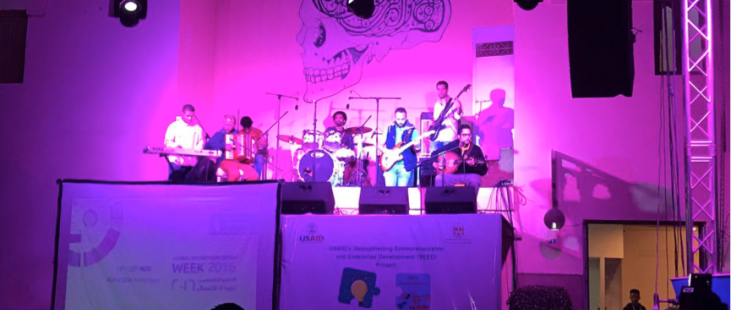



Global Entrepreneurship Week Egypt 2016 started on Monday, Nov. 14, with a lively opening ceremony at the cultural venue Darb 1718 in Old Town Cairo. It was an evening full of music and stories shared by entrepreneurs from different fields, giving everyone attending the opportunity to meet, connect and celebrate entrepreneurs.
GEW Egypt featured 162 events, workshops, conferences, training activities and celebrations in six cities and more than 70 event-partners this year – all brought together by the GEW host organization in Egypt, Middle East Council for Small Business and Entrepreneurship (MCSBE). The participating cities are Cairo, Alexandria, El Gouna, Elfayoum, Port Said and Aswan.
MCSBE is set up to inspire and empower university students and researchers to develop their ideas into successful companies. They focus on entrepreneurship as a practical discipline, exposing their participants to an extensive network of experienced entrepreneurs and professionals. MCSBE’s mission is to cultivate innovation as well as promote viable entrepreneurial businesses through their multi-sector platform.
The anchor event of GEW Egypt this year is the “Egypt Entrepreneurship Summit 2016,” which began on Nov. 16, and runs through Saturday, Nov. 19 at the Red Sea resort, El-Gouna. The conference is organized in partnership with organizations such as International Labour Organization, Ministry of International Cooperation of Egypt and Tatweer Misr, the main sponsor of GEW Egypt.
The conference started with a welcome speech by Ahmed Osman, GEW Egypt host and followed by opening remarks by HE Dr. Sahar Nasr, Minister of International Cooperation, along with Mr. Peter van Rooij, of the ILO Cairo Office, as well as North Africa DWT Director, and Mr. Troy Lulashnyk, the Ambassador of Canada to Egypt. I was also delighted to be present at the conference and give opening remarks on behalf of the Global Entrepreneurship Network.
On the first full day, Nov. 17, the conference delved into the changes that are affecting Egypt as a whole, such as the free floatation of the Egyptian Pound and Egypt leading the way in the implementation of United Nation’s new Sustainable Development Goals, as well as the technological disruptions such as artificial intelligence and their impact on the global entrepreneurial ecosystem and political development such as Brexit.
Other sessions focused on the role of entrepreneurial education, whether it is essential to fostering entrepreneurship, and the broader spectrum of entrepreneurship that encompasses arts, culture and media. Another session put innovation and creativity under the microscope, and examines the effects of unleashing innovation and creativity and whether they are predecessors of entrepreneurship.
On Friday, Nov. 18, the conference’s focus shifts to the future and towards a more action-oriented approach. Sessions focus on how to move forward, and examine the strategies, action items, and tools needed for Egypt to grow and prosper. The key questions are how to engage the young people of Egypt and what are the metrics for success. One session explores business incubators and how they might be utilized to cultivate new businesses, while another focuses on co-working spaces. Another session looks at the “Triple Bottom Line,” the intersection of social entrepreneurship, CSR and sustainable profits and asks provocative questions such as whether CSR is just a gimmick for companies and if social entrepreneurship can really make a difference.
On the third full day of the conference, No, the conference closes with three plenary sessions, each focusing on different themes. First one examines if “Small is still beautiful” in response to the increased demand for interventions supporting small and medium sized enterprises (SMEs) because of the widely held notion that they provide most of the jobs. International labour Organization (ILO) and the German Agency for International Cooperation (GIZ) present a new study that collected all the recent empirical evidence on the job creation effects of SMEs in developing countries. The key finding is that small is still beautiful because this enterprise segment creates most of the new jobs when compared to large enterprises.
The focus of the second plenary session is on Women and Entrepreneurship, one of the global themes of this year’s Global Entrepreneurship Week. A recent Kauffman study states that female entrepreneurs start companies with 50 percent less capital than male entrepreneurs, according to Access to Capital by High-Growth Women-Owned Businesses, research commissioned by the National Women’s Business Council (NWBC). Economists and academics agree women entrepreneurs are an under-tapped force that can resuscitate economic growth.
The Closing Plenary Session examines what is next for the future and the importance of entrepreneurship.
The city of Alexandria hosts another one of the largest events of GEW Egypt, Entrepreneurship Innovation Week (EIW). EIW is a one-week event (Nov. 13-20) organized by EDZone Co-Working Space and the U.S. Consulate General Alexandria in partnership with Arab Academy for Science, Technology & Maritime Transport. EIW features a competition for those entrepreneurs who want to start their entrepreneurship career in Alexandria, an exhibition and networking opportunities, a two-day conference with entrepreneurs sharing their entrepreneurial journey to inspire others and a four-day training course.
Organized by the Association for Women’s Total Advancement and Development (AWTAD), “EntrepLand” is another exciting event of GEW Egypt that takes place on 17 November in Cairo. AWTAD has identified the aspect of challenging oneself as one of the key drivers of success, and this event will challenge all participating entrepreneurs with a surprise simulation. The simulation game, EntrepLand has three key players, the government, the financial zone and the industrial zone. Fluctuations in the economy directly influence all the players in the market. However, these changes are influenced and controlled by the government. Finance is a very important part of starting and expanding a business. Even though, finance can be the key to growing your business it can also kill it; what kind of finance you opt for and when is crucial. Every industry has its supply chain and along the supply chain, there are the pioneers and dominators. Every entrepreneur needs to both innovate and execute at the same time, to ensure that his or her business remains on the right track.