



In the midst of what feels like an environmental crisis, 123Carbon is doing its part by pushing the maritime sector on a path to sustainability. Led by GEN Starters Club member and founder Jeroen van Heiningen, this Dutch company is pioneering the first independent blockchain-based carbon insetting platform for the transport sector.
123Carbon's partnership with Chevron on marine carbon insetting (don't worry, we'll explain) shows 123Carbon's ability to provide the world with innovative solutions for decarbonizing supply chains and bring these solutions to major players in the industry. By tokenizing the bunkering of biofuel for Chevron's ships in Singapore, 123Carbon is proving how to green an entire segment of the transport industry.
We sit with Jeroen van Heiningen to navigate the depths of this venture and its impact on global transportation.
Pauly Suchy: As you may know, all of our people at GEN are celebrating Global Entrepreneurship Week this month. I'd say that you celebrated better than anybody with your recent win at the Captain's Table. Tell us a bit about how you got involved with this competition and what it means for your startup.
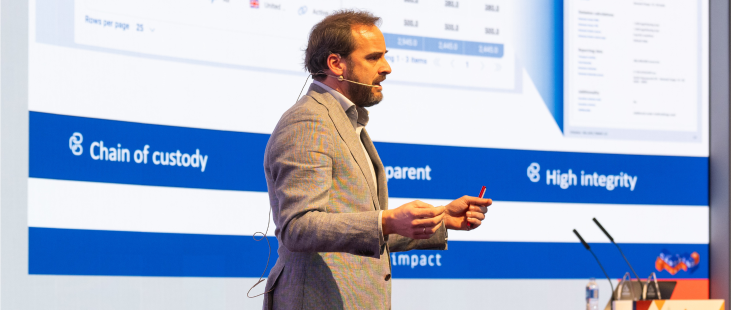
Jeroen van Heiningen: We celebrated alright. We had a great week with all six finalists and the organizing committee, Young Professionals in Shipping Network (YPSN) from Hong Kong. The Captain’s Table is a globally renowned pitching competition specifically focused on marine innovations and therefore has a very knowledgeable audience. It is part of the Honk Kong Maritime Week, a leading APAC Marine conference. Given our traction in the marine industry, one of our APAC contacts informed us about the competition and introduced us to the YPSN-team earlier this year.
We entered this competition to create awareness for carbon insetting in APAC and to investigate whether this could be an interesting market for us, as this currently is predominantly an European tool. With over 200 people in the audience and 2,000 people watching online on Splash and Youtube, we absolutely succeeded to create awareness. I specifically ordered new business cards for this event, but I don’t think I have any left.
Suchy: Could you walk us through the genesis of 123Carbon and its mission in the transport sector?
van Heiningen: 123Carbon is an impact company with a mission to accelerate the decarbonization of transportation by allowing fuel providers and carriers to share the carbon reductions and the costs with their supply chain partners. We provide an independent platform based on in-depth industry and insetting knowledge that is specifically designed as a one-stop shop to support companies in executing their insetting strategy.
Pauly: Your recent pilot with Chevron in Singapore is a significant milestone. What were the key outcomes of this initiative, and how will it shape 123Carbon's trajectory?
van Heiningen: Our pilot with Chevron demonstrated that we can successfully bring insetting to the APAC market. Obviously, being able to do a pilot with such a market leader allows us to build trust in the market for our innovative solution and creates great exposure. On top of that, Chevron also explicitly mentioned us in the 2023 Climate Change Resilience Report.
Suchy: 123Carbon's approach is unique, leveraging blockchain for carbon insetting. Can you explain how this technology is necessary to your platform and the advantages it offers over traditional methods?
van Heiningen: I would not say that blockchain technology is imperative in what we do, but there are sound reasons why we use it. First of all, our insets are basically immutable digital certificates that can be allocated to relevant actors in the transportation supply chain. We publish a hash-key of this certificate on the blockchain, allowing us to prove that the certificate has not changed, while ensuring confidentiality for the users. However, if potentially we will receive data from multiple sources, there could be an additional rationale to use blockchain.
Suchy: Carbon insetting is a new concept for many. Could you define it for us and elaborate on how it benefits fuel providers, carriers, and ultimately the environment?
van Heiningen: Basically carbon insetting is a carbon accounting methodology based on a so-called “Book and Claim”” system that allows fuel providers or carriers to separate the environmental benefits from the fuel or the transport service and “book” these in a separate registry. Subsequently, these benefits can be allocated to specific customers or even to the broader market, who can “claim” these benefits in their annual reports. This allows fuel providers and carriers with a very flexible and scalable solution to recover their decarbonization costs and drive the energy transition.
Suchy: Partnering with AllChiefs, Verifavia and Bureau Veritas offers 123Carbon external assurance and implementation services. How do these partnerships enhance the credibility and scalability of your insetting programs?
van Heiningen: First of all, we wanted to make sure that every inset that we generate, is externally verified by a professional party. Hence our collaboration with Verifavia and Bureau Veritas. Secondly, we need to make sure as a young company that we had the capacity to scale our solution and onboard customers. AllChiefs is a consultancy firm with a specialism in sustainable transportation and strong knowledge on how to implement insetting. It was instantly clear they could support our customers in onboarding our platform.
Suchy: Looking towards the future, how do you foresee carbon insetting evolving, and what role will 123Carbon play in the broader journey to net-zero within transportation?
van Heiningen: As carriers are faced with increasingly higher costs for decarbonization, these costs need to be recovered in the downstream supply chain. This can either be done by increasing prices for all customers, which can compromise your competitive position or by allowing companies to sell the environmental benefits to those companies that are willing to pay more (meaning that other customers will have to pay less) and claim these benefits. We are convinced that the latter model leads to a better customer proposition and an higher adoption of low carbon solutions.
Suchy: How does the collaboration with organizations like the Smart Freight Centre and its Book & Claim methodology underpin the effectiveness of your carbon insetting initiatives?
Heiningen: As a independent platform, we do not make the rules for insetting. These rules are made by NGO’s like Smart Freight Centre after an extensive stakeholder dialogue and in alignment with carbon reporting initiative like GHG protocol and Science Based Target Initiative (SBTi). The better Smart Freight Centre is in defining clear policies, the better we can build our platform to service the market. Though multiple insetting frameworks exist, are a strong advocate of Smart Freight Centre, due to its multi-modal approach and therefor its relevance to the entire transportation market.
To learn more about 123Carbon, visit www.123carbon.com.