


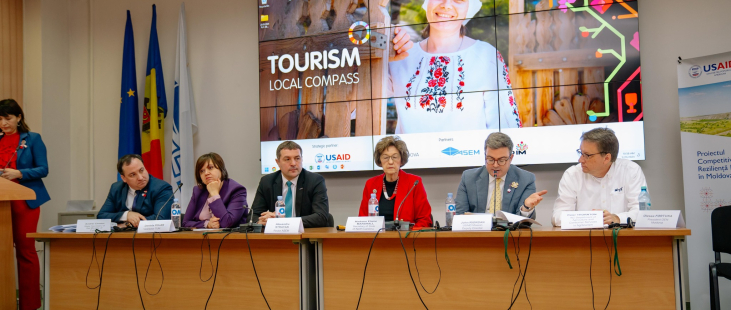


The development of tourism in the Republic of Moldova is a priority for both the academic and associative sectors and international donors. An opportunity for this sector can be the cooperation between actors, the identification of development opportunities, and the sharing of experiences. At the same time, eliminating regional and gender disparities will help to launch new entrepreneurs, involve more people in the growth of tourism at home, and reduce economic inequality between Moldova's regions.
These ideas were identified at the conference "Local Compass in Tourism: Resilience and Innovation," held on 20 March at the Moldovan Academy of Economic Studies. The event brought together representatives from academia (students and professors), practitioners from the regions, guests of honor from the official delegation from North Carolina that visited Moldova, including Mrs. Elaine Marshall, Secretary of State in North Carolina, representatives of local and central authorities, donors and local associations.
In his welcome speech, Alexandru Stratan, Provost of the Academy of Economic Studies of Moldova, mentioned that one of the main priorities ASEM focuses on, as a significant area of interest, is Tourism and Leisure Services. "This event is an excellent fit for strengthening knowledge in the field. I am glad that we are together and can call ourselves friends because, thanks to this friendship, we have reached 25 years of cooperation in the Republic of Moldova - North Carolina. Our country has benefited a lot as a result. Please, Madam Secretary of State, convey our warmest thoughts to the American people and express our openness to further cooperation through ASEM as an institution that trains future tourism specialists for local economic development," said Mr. Stratan.
For her part, North Carolina Secretary of State Elaine Marshall praised the role of entrepreneurs in rural areas, highlighting the disparities they face, the challenges entrepreneurs face, and the solutions the North Carolina Secretary of State's Office offers.
"I understand the ups and downs an entrepreneur goes through because I used to be an entrepreneur. In particular, I understand the dilemma of women entrepreneurs... I am the first girl in my family to graduate from college/university... When I first moved to North Carolina, I earned a degree in textiles and opened a decorating business. I was also a teacher. I taught fashion design and tailoring at Community College... I needed a loan to purchase fabric for the winter holiday season in my decorating business. I had an appointment at the bank to take out the loan, where I was asked where my husband was and asked to come in the next day. The next day, I came with him; the bank officer only spoke to my husband, who was not in the business and did not know the difference between fabrics. I didn't say anything; I was furious, but I understood I needed this credit to help me develop my creativity, entrepreneurship, communication, and business skills. I was very dissatisfied that day, but I got the money, and my business was successful. This is one of my experiences," the Secretary of State told the event.
The official also spoke from the farmers' point of view. "We have seen the disparities between the opportunities for urban and rural regions. I know how to feel disadvantaged because of this. And I know how to feel disadvantaged because of gender inequality when women were treated differently than men. It's one of the reasons why, in 2021, the North Carolina Secretary of State's Office created the Rural RISE - Resources, Innovation Startups, and Entrepreneurs - program.
To start, we surveyed young entrepreneurs with one to three years of experience and asked them about their needs and what information they would like to find in their region. From this survey, we created Rural RISE communication, a communication platform, not a service provider. When the entrepreneur launches the business, they send the presentation. They are directed to the offices that can offer a loan, the locations where they can get help with the business plan before they hit the road, and the offices where they can ask questions. All of these resources are available at the North Carolina government level or can be provided by NGOs for no or a minimal fee," said Elaine Marshall.
"The signing of the memorandum underlines a fact that has not and will not change in our relationship: Partnership is not about a document or a piece of paper; it's about people, people-to-people diplomacy, people-to-people understanding, empathy when you know other people's plight and can put a face to problems. It is about connections and synergies developed for a better future", the Secretary of State in North Carolina concluded.
Similarly, Mr. John Riordan, Deputy Director of USAID, spoke about his family's experience in discovering tourism in the Republic of Moldova. "I am happy to be here and celebrate tourism in the Republic of Moldova and its growth. I have been with my family throughout the country and experienced the hospitality that tourism brings and its effects on rural communities. We are strengthening rural resilience in the Republic of Moldova through the project," said Mr. Riordan.
Andrei Chistol, Secretary of State, Ministry of Culture, also discussed the role of culture in promoting tourism and national identity. "A few days ago, at the event that GEN Moldova organized with the local authorities in Stefan Voda, we discussed their problems. There and here, we are also focusing on developing the Tourism Agenda better. We will be able to evolve a new tourism stage in the Republic of Moldova because the potential is there," Chistol said.
Daniela Pojar, vice-rector of the Technical University of Moldova, spoke about the potential of developing tourism education and taking over the American experience. "The growth of the economic sector, especially tourism, depends on the education system. TUM is implementing a project funded by the US Embassy, the "Exchange Speaker Program," in partnership with North Carolina State University, TUM, involving other US universities and similar institutions in Cahul and Balti. The objective is to modernize the curriculum and align it with the best practices we saw during the November 2023 visit to North Carolina State University. This involves adjusting the curriculum to study agriculture, especially the interdisciplinary module, and implementing the education and research concept," Pojar said.
Mr. Peter Thornton, North Carolina Department of Agriculture, recounted the experience of implementing a new strategic plan that aligns with modern realities. "The development steps are identifying direction and establishing roles. Because some people have 30 years of experience and their tasks were current but no longer relevant, there have been discussions with people to get us all aligned in a straight line and all going as a team where they will all find themselves in the same direction," Thornton said.
Jose Cisneros, Director of International Programs at CALS (College of Agriculture and Life Sciences), discussed entrepreneurship's inspiring and challenging aspects and the potential for growth and success in the Republic of Moldova. "In business, the joy is in adapting, improving, and capitalizing on new opportunities as the journey continues. However, the harsh reality is that success can elude you even if you have all the knowledge and do meticulous planning. Other times, despite all your mistakes, victory can still be yours.
Moldova is a fast-developing country, and we often meet people who complain that not everything is working and that there are no opportunities. If something is missing, if there are gaps, it brings opportunity. If you go to the United States, where everything is done, identifying opportunities takes time and effort. If you want to create something, you have to compete with big business. There are many opportunities to identify a need and start something here," said Jose Cisneros.
Diana Lazar, from the USAID-funded RCRA project, spoke about friends of tourism who are true patriots. "It is necessary to love your country, people, locality, and little place at home. We are in a global context, and the tourism industry is global. We are connected with the whole world. In addition to this facility to connect the whole world, tourism must be subject to a sustainability approach. When we start a business, especially in tourism, the conscious approach is to be sustainable by using resources and the environment while leaving room for future generations," said Diana Lazar.
From the global context, we moved to the local one with Olga Luchian, President of the District Council of Stefan Voda, who invited partnerships to create the Tourism Hub in Stefan Voda. "The tourist potential in the locality is great; we want to create a hub that would compile all the opportunities and present them to the tourists who will come to us. It is an idea that will provide local and regional development opportunities," said Olga Luchian.
The cluster and the opportunities it brings for the tourism ecosystem explained Ludmila Ursatiev from the Ungheni West County Tourism Cluster. "The aim is to intersect the interests of all stakeholders in the ecosystem to help promote Ungheni as a tourist attraction. We have gone through two stages of development, forming and updating the strategy and objectives we have for the coming years in 2022. An important brick was the inspirational visit to North Carolina as part of the Open World program. Some seeds sparked interest and we are looking for opportunities to implement. The digitization of tourism services, thanks to the support of the Ministry of Culture, has reduced our burden of finding our own sources of promotion on the international platform," said Ludmila Ursatiev.
"It is important to develop connections in the tourism industry by focusing on the need for collaboration and partnerships between different stakeholders to maximize the potential of tourism as a catalyst for economic growth and cultural exchange. ANTRIM seeks to be a spokesperson for the sector. The institution was instrumental in organizing the first open space opera festival in Europe, which is DescOpera, and launched several awareness campaigns: "Be our guest", "Moldova is waiting for you at Christmas," "Give peace," etc. A nice project at its fifth edition, offering grants in the tourism sector and there is interest, over 150 applications", said Nicolai Olarasu, ANTRIM Lobby & Advocacy Consultant.
"For Moldova's regions to thrive, it is important to consider improving the interconnected aspects of local economic growth, such as tourism, agriculture, gastronomy, and crafts. These interlinkages can be tailored to meet the specific needs and interests of the local community. Fostering a strong relationship between academia, extension services, and workforce development will enable the expansion of local economic progress. The inclusive approach lays the fundamental foundation for sustainable development", summarized GEN Moldova President Olesea Fortuna.
The event is organized by GEN Moldova, the Academy of Economic Studies, the USAID-funded Competitiveness and Rural Resilience Project, and ANTRIM and takes place in the framework of the local events of the Delegation on Agriculture, Tourism and Irrigation Systems, which comes with the signing of the agreement between the countries to strengthen relations in the framework of this North Carolina, USA-Republic of Moldova Bilateral Partnership.