

Day three of the Global Entrepreneurship Congress followed up on yesterday’s focus on entrepreneurs during the Start + Scale Forum with a look at data and government involvement with the Research + Policy Summit.
Jonathan Ortmans, chair of the Global Entrepreneurship Congress, opened the day’s sessions by discussing the changing role of government in the global entrepreneurship ecosystem. Policymakers are now sitting at the table with entrepreneurs, accelerators, and researchers and are welcoming people from startup communities into their ranks.
Since the establishment of Startup Nations, a group of startup-savvy policy advisors, examining how policy and entrepreneurship interact has been an important part of the Global Entrepreneurship Network. Enrique Jacob, president of INADEM, spoke to the crowd about the impact of Mexico’s growing entrepreneurship and invited anyone interested in sharing lessons learnt on a country level, collaborating to create better public policies to aid the next generation of entrepreneurs to attend this year’s Startup Nations Summit in Monterrey, Mexico during Global Entrepreneurship Week in November.
As the Research + Policy Summit continued throughout the day, numerous startup champions from around the world shared insight.
- Ambassador John Phillips reminded everyone that immigrants are important players in the entrepreneurship realm. The United States has entrepreneurship in its DNA and immigrants are twice as likely to start a company.
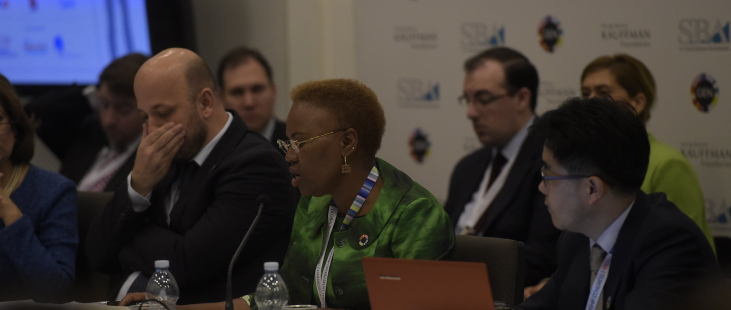
- Maria Contreras-Sweet, administrator of the US Small Business Association reminded everyone that Rome wasn’t built in a day, and thriving entrepreneurial ecosystems won’t be either. People are realizing that entrepreneurship affords incredible opportunities to change the world for the better. She invited everyone to work together to change attitudes and join the movement. She also teased the location of this year’s Global Entrepreneurship Summit, hinting that it will be held in Sub-Saharan Africa.
- Administrator Contreras-Sweet was followed by Brett Bruen, director of global engagement at the White House, who spoke of the US government’s new initiative: Spark. A universal statement and symbol that captures what it means to be an entrepreneurs, the program is looking for ways to spark new ideas and capture conditions in which entrepreneurship thrives. He invited everyone to join the conversation online using #startthespark because the White House wants everyone’s ideas from around the world to align efforts to grow entrepreneurship around the world.
- Stefano Firpo, chief of the Italian Minister of Economic Development’s Technical Secretariat presented Law 221/2012 Italy’s Startup Act, discussing various elements of it including the incentives it creates for investment and the startup visa.
- Usman Ahmed, policy counsel for eBay, offered his audience case studies to demonstrate the impact of the Internet, reminding everyone that someone can be a global entrepreneur while still contributing to their local ecosystem.
- Felipe Hoffa, developer advocate for Google Cloud, spoke about how policymakers can make data more accessible and shared how Google came to be what it is.
- Rasmus Wiinstedt Tscherning, chairman of the European Creative Industries Alliance, spoke about the policy recommendations that the ECIA pulled together to support creative industries in Europe. These included stimulating innovation by enabling cross-sectoral collaboration and building better business support in effective regional ecosystems.
- Karen Wilson from Bruegel expressed concerns about the buzz word "ecosystem" which many times is used to describe any random collection of elements in an entrepreneurship community rather than a set of key dynamics.
- To that point, Dane Stangler, vice president of research and policy at the Kauffman Foundation, explained that most of the people you meet at the GEC are representing places that are not their actual city of origin, which tells us that mobility and people flux are key characteristics of entrepreneurship ecosystems that should be tracked. Stangler released a new report timed with the gathering of ecosystems in Milan. Copies are available online or at the Kauffman booth of the GEC Ideaspace. This report is part of Kauffman efforts to go past headliner "data"of the vibrancy of any given ecosystem ecosystem.
- EJ Reedy, director of research and policy at the Kauffman Foundation provided more insights into the logic behind this shift from national level data to local data, such as that of co-panelist Danny Holtschke from Compass.
Following yesterday’s announcement of Johannesburg as the host city for GEC 2017, Minister Lindiwe Zulu met with 50 delegates from around African this morning to talk about the opportunities that the event will bring to the continent and the potential for collaboration over the next few years.
Later in the day, Africa was on everyone’s mind again during “Building Cohesive Ecosystems for Africa” presented by Lions@frica. Thomas Debass, deputy special representative for global partnerships at the US Department of State, reminded everyone “we are in the business of building entrepreneurial ecosystems, not ego-systems.” Speakers from organizations such as VC4Africa, DEMO Africa, the Young Gabonese Entrepreneurs Association and more discussed facets of their ongoing goal of creating healthy and cohesive entrepreneurial ecosystems throughout Africa.
Alicia Robb, senior fellow of the Kauffman Foundation moderated “Moving the needle on high-growth women’s entrepreneurship,” which examined the startup world’s gender diversity problem. Ruta Aidis, senior fellow at George Mason University presented the Women’s Entrepreneurship Research Forum, citing the importance of having a central location to find data on female entrepreneurship. Rebeca Hwang, cofounder of Rivet Ventures, highlighted the huge potential that female consumers represent because male entrepreneurs don’t set out to solve their problems. The presentations were followed by a lively question and answer session that covered the confidence gap, pitching expectations and the importance of changing the mindset.
The Congress continues tomorrow with the Global Business Angels Summit.