




As I trek around our country this week, attending events and meeting entrepreneurs I’m going to attempt to pen some quick roundup blogs reflecting key themes from this week. (This comes with the humble caveat that I agreed to this idea under duress from colleagues and I might not have taken a realistic review of my event schedule for the week.)
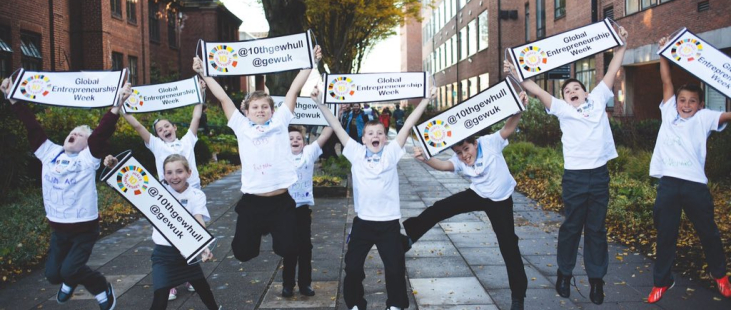
On Monday morning we kicked off GEW campaign with a national launch event in The City of Hull. For #GEW2017 we brought together 17 student groups, introducing them 17 local businesses for a high impact working session that marked the start of a real collaborative project.
We chose Hull as the location for our national launch for a couple of reasons. Not least in recognition of the City's blockbuster year. Not only is Hull the UK City of Culture for 2017, but it was also named as the most enterprising place in the UK in 2017 - so what better place to kick off the campaign?
Quite deliberately, for this event, there was no media list of enterprise editors, no government ministers and no unicorn entrepreneurs on the agenda. All the speakers were chosen to support the narrative of the event and add something to the kids’ understanding of the project. In many ways, it was the perfect GEW event.
Predictably the choice to launch GEW somewhere other than a plush Central London location was met with confusion and derision in some corners. In conversations with journalists, I was met with dire warnings that if you are not holding your launch in London, and working overtime to bring in the usual suspects as speakers, you are essentially wasting your time.
In the past, the choice of locations for headline GEW events was driven in a large part by the need to pick a venue that would make it as easy as possible to attract a high profile keynote speaker or minister something I always found counter-intuitive. I have found the time my team and I spend chasing high profile guests a to be a frustrating experience and a poor allocation of resources within a campaign that exists to empower all the various layers in our national entrepreneurship ecosystem.
Role models and their stories are important and should be celebrated, obviously, but in the last few years, we have seen something of a backlash against the ‘usual suspects’ filling out the same panel discussions, asking the same questions of the same old moderators and giving the same answers to the same formulaic questions.
Because when the demand for high profile speakers outstrips numbers of entrepreneurs of the right calibre, and we see no change in the default event style we quickly bump up against a level of startup event fatigue.
Everybody loves to hear inspiring stories of runaway entrepreneurial successes and to bask in the reflected glory of unicorn startups but the reality is that these stories are of limited value to 99% of the people GEW is trying to reach.
In many ways, this situation is a function of the democratisation of entrepreneurship and success of campaigns like GEW, Startup Britain and others.
In 2005, when we kicked off the first UK Enterprise Week campaign, the world of entrepreneurship was almost unrecognisable. We were just on the cusp of the explosion in what we now know as startup culture.
More than a decade later entrepreneurship has moved from a niche pursuit dominated by young men in the tech and software business, to become a key part of our collective consciousness, economic destiny and popular culture. Entrepreneurs are rockstars, startups are sexy. This transformation has been hugely positive in helping people to see entrepreneurial potential in their own lives. However, this new diversity in startup culture has not been always been matched by an increased diversity among role models and the ambassadors who we hold up to inspire the next generation.
Exceptional stories of startups that reach scale are fun to read about but in the real day to day reality of starting a business in the United Kingdom, these examples are of limited use.
Just today I’ve spoken with half a dozen active entrepreneurs in a range of fields beyond tech, who, in previous years, used GEW to launch real businesses that are now thriving.
They didn't start these businesses, because they heard the incredible startup stories of Google, Apple and Facebook. They used GEW to meet cofounders, mentors and investors who have been instrumental in helping their businesses start and grow. That is what GEW is about. These connections are not catalysed by hours spent on the phone securing Ministerial attendance, nor are they driven by journalists rushing to get into another glittering keynote.
We believe collaboration is the new innovation and that GEW has a role to play. The UK needs more entrepreneurs and GEW has a huge part to play in shaping this debate
That is why we were so happy to break with tradition and launch GEW at an event that was proudly free of journalists and government ministers and had no interest in gaining column inches. Our 2017 launch had a laser focus on sowing the seed of entrepreneurship as a real career option. For me, and the wider GEW community, impact and outcomes are the real payoff/
The ultimate aim of Global Entrepreneurship Week is to encourage more people to become active entrepreneurs, and event like our launch in Hull are incredibly effective in making that happen. Not to say that we don’t like those glitzy high profile events with inspiring speakers - GEW has a wealth of those. At the end of the day GEW exists to create new entrepreneurs and equally importantly to increase entrepreneurship in less entrepreneurial areas. This what GEW Hull and our hundreds of amazing partners are doing.
THAT’S why this year we’re using the spotlight provicded by GEW 2017 to launch GENUK and our new grassroots platform, with the ambition of aimed a connecting every single element of the uK ecosystem together for the first time. But more on that tomorrow...