


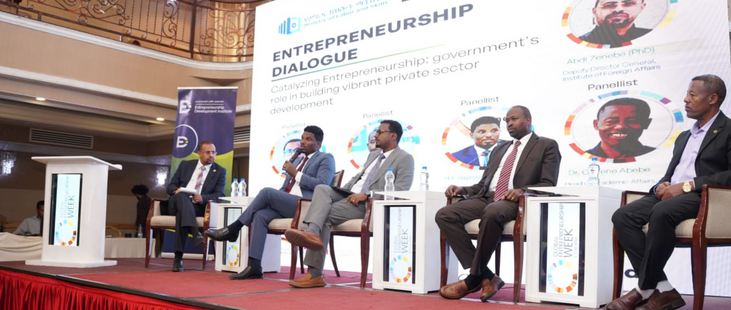
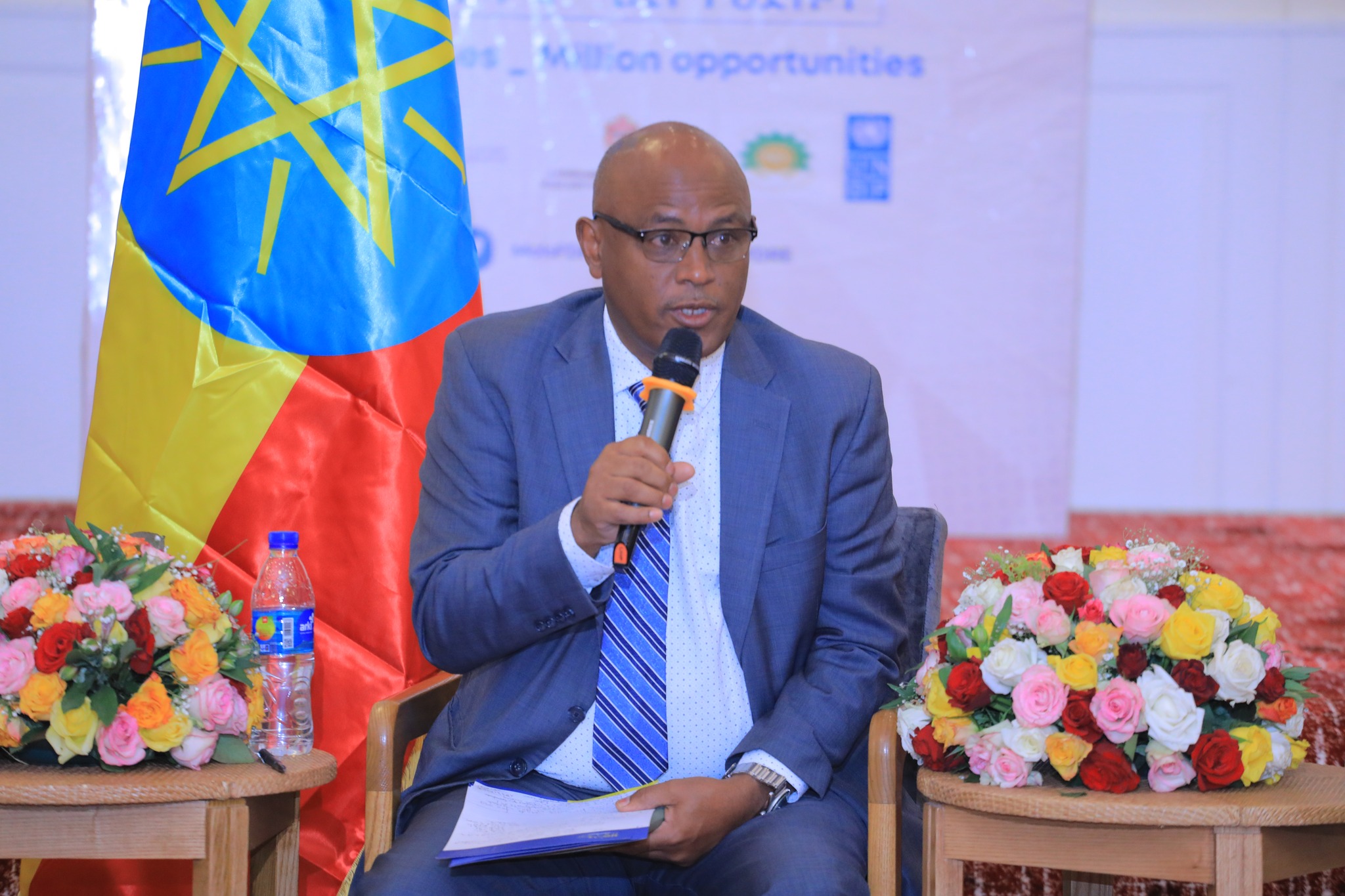


Celebrated under the global theme “Together We Build!”, the Global Entrepreneurship Week event brought together State Ministers from the Ministries of Innovation and Technology, Labor and Skills, and Planning and Development, along with leaders from the Entrepreneurship Development Institute (EDI), officials from the Technical and Vocational sector, entrepreneurs, and a wide range of ecosystem partners.
During the discussion, H.E Dr. Bayisa Bedada, State Minister of Innovation and Technology, highlighted the government’s multifaceted efforts to create an enabling environment for entrepreneurship. These efforts include legal and regulatory reforms, foundational capacity-building, and strategic investments in human capital. He explained that Ethiopia is putting in place a system capable of transforming ideas into wealth. The rapid expansion of the digital sector, he noted, has addressed long-standing bottlenecks and unlocked new opportunities that accelerate national development and fuel economic growth. Dr. Bayisa emphasized that Ethiopia possesses vast untapped potential, and with a supportive environment now taking shape, citizens are increasingly able to leverage their skills and knowledge to generate wealth and unlock new possibilities.
He added that wealth creation is increasingly driven by innovators, and that recent advancements—such as improvements in technological capacity, foundational reforms, and the enactment of the Startup Act—are attracting a growing number of investors to Ethiopia’s entrepreneurial ecosystem.
H.E Mr. Solomon Soka, State Minister of Labor and Skills, underscored the essential role of entrepreneurship in driving national progress and generating solutions to societal challenges. He highlighted the Ministry’s ongoing work to cultivate brilliant minds and creative problem-solvers who can help lift Ethiopia out of poverty and backwardness. He stressed that building an entrepreneurial nation cannot be achieved by government alone; it requires the collective effort of citizens, institutions, and all ecosystem stakeholders.
Ato Solomon also noted that Ethiopia is steadily building an entrepreneurial government. The Ministry of Labor and Skills and its affiliated institution, the Entrepreneurship Development Institute, play a central role in expanding entrepreneurial culture and strengthening the enabling environment across institutions. Their establishment and continued growth, he said, demonstrate the government’s strong commitment to entrepreneurship development. He further explained that the Ministry is leveraging entrepreneurship as a transformative tool and has begun integrating entrepreneurial thinking across its agencies and Technical and Vocational Training Colleges. He also highlighted the launch of a Public Sector Innovation Lab, designed to deepen the culture of innovation, conduct research on systemic challenges, and support the development of effective operational solutions.
Overall, he noted that Ethiopia’s ongoing efforts to cultivate an entrepreneurial culture are gaining international attention and, most importantly, contributing to the emergence of a new generation of entrepreneurs capable of driving the country toward sustainable prosperity.
Adding to this, H.E. Mr. Bereket Tesfatsion, State Minister at the Ministry of Planning and Development, emphasized that entrepreneurship is firmly embedded within the government’s Homegrown Economic Reform Agenda, recognizing it as a cornerstone for achieving structural transformation, inclusive growth, and long-term competitiveness in Ethiopia. He noted that the government’s planning frameworks increasingly prioritize private-sector development as a driver of job creation, innovation, and productivity.
H.E Mr. Bereket highlighted that entrepreneurship is not viewed as an isolated activity but as a strategic pillar woven into national development plans, medium-term economic strategies, and sectoral priorities. He explained that the Ministry has taken deliberate steps to ensure that policies, regulations, and institutional mechanisms are designed to stimulate entrepreneurial activity, reduce barriers to entry, and ease constraints faced by startups, MSMEs, and innovators.
He further noted that government structures are now better aligned to provide coordinated, coherent, and forward-looking support for entrepreneurship. This includes harmonizing planning efforts across ministries, strengthening inter-agency collaboration, and ensuring that development programs incorporate entrepreneurial pathways for youth, women, and rural populations.
H.E Mr. Bereket concluded by affirming that building a vibrant private sector is central to Ethiopia’s journey toward a modern, inclusive, and globally competitive economy. He reaffirmed the Ministry’s commitment to working hand-in-hand with other government bodies, the Entrepreneurship Development Institute, private-sector actors, and development partners to ensure that entrepreneurship continues to serve as a catalyst for national transformation.