


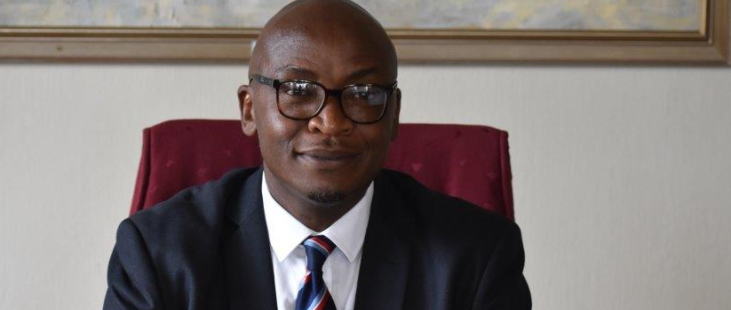


Alfeus Benjamin hails from Tsumeb where he grew up with his parents and 5 siblings. His mother worked as a domestic help for a German family while his father, a self-taught mechanic, was employed by Metje & Ziegler repairing trucks.
He went to school at Opawa Primary School and later Otjikoto Secondary School, where he matriculated with exemption. He obtained a teaching Diploma and a B.A degree in English and History at ‘The Academy” (now NUST). After he graduated he got at teaching position at his Alma Mater, Otjikoto Secondary School. As a firm believer in the principle of life-long learning Alfeus never gave up studying and obtained post-graduate qualifications from the University of South Africa, University of Orange Free State, NIPAM and the African Leadership Institute.
There were a lot of challenges in teaching. There was no curriculum, guidelines, textbooks or internet. It was the eve of Namibia’s independence, the time the education system was migrating to English as the medium of instruction for all Government schools. As a proud English Major fresh from university, he steam rolled this obstacle by developing and implementing his own program of studies. He worked his way around the grammatical structure teaching, putting ingenuity at work as inspired by his former lecturers such as Harlech Jones, Dr. Haarhoff and the late Professor Annemarie Heywood. He was also inspired by West African writers and shared their ideas and novels in his language classes. One such piece of inspiration was Chinua Achebe's “Things Fall Apart” 1958, a story about African society told from an African point of view detailing the colonization of the Igbo. It is thus that he was able to develop a comprehensive ‘syllabus’ comprising of grammar, literature and research. The outcome was a tremendous improvement in performance results for the English language at Otjikoto Secondary School.
Before long, Alfeus was appointed as hostel superintendent and Head of Department for Social Sciences. Managing over 700 learners and other hostel occupants was not an easy position, but he carried it out admirably. When he got married and welcomed his first child, he moved out of the hostel.
Alfeus knew he did not want to be a classroom teacher for life. He wanted to study further for a master's degree in education, but his interest in teachers’ politics at NANTU drew him in and his focus changed and he pursued social sciences instead.
After 2 years as HOD at Otjikoto, he dared to be bold and applied for a teaching position at Afrikaans Medium Skool, a ‘whites only’ school and a relic from the colonial era. The community was dead set against this move and the school flat out rejected his application. They finally gave him a token interview after the Regional Education Director intervened on his behalf before they again declined his application. This did not come as a surprise. What he did not expect was the total lack of support from his community, discouragement and criticism at his audacity for wanting to teach whites.
Alfeus later applied for and got a school principal position at Afrikaans Medium School, a primary school for Afrikaans speaking children in the community.
The road to this position was plagued with negativity from his community. He was again criticized, provoked and discouraged from attending the interview. A black man heading a ‘white school’ in 1996 was unheard of in a Namibia still transitioning. But he was egged on by what his late father had taught him: to aim for greatness. “Not what is better for me, but what is better for the world.” from Die Nuwe Skoolhoof | Alfeus Benjamin.
His decision to accept the position was inspired by a quote from Kwame Nkrumah, “Revolutions are brought about by men, by men who think as men of action and act as men of thought.” This appointment turned out to be only a symbolic response to the call for ‘change, and inclusivity’. The whites were determined to preserve their superiority over blacks, but this never deterred Alfeus. He transformed the school by leading his team to disprove the narrative about blacks and whites performance in the education sector as leaders. Like Otjikoto Secondary School, the performance of the school flourished under Alfeus’ leadership and it was consequently upgraded to a junior secondary school.
Alfeus was now known as the ‘culture creator’ and was later appointed Deputy Director in the Ministry of Education’s Ondangwa office.
After nine months, Alfeus was appointed CEO of Tsumeb Town Council where he was instrumental in laying the foundations that transformed Tsumeb from a copper ghost town to its current fully functioning municipal status.
The key to Alfeus’ success is his attitude towards challenges. He adopts the philosophy of ‘not to break down, but to find out what is working, build on it and change what is necessary to change.’
In 2018 Alfeus Benjamin was appointed CEO of Swakopmund municipality. This appointment process was harder than any he has ever gone through before. The adjudication process was long, stringent, traumatic and taxing. He became a walking skeleton under the pressure of unfamiliar experiences such as national security screening and negative community prejudices. It was a matter of perceptions, i.e. a CEO of a small town to a CEO of Swakopmund – failure expectancy was high. The community was scared that the status of a neat and tidy tourist town would be degraded by an incompetent management. There was intense negative energy around his application appointment process, which took nine months to finalise.
The experience reminded him of the adversities he faced with his first interview and appointment at Etosha Secondary School and again at Afrikaans Medium Skool. He thought back to the difficult time he lived through when he was appointed as the Chairperson of the Principals' Association. His resolve strengthened and he knew that he would emerge from this stronger than ever.
When he took office people were apprehensive, looking for failure and division. There were high expectations of potential political influences to destabilize the city’s growth and a generally unhappy inhabitant community. He drew strength from inside of himself, past experiences and many life lessons he’d learned. An old man at Ohangwena Education Region once said: “The boy has become a man.” He had to once again become a man for his new town. His internal self-efficiency boosted his confidence in his abilities and gave him clarity of the future of the city of Swakopmund.
His first self-assigned task on the job was to carry out an assessment of internal and external environment and formulate the town’s long term vision.
When he started the processes, the first strategy he deployed was to bring in all stakeholders and solicit their buy in into the strategic development of the City of Swakopmund. With a contingent of 370 staff behind him, planning, evaluations and reviews were done until all agreed on an acceptable infrastructural development plan. This culminated in the following pillars for infrastructural development:
Housing – to review existing plans that were never executed and make the plots available to potential homeowners.
Tourism – to ensure that the tourism business community flourished.
Events – to host more events than ever before and bring Swakopmund’s events calendar on par with its population.
Cultural Tourism – to bring to life diverse cultural exposure so that underprivileged community members benefit from the implemented strategy.
Health Tourism – to keep the momentum of Swakopmund as a recuperating destination that was boosted by actress Angelina Jolie by making the information about health retreats available, accessible and visible.
Tertiary Education – to invite tertiary educational institutions establish campuses in Sakopmund.
Urban Agriculture – To teach the community how to build and maintain backyard gardens in a desert city.
Smart City collaborations – to cultivate interactions with other cities nationally and globally to learn from them and partner on projects.
Optic Fibre Cables – to extend optic fibre cables and collaborate with network service providers such as Telecom, Paratus, MTC, Demshi.
Connectivity Towers – to encourage service providers such as Powercom, MTC and Demshi Holdings to increase the volume of connectivity towers to improve coverage in Swakopmund.
The plans were implemented and municipality engaged the community annually to brief them on the progress.
All the above are ongoing activities and the team leader is positive about achieving all the set goals. Of note is the successful implementation of the urban agriculture initiative, which is the signature project of Swakopmund Municipality in collaboration with UNDP (United Nations Development Program). Of the tertiary institutions that were invited to branch out to Swkopmund, the following have responded positively:
International University of Management (IUM) to build a research station and put emphasis on agriculture in the desert.
Welwitschia University to focus on health care and entrepreneurship.
Maritime University to offer marine training at the coast.
Alfeus Benjamin has a very effective leadership style. He adopts the participatory method of management which he executes with complete control and finesse, and leads by example. As stated earlier, Alfeus’ tenure at Swakopmund got off on a bumpy start, fraught with uncertainties and distrust. Today the citizens of Swakopmund are delighted to have him as their CEO and leader of their town. Because of Alfeus Benjamin’s exemplary leadership and the dedication of his staff, Swakopmund is the proud holder of the position of No.1 cleanest city in Namibia and holds the No. 2 position on the continent.
Alfeus is best described as a changemaker and implementer par excellence. He deserves to be inducted into the Namibian Business Hall of Fame for his ingenuity, business ethics, contribution to the economy of the country and his commitment to community upliftment.
Alfeus Benjamin is a family man, married to Hermien Benjamin, a school principal at Namib Primary School and is a father of four boys.
CITY OF SWAKOPMUND’S VISION & MISSION
Vision
To be a leading Smart City providing excellent services to all.
Mission
We provide safe, efficient, reliable, affordable services and infrastructure to all.
Values:
Integrity – We are people with justice ,fairness , honesty and accountability
Diversity& Inclusiveness – We are people who accept different backgrounds, cultures and have respect for different views.
Innovation – We are people with the ability to adapt to change, be pro-active and look for better ways of doing things