

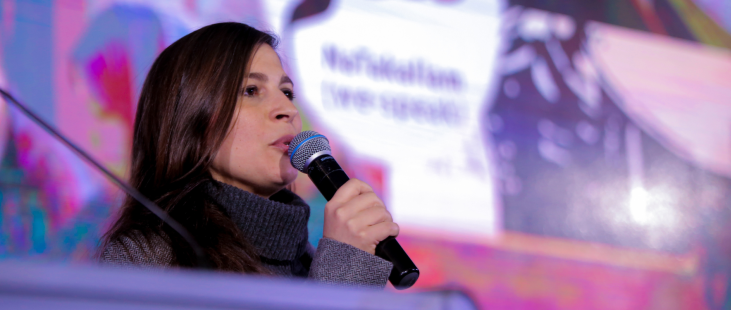



Seven years ago, Aline Sara, a former researcher and journalist, was inspired to launch NaTakallam — a language learning, translation, and cultural exchange enterprise powered by refugee talent and their host communities.
The company, named after the Arabic word “we speak”, has since attracted international attention, provided over USD 1.7 million to refugees and host communities, and connected over 12,000 students with more than 200 refugee workers for language training and cultural exchange opportunities.
Sara is among 20 impressive tech founders awarded funding through the AccelerateHER Fund, a grant program sponsored by Tiger Global and administered through GEN’s Small Business Grants Program in partnership with Hello Alice. The program provides up to $50,000 to women entrepreneurs building breakthrough technologies or tech-enabled companies.
GEN spoke with Sara on how growing up in New York — isolated from the conflict her family faced in Lebanon during a sectarian war — influenced her entrepreneurial journey, as well as her company's pursuit to increase aid for those living within conflict and climate catastrophes.
*This interview has been edited for length and readability.
GEN: Tell us about you. Why did you become an entrepreneur? What is the origin story of your business?
Aline Sara: I grew up in New York because of the civil war taking place in my homeland, Lebanon. Every morning, my father would drive my brothers and I to school and share his stories of working with the Red Cross, tending to the medical needs of his countrymen, children, women and terrorists alike. The dichotomy of watching my cousins living in violence and me living in the United States struck me.
Later, as a Beirut-based journalist, I was aware of Syrian refugees' plight: millions, waiting in idle and in harsh conditions, cut off from the labor market. Meanwhile, living in NYC, I was looking for an affordable way to practice my conversational Arabic. I had the idea of hiring refugees as online conversation partners through the digital economy. My pilot coincided with the photo of Syrian refugee Aylan Kurdi going viral on social media. People awoke to the severity of the refugee crisis, and NaTakallam was met with organic success and sign-ups and has continued to grow over the last seven years.
GEN: Tell me about NaTakallam. What need does it address?
Aline Sara: Regardless of where you are and regardless of your formal work status, we leverage the freelance digital economy to prioritize refugees, individuals in conflict zones and those affected by conflict. NaTakallam provides displaced persons and their host community members with access to work opportunities. They are hired to teach their own language, provide translation, and share their stories. We also provide interpretation and cultural exchange services. Everything we do is related to language and culture.
GEN: Can you share a notable anecdote or success story that illustrates the company’s impact?
Aline Sara: Yes. We had a student learning Arabic with one of our Syrian tutors. The tutor had been living undocumented and in hiding for four years in Lebanon. He was also blacklisted by Lebanese authorities. If they caught him, they would incarcerate him indefinitely or send him back to Syria, where the Syrian authorities knew him as a deserter of the army, which in Syria means you're likely to be tortured and imprisoned.
The tutor was able to connect, through his student, to a small resettlement agency out of Italy. And he was able to resettle. That was basically his only way to survive.
GEN: What goals do you and NaTakallam have for the coming years?
Aline Sara: We hope to continue growing the number of people utilizing NaTakallam. We are also exploring additional languages and developing our service offerings for corporate clients.
Unfortunately, in our world, there's conflict everywhere. We are covering a few regions, but there are many other languages and populations displaced due to war and climate change.
GEN: How will the funding from the Accelerate(HER) Fund help achieve these goals?
Aline Sara: We hope to do more outreach and communications about our work. We find that a lot of people know about us, especially for Arabic, which is the language we were born with. We're looking forward to getting the word out more about how through NaTakallam, you can learn French, Persian, Spanish, Ukrainian, and Russian. We also have Armenian and Kurdish language training.
We also hope to use the funding to create even more compelling offerings for our organizational clients including schools, universities, NGOs, and corporations.
GEN: What impact will the grant have on you and your company?
Aline Sara: The grant will have a significant impact on NaTakallam's work. We are a small to medium-sized social enterprise. Whenever you're a bit on the smaller end, you don’t need to have $5 million to make an impact.
To learn more about Aline and NaTakallam, visit www.natakallam.com.