

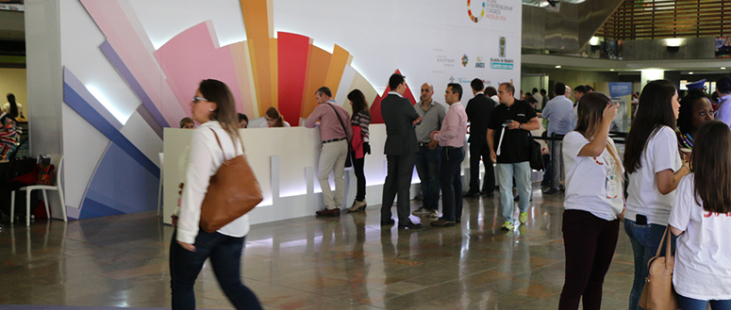


Not long ago labeled as the Innovative City of the Year, Medellin provided the perfect backdrop for the 2016 Global Entrepreneurship Congress. More than 4,000 delegates converged in the Colombian city with a thriving startup hub to explore innovative approaches to helping entrepreneurs start and scale new businesses around the world.
Now in its eighth year, the Global Entrepreneurship Congress continues to expand as it more deeply engages all elements of the ecosystem – bringing together entrepreneurs, investors, researchers, policymakers and other startup support champions from roughly 160 countries.
“Countries around the world are increasingly focused on creating an environment that empowers their entrepreneurs and allows them to flourish,” said Jonathan Ortmans, president of the Global Entrepreneurship Network. “The Global Entrepreneurship Congress brings together an inspiring number of individuals, organizations and governments whose dominant focus is on making it as easy as possible to create and grow new businesses.”
Federico Gutiérrez, the mayor of Medellín, welcomed roughly 1,500 international delegates to his city – once known for the violence of its drug cartels and now recognized as an emerging startup hub. The shift was already underway in 2013 when the Wall Street Journal identified the Colombian city as its Innovative City of the Year and its commitment to supporting entrepreneurs is evident throughout its Innovation District with accelerators and tech hubs like Ruta N and Parque E.
The four-day Congress was cohosted by GEN, Kauffman Foundation, National Business Association of Colombia (ANDI) and the Mayor’s office in the City of Medellin. It gathered entrepreneurs, policymakers, investors and researchers to discuss best practices, latest success stories and the future of establishing one global entrepreneurial ecosystem. Sessions covered a variety of topics, including:
- Mapping an measuring entrepreneurship ecosystems;
- Stabilizing and strengthening post-conflict economies;
- Creating an entrepreneurial mindset and culture;
- Enhancing early stage investment;
- Catalyzing startup communities;
- Disrupting traditional industries; and more.
A Focus on Entrepreneurs
The 2016 Congress focused on the “Business of Next” and Jeff Hoffman, GEN board member and part of the cofounder team for Priceline.com, shared the stage with William Shaw, founder of VivaColombia, for a fast-paced discussion on their experiences in disrupting the travel industry and advice for disrupting other traditional industries.
GEC Talks featured speakers from around the world to talk about the future of cities, scaling firms, connecting ecosystem players and global innovations.
Larry Alder, director of access strategy for Google, discussed the future of wireless cities. The conversation continued with Pablo Aquistapace, founder and CEO of Eventioz; Juan Manuel Barrientos, founder of El Cielo restaurants, who discussed how cooking can help bridge conflict gaps; Donna Harris, co-founder of 1776; Verne Harnish, CEO of Gazelles; and German Schäfer, founder of Bioprocol.
While well-known startup hubs continue to receive the most attention, a panel discussion featuring Chris Schroeder, author of Startup Rising and Elmira Bayrasli, author of From the Other Side of the World emphasized the growing number of entrepreneurs emerging in unexpected communities, cities and countries – like Medellin.
Bill Aulet, managing director for the Martin Trust Center for MIT Entrepreneurship, engaged participants in a discussion about how to teach entrepreneurial skills more effectively and debunked common myths about the path to entrepreneurship. He emphasized the need for an education framework to best close the gap between the entrepreneurial spirit and the entrepreneurial mindset.
GEN Unveils New Efforts to Support Entrepreneurs
Several new programs to identify and promising startups and founder teams were spotlighted in Medellin. Six members of the new GEN Starters Club pitched their startups from the main stage: William Janssen of Desolenator (UK), Aisa Alvarez Mijeno of Sustainable Alternative Lighting (Philippines), Byron Musumba Sitawa of Chura (Kenya), Abdeljalil Sadouk of Societall (Morocco), Theo Marcolini of Caleche (UK) and Paul Koenig of Viroment (United States).
Steven Rodriguez, startup community manager for GEN, led a session highlighting the recent release of Startup Compete, a business plan competition platform, as well as plans for the roll out of Startup Huddle, an experiential learning program to help promising entrepreneurs sharpen skills and make connections through a monthly series of meetups.
GEN also announced plans to work with ANDI and Endeavor Colombia in establishing GEN Colombia.
GEC Helps to Further Understanding of Entrepreneurship
Parallel to the increasing amount of data that demonstrates the powerful impact of new and young firms on entrepreneurial growth, there is increasing demand from countries for experts who can provide solid, evidence-based counsel in terms of policies and programs that accelerate that growth.
For the second year, the GEC featured a Ministerial session, organized in collaboration with the U.S. Small Business Administration. Officials from 13 countries from Europe, Central America, South America and the Asia-Pacific region, spent a full day exchanging knowledge on emerging government practices with a focus on supporting startups through the growth cycle. This year’s dialogue was focused on four key pillars: creating jobs, building international collaboration, facilitating trade and promoting gender equity.
The participating governments collectively represented 52 percent of global GDP.
SBA Administrator Maria Contreras-Sweet led the Ministerial (see her opening remarks here) and was commended by participating governments for effectively framing discussions in the context of innovation in government and next-generation policies. In closing the Ministerial, Contreras-Sweet signed an agreement with GEN to continue aligning the Ministerial as part of the GEC next year in Johannesburg, South Africa.
“We all understand the important role of entrepreneurship in creating the dynamic social fabric of our societies,” said Contreras-Sweet. “Entrepreneurship is a fundamental economic strategy. But it’s also a core security strategy, giving people alternatives to crime and extremism so they can imagine a better future. If you can't get a job, entrepreneurship allows you to create your own. And small businesses not only create most of the jobs in our global economy, they also create a sense of pride in local neighborhoods and contribute tax revenues that can help fund better services and better schools.”
Startup savvy policymakers and advisors can’t be effective without the support of a growing body of solid entrepreneurship research.
Global Entrepreneurship Research Network (GERN) members and funders, led by GERN Executive Director Phil Auerswald, met during the GEC to discuss current issues and global and programmatic research on entrepreneurship. Members examined new opportunities to impact public policy and discussed what’s next in providing evidence-based support for GEN’s ecosystem development. During the meeting, members explored ongoing collaborative research projects on accelerator performance metrics, ecosystem connections mapping, government data infrastructure and entrepreneurship education and mindset information – and discussed new possibilities.
The Role of Entrepreneurship in Rebuilding Post-Conflict Societies
As Medellín works to shed its violent past, the GEC featured a session on the role of entrepreneurship in rebuilding and strengthening societies and economies devastated by conflict. Chris Schroeder, author of Startup Rising, a book about the entrepreneurial revolution in the Middle East, Ambar Amleh from Palestine for a New Beginning, and Angelo Burgazzi of EneVenezeula all shared insights from their personal experiences and daily lives. Amleh mentioned the work of Palestinian and Israeli entrepreneurs who are crossing borders while Burgazzi, who recently had to flee his country, pointed to entrepreneurs and how much hope they offer to overcome a government and system that is resistant to change.
Looking Ahead to 2017
As the proceedings in Medellín came to a close, the focus shifted briefly to the next host city for the Global Entrepreneurship Congress. Kizito Okechukwu of GEN South Africa joined Ambassador Thaninga Shope-Linney and Ruby Mathang, member of the Mayoral Committee for Economic Development in Johannesburg, in inviting all delegates to the 2017 GEC in South Africa from March 13-16.