


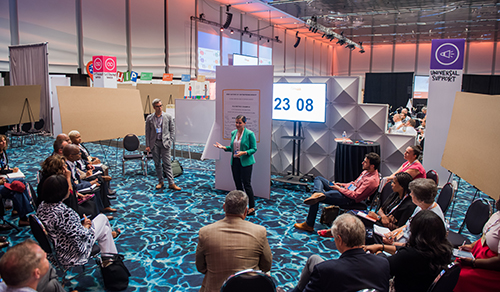



“We are swimming in data,” said Julia Lane, a thought leader in urban informatics from New York University, as she opened the Mayors Conference on Entrepreneurship, hosted by the Ewing Marion Kauffman Foundation in Kansas City.
Lane was referring to the massive amounts of community driven-data that are available today, but which are not being fully tapped yet to make cities more equitable, efficient and resilient. With her opening remarks, the 121 mayors from across the United States attending had a challenge at hand: how to use data for non-traditional metrics that can help them understand and improve their entrepreneurship ecosystems.
Via a hands-on approach, mayors took center stage at the conference to discuss the limitations of traditional, quantity-based metrics such as the ‘number of accelerators’ and ‘how many participants in a given program,’ and to brainstorm new metrics that can provide more accurate estimates of performance. These new metrics are necessary to answer questions, such as: Are accelerators actually changing the rate at which startups grow? How are connections within the ecosystem influencing startup success?
These questions require thinking about the possibilities of data analysis in a deeper way, as well as about using a whole new set of tools to visualize the startup ecosystem. In the case of accelerators, for example, it means comparing the path of accelerated startups to that of startups that did not get accepted into the program.
The Mayors Conference left a clear message to governments and ecosystem support organizations – keep records along with your support processes to have data available that can be turned into insights.
In the campfire-type breakouts, mayors had an opportunity to tap into expertise from mentors like Ian Hathaway from the Center for American Entrepreneurship and Sarah Jane Maxted of the MIT Regional Entrepreneurship Acceleration Program to think of ways to evolve from the old input-oriented approach of “number of incubators” or “number of VC deals,” to focusing on new kinds of metrics that are better suited to measure the new economy, such as:
- Local connectedness and diversity
- Network maps to understand how relationship drive value
- Raise rates
- Percentages of local firms
- Interactions per hour
- Business dynamics using utility data
These new types of metrics not only produce more credible measures of impact of support interventions, but also help design experimental policy and program tools, such as the Universal Basic Income pilot to boost startup rates in Stockton, California.
Ed Egan, director of the Baker Institute's McNair Center for Entrepreneurship and Innovation, also highlighted the importance of these new ways of analyzing ecosystems for governments to be able to make smart decisions on where to help.
“You don’t build a program and hope the entrepreneurs will come,” he advised, calling for a bottom-up model where you map the existing resources, look at the data to identify gaps, talk to local entrepreneurs and stakeholders, before launching anything.
Jonathan Ortmans, president of the Global Entrepreneurship Network, introduced the Public Policy Lean Canvas and the policy hack approach to regulatory and policy dialogue, as ways for policy leaders to organize that process, gather input from across the entrepreneurial spectrum, iterate aspects of a program’s design and develop metrics that you will use to evaluate impact.
“Governments, and entrepreneur support organizations, are working on really similar problems. Take time to collaborate,” emphasized Carolyn Rodz, co-founder of Alice, reflecting on the nearly two days of rich exchanges at the Mayors Conference on Entrepreneurship.